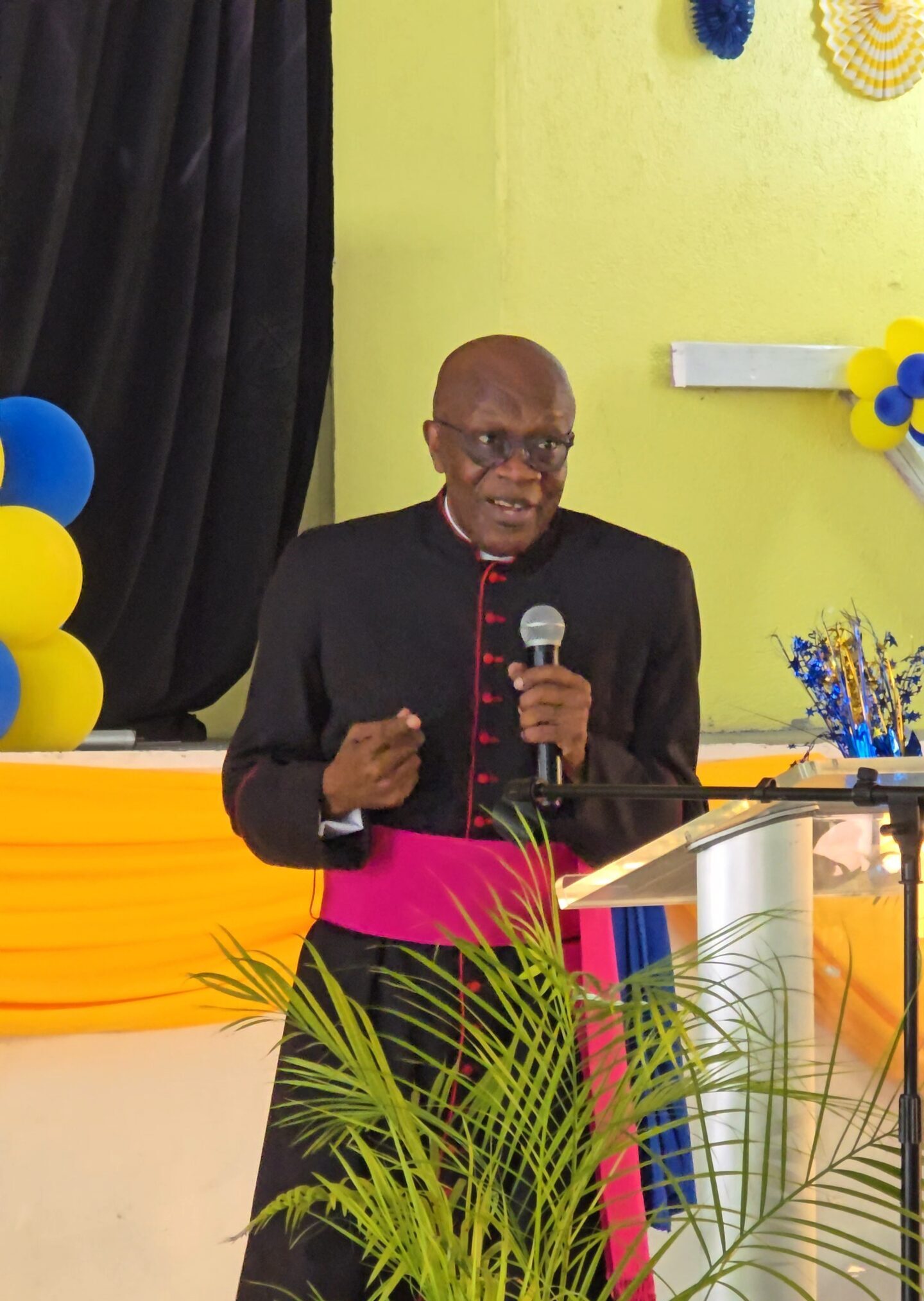
One day after Dr David Estwick was formally unveiled as the new president of Barbados’ Democratic Labour Party (DLP), a senior Anglican cleric delivered a stirring call to action for the struggling opposition party at a special anniversary church service held at the DLP’s George Street headquarters on Sunday.
Reverend Canon Dr Monrelle Williams, priest-in-charge of St Barnabas Church, used his sermon before assembled DLP officials and supporters to urge the party to confront its deep-seated internal divides, embrace a culture of humble servant leadership, and leverage its time out of parliamentary power to rebuild the public trust it has lost over three straight cycles of poor electoral performance.
Opening his address, Williams pressed party members to conduct an unflinching, honest self-assessment that examines both external barriers the DLP has faced and the damaging internal choices that have contributed to its current marginalization. He challenged members to answer three critical questions: Have they listened closely enough to the Barbadian public? Have they organized their operations effectively and ethically? Have they delivered consistent service to the communities they claim to represent?
He urged the party to welcome new perspectives, heal long-simmering internal wounds, and prioritize collective unity over individual ego. A core pillar of his message centered on redefining what political humility means for the DLP: Williams emphasized that public office is not a permanent privilege to be claimed by party elites, but a temporary public trust and stewardship granted to politicians by the people. He warned that unchecked personal ambition and oversized egos have repeatedly undermined the party’s ability to advance policies that serve the best interests of Barbados.
“Part of the problem is that sometimes our egos get in the way of our doing what is best for this country that we seek to serve,” Williams said. “A humble party is not a weak party. A humble party is a party that can still challenge injustice. It can still expose failure. It can still speak truth to power, but it does so with clean hands and a steady heart.”
Williams went on to stress that healing internal fractures and setting aside personal vendettas is not just a party priority — it is a national imperative, as failure to unify will ultimately leave Barbadians worse off. “We need to heal the divisions that exist in our midst. We need to put aside our own personal vendettas and try and bring healing in the midst of this burden, because you see, if we do not do that, then this country will suffer,” he said.
He noted that genuine organizational unity does not emerge spontaneously; it requires intentional effort, collective sacrifice, patience, forgiveness, and consistent discipline. More often than not, Williams argued, political parties fracture not because their core mission is unclear, but because individual pride drowns out the collective purpose the organization was founded to advance.
Rejecting the common approach of purging party members who hold dissenting views, Williams argued that unity does not demand uniform thought. “Unity means that every voice will join in singing the same song, but all the voices might be different,” he explained. “It is not about telling people that if you disagree with me, you have to leave my party. It is about recognising that diversity is important and that we all can’t be the same. We might be singing from the same sheet, but we might be singing different parts. But the harmony is important.”
On the topic of leadership, Williams pushed back against the model of top-down, one-person dominance, arguing that effective party leadership should focus on mentoring, training, and equipping all members to serve their communities. He encouraged the DLP to invest in grassroots candidate development to build a roster of leaders of strong character, craft well-researched, substantive policy platforms, and prioritize listening to community needs before making policy pledges from the campaign trail.
He also challenged the narrative that the DLP, which currently holds no seats in Barbados’ Lower House, is powerless in its current opposition role. “A party with no seats in the Lower House may be tempted to believe that has no real influence. That temptation will always be there, but hear this clearly: influence is larger than office, and purpose is larger than position,” Williams said. He reminded the party that even out of parliament, it retains the power to shape public conscience, raise ethical standards, defend vulnerable communities, educate citizens, and model the political integrity Barbadians deserve.
“Before a party can lead from parliament, it must show that it can lead from the community; before it can sit in seats of power, it must stand faithfully in the places of need,” he added.
Williams called on the DLP to fully embrace the model of servant leadership, which puts the needs of the Barbadian people ahead of the personal ambitions of party leaders. He framed the party’s current moment as an opportunity to reframe its core priorities, posing a series of guiding questions for members: “This party must ask not only how do we win, but how do we serve. Not only how do we return to parliament, but how do we return to the people? Not only how do we gain power, but how do we become trustworthy stewards of that power when it is given to us?”
He also appealed for radical honesty in the party’s political communication, warning against making unrealistic, undeliverable campaign promises or exploiting public suffering for partisan political gain. “We must not promise what we cannot deliver, we must not stir anger without offering serious solutions. We must not use the pain of the people as a political instrument,” Williams said.
He urged the party to treat its time out of government as a valuable preparation period for future opportunities to lead, encouraging members to reframe their current struggles as growth opportunities. “Do not despise smallness. Do not mistake absence from Parliament for absence from purpose; do not confuse electoral defeat with divine rejection,” he said. “Turn your disappointment into discipline and your losses into learning.”
Williams also cautioned the party against rushing to announce half-baked policy initiatives, a tendency he said is common across Barbados’ political spectrum, noting that poorly thought-out plans only erode public confidence. “You need to know what your purpose is. You need to know that when you say we are going to do X, you have thought it through and you have looked at all the consequences and the possible ramifications, because you do not want to look as though you don’t know what you’re doing,” he said.
Repeating his call for radical truthfulness, Williams stressed that the DLP’s promises must always match its ability to deliver: “If you can do it, say you can do it. But don’t say you can do it and then don’t do it.”
Closing his address, Williams reminded the DLP that its responsibility to the Barbadian people does not end when it is out of government. He closed with a final reminder of the critical role a robust opposition plays in a healthy democracy: “For if there is no opposition, the government will always do as it likes.”