On the 47th anniversary of the Sandinista Revolution that once toppled a decades-long dynastic dictatorship, Nicaraguan President Daniel Ortega delivered a bombshell announcement that stripped away the last veneer of democratic legitimacy from his regime: there will be no future elections that allow opposition parties to contest for national power. Accompanying this declaration, Ortega pledged to enact new legislative barriers targeting individuals his administration labels as coup plotters and traitors to the state.
This moment stands as a bitter irony for Nicaraguan history. The popular uprising that ended the Somoza family’s authoritarian rule has itself given way to a new dynastic administration, led by Ortega and his wife Rosario Murillo, who serves as co-president alongside him.
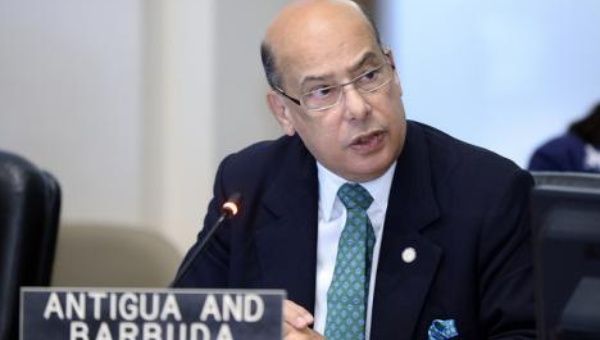
As Antigua and Barbuda’s Ambassador to the United States and the Organization of American States (OAS), and Dean of the OAS Corps of Ambassadors, I immediately issued a public condemnation of Ortega’s announcement on X. My statement was clear: this move is a deliberate assault on core democratic principles and fundamental human rights, and all governments committed to democratic governance must reject this unacceptable power grab. The Nicaraguan people have already endured far too many years of repression under this regime.
While Ortega’s announcement marks a dramatic shift in official rhetoric, it changes little about the on-the-ground reality of Nicaraguan politics. For years, elections have been nothing more than a hollow gimmick, maintaining the visual of popular choice without any of its substance. Ahead of the 2021 general election, all major opposition parties were banned from participating, dozens of prospective presidential candidates were arrested, independent media outlets were shuttered, and civil society organizations were either forced to shut down or drive into exile. Ortega’s latest statement simply removes the last remaining pretense of competitive electoral democracy.
In the weeks following the announcement, several individual OAS member states have publicly condemned Ortega’s edict. OAS Secretary General Albert Ramdin correctly framed the elimination of competitive elections as a direct denial of the Nicaraguan people’s sovereign right to select their own government. However, neither the Secretary General nor individual member states can speak for the organization as a whole. While the OAS General Assembly adopted a declaration addressing the steady deterioration of democracy and human rights in Nicaragua just one month before Ortega’s announcement, the organization has yet to issue an official collective response to the latest attack on democratic governance.
To address this institutional silence, delegations from Canada and Chile began drafting a collective statement for OAS member states, and I contributed language to the text that firmly condemns Ortega’s actions and calls for the restoration of genuine multi-party electoral competition in Nicaragua. As of this writing, the draft statement has not yet been taken up for consideration by the OAS Permanent Council, and the United States has separately proposed its own resolution on the issue that also awaits deliberation.
The core point of contention now before the OAS is how to legally and politically characterize Ortega’s actions. There is no question that Nicaragua currently faces a deep crisis of representative democracy, human rights, and the rule of law. The Ortega-Murillo administration’s systematic revocation of basic civil and political rights has deepened widespread instability and fear across the country, pushing thousands of Nicaraguans to flee repression via irregular migration routes and creating new humanitarian pressures for neighboring receiving states.
But this internal human rights crisis does not automatically equate to a threat to hemispheric peace and security. Nicaraguans fleeing political persecution are victims of repression, not security threats to the countries that grant them refuge. This distinction is not merely semantic; it carries critical legal weight for the OAS and its member states.
In November 2023, Nicaragua formally withdrew its membership from the OAS, a process that took effect when I was serving as President of the OAS Permanent Council. At that time, the organization made clear that Nicaragua’s withdrawal does not absolve the regime of its binding international human rights obligations, including those enshrined in the American Convention on Human Rights. Nicaragua chose to leave the OAS after a majority of member states pushed back against its ongoing democratic and rule of law violations, at a time when suspension under the OAS Charter and Inter-American Democratic Charter remained a possible outcome. Crucially, suspension provisions only apply to current member states, so that mechanism is no longer available to the organization.
This legal reality does not mean the OAS is required to remain silent or inactive in the face of Ortega’s crackdown. It simply means the organization must draw a clear line between political and human rights actions that fall within its existing competence, and coercive measures that would require a legal basis the OAS does not possess.
Within the inter-American system, binding collective sanctions can only be pursued, if at all, by member states of the Inter-American Treaty of Reciprocal Assistance (commonly known as the Rio Treaty). This separate procedure is only open to parties to the treaty, and requires a formal, evidence-based determination that the peace of the Americas is actively endangered. Not all OAS member states are parties to the Rio Treaty, and Nicaragua is no longer an OAS member in any case. More importantly, while Ortega’s oppression of the Nicaraguan people is morally reprehensible, it does not constitute an armed attack against another state, nor does it meet the legal threshold for a threat to hemispheric peace and security. International law cannot be stretched to fit a desired political outcome just because we find Ortega’s conduct offensive. Overextending legal frameworks to punish objectionable conduct would only weaken the rules-based international order that democracy advocates seek to uphold.
Even without coercive sanctions, there are many meaningful, legally grounded actions the OAS can and should take to address the crisis. The Permanent Council has the authority to adopt a clear resolution condemning the elimination of meaningful electoral competition, and rejecting the arbitrary exclusion of opposition candidates and civil society groups solely for their peaceful opposition to the Ortega-Murillo regime. It can demand the immediate release of all political prisoners, the restoration of full civil and political rights for all Nicaraguans, and the reopening of civic space for independent media and civil society organizations.
The OAS can also keep Nicaragua under active and sustained consideration in line with the June 2024 General Assembly declaration, receive regular monitoring updates from the Inter-American Commission on Human Rights, and support the Commission’s ongoing monitoring work, public hearings, and precautionary measures for at-risk Nicaraguans. The organization can formally call on Nicaragua to comply with rulings and provisional measures issued by the Inter-American Court of Human Rights. The Secretary General can offer his good offices to facilitate dialogue, even if the Ortega regime refuses to engage. Individual OAS member states can also provide support to exiled Nicaraguan civil society groups, cooperate with United Nations human rights mechanisms to preserve evidence of abuses, and extend protection to Nicaraguans forced to flee their country.
Individual governments retain the right to implement their own lawful diplomatic measures in response to the crisis, but these actions should be clearly acknowledged as national policy choices, not misrepresented as collective OAS action unless formally authorized by the organization’s competent governing bodies.
The message from the inter-American community to Ortega and Murillo must be clear and unmistakeable: Nicaragua’s withdrawal from the OAS does not place their regime beyond international scrutiny or accountability. The OAS must maintain constant vigilance over the situation, document ongoing human rights abuses through its existing human rights institutions, keep the crisis under active consideration by its political organs, and insist that all those responsible for violations are held accountable under applicable international law.
Ortega abandoned free and fair elections because he fears the verdict of the Nicaraguan people. The inter-American community must not normalize his authoritarian conduct, nor allow the crisis to disappear from hemispheric attention. The OAS response must be united, persistent, and unambiguous – while remaining firmly rooted in international law and the rules-based order.