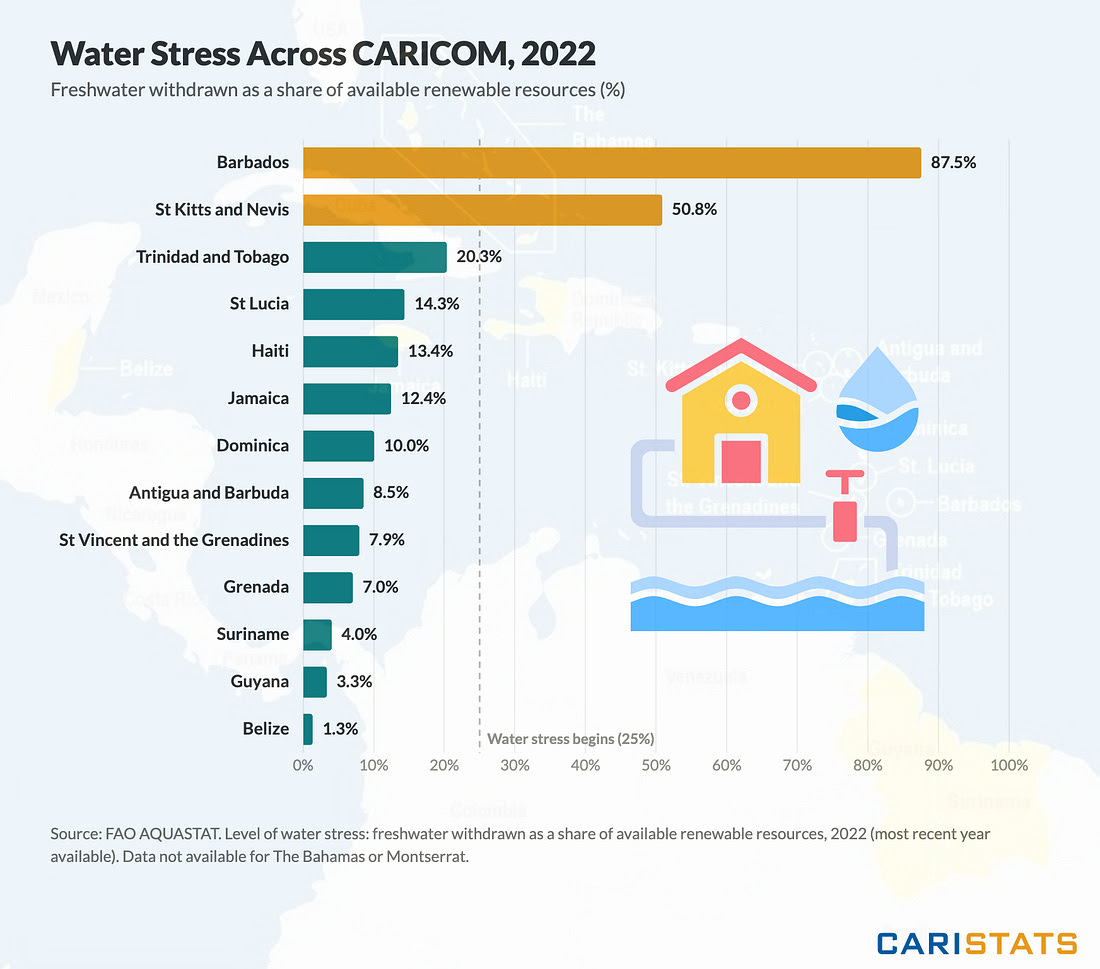
Water stress, a key metric that tracks the proportion of a nation’s renewable freshwater reserves withdrawn annually for agricultural production, industrial activity and domestic consumption, serves as a critical indicator of resource competition. When withdrawal rates climb higher, the competition for this limited, life-sustaining resource grows more intense. The United Nations has established a standard threshold: any nation withdrawing more than 25% of its available renewable freshwater is classified as experiencing water stress.
The latest data from the Food and Agriculture Organization’s AQUASTAT monitoring program, released for the reference year 2022 — the most recent year for which full data is available, due to a multi-year national reporting cycle that delays public releases by two to three years — paints a mixed picture for the 15-member Caribbean Community (CARICOM). The vast majority of member states fall well below the UN’s 25% water stress threshold, showing ample renewable freshwater reserves relative to current consumption levels.
Three CARICOM members with large landmasses and extensive river systems — Belize, Guyana, and Suriname — record some of the lowest withdrawal rates in the region, all pulling less than 4% of their total renewable freshwater each year. Larger island nations including Jamaica, Haiti, and Trinidad and Tobago also remain within the UN’s “no-stress” range, with Trinidad and Tobago reporting the highest withdrawal rate in this group at 20.3%. Two member states are the notable exceptions to this trend, however: Barbados and St. Kitts and Nevis.
Barbados, a small, flat coral island with no permanent surface rivers, relies almost entirely on groundwater to meet its freshwater needs. The nation withdraws a staggering 87.5% of its total renewable freshwater annually, placing it firmly in the UN’s high-stress category. Neighboring St. Kitts and Nevis, another small island archipelago, also exceeds the threshold with a 50.8% annual withdrawal rate. Both nations, as small Caribbean island states, face inherent structural constraints: their limited landmass translates to far smaller renewable freshwater reserves than their larger, mainland CARICOM counterparts, creating a stark divide in water security across the bloc. It is important to note that data for two CARICOM members, The Bahamas and Montserrat, was not available for this 2022 analysis.