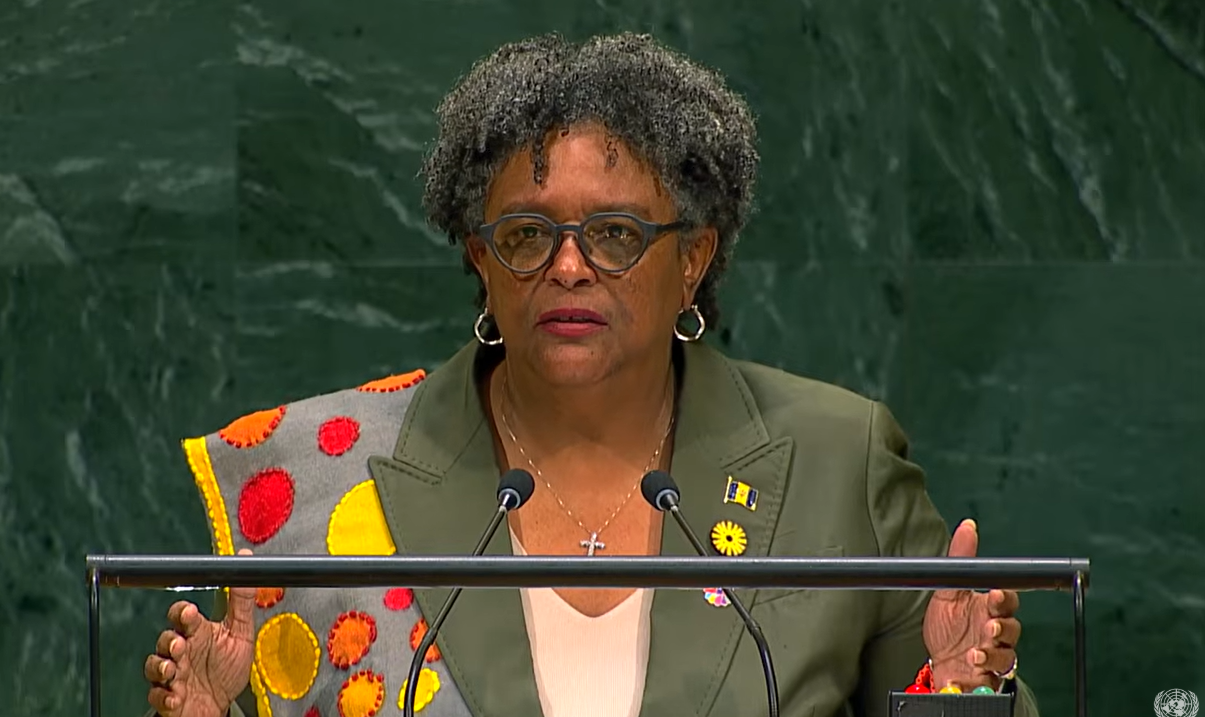
Speaking from the podium of the United Nations General Assembly, Barbados Prime Minister Mia Mottley has issued a stark warning about the growing climate financing crisis facing the world’s most climate-vulnerable nations. By 2030, Mottley estimates that these countries will face an annual shortfall of nearly $400 billion in funding needed to address climate change impacts — and that gap is being widened dramatically by unfair lending practices that force vulnerable countries to pay billions in extra annual interest payments compared to richer, developed nations.
Mottley laid out the staggering mismatch between current funding and what is actually required, noting that vulnerable countries need to mobilize approximately $490 billion every year by the end of the 2020s to build climate resilience, adapt to shifting weather patterns, and recover from increasingly frequent extreme climate events. That stands in sharp contrast to the current annual climate finance flows that reach these nations, which sit at just $9 billion. “As the young people in Barbados would say, the math simply ain’t mathing,” Mottley declared, driving home the disconnect between global climate commitments and on-the-ground financing support.
Beyond the massive gap between what is needed and what is actually delivered, Mottley emphasized that the inequity of current lending structures is compounding the crisis. Climate-vulnerable countries currently face borrowing costs that are roughly 1.2 percentage points higher than those charged to advanced economies. While that gap may seem marginal to outside observers, Mottley calculated that it adds up to $62 billion in extra annual interest payments that vulnerable nations must pay, a burden she described as fundamentally unfair. This higher cost of borrowing acts as a persistent drag on economies already struggling to cope with the fallout of climate shocks, from sea-level rise to devastating hurricanes and droughts.
Mottley used these concrete numbers to reinforce a long-running argument: the existing international financial system systematically disadvantages climate-vulnerable developing countries, particularly when they seek financing to strengthen resilience and advance sustainable development. As the current president of the Climate Vulnerable Forum and its V20 group of climate-vulnerable economies, Barbados has been leading targeted efforts to expand access to affordable, long-term financing for these nations.
One key initiative highlighted by Mottley is the Vulnerability to Viability Compact, developed in partnership with the OPEC Fund for International Development, which has already gained the backing of 74 countries and 16 major development finance institutions. This initiative aims to remove barriers to low-cost, long-term capital for critical community projects spanning education infrastructure, healthcare facilities, and water access systems. Mottley also noted that the V20’s Lifeline Fund is set to become operational in the near future, designed to provide rapid liquidity support to countries facing balance of payments pressures in the immediate aftermath of climate shocks. “It seeks to provide rapid liquidity when climate shocks create balance of payments pressures for countries,” she explained. “So we are moving to help ourselves.”
For Mottley, access to long-term financing is non-negotiable if vulnerable nations are to move beyond a constant cycle of post-disaster recovery and make the foundational investments needed to build strong, resilient economies. “You cannot build hospitals and schools and water infrastructure with 10- and 15-year money,” she argued. Short-term financing “crowds out critical investments for our people and leaves you flat-footed, and that is why this important initiative represents real progress.”
Even as she celebrated the progress of these collaborative efforts between vulnerable nations, Mottley was careful to note that incremental changes to financing practice are not enough to fix the deeper structural inequities at play. “Mechanisms such as this one cannot on their own address the underlying flaws of the international financial architecture,” she cautioned. This warning aligns with the core mission of the Bridgetown Initiative, the proposal spearheaded by Barbados over the past five years that calls for systemic reform of the international financial system and expanded access to affordable financing for vulnerable developing countries.
Mottley reiterated that the interconnected nature of the world’s biggest challenges demands a coordinated, holistic policy approach. For almost five years, the Bridgetown Initiative has consistently argued that climate resilience, debt sustainability, and access to affordable finance cannot be treated as separate, siloed issues. “For many vulnerable countries, the problem is not simply the availability of capital, but whether we have the fiscal space to borrow and to invest on reasonable terms,” she said.