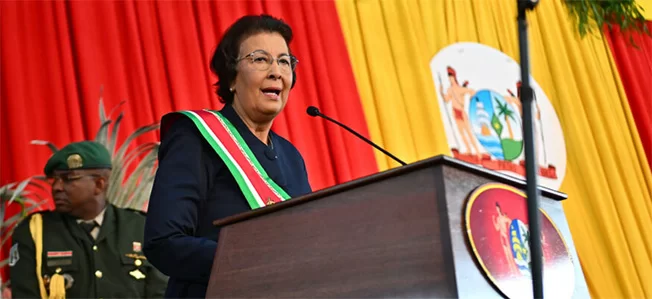
On July 16, 2025, Jennifer Simons was inaugurated as President of Suriname, opening her term with a clear vision: to steer the country toward long-term economic recovery and inclusive growth. In her inaugural address, she outlined four core pillars of her administration: a new culture of governance, strict fiscal discipline, broad-based economic diversification, and the equitable distribution of future oil revenues to lift all Surinamese communities. One year after she took office, it is an opportune moment to take stock of the Simons administration’s progress, challenges, and unmet promises.
Simons did not sugarcoat the severe economic headwinds her government would face from the outset. She acknowledged that Suriname entered her term grappling with deep systemic economic vulnerabilities, but held out hope that the nation could emerge stronger if it navigated the early difficult years successfully. That early assessment quickly proved prescient: almost immediately after Simons took office, rising geopolitical tensions in the Middle East sent global oil prices soaring. For Suriname, a net fuel import nation, this price shock created immediate downward pressure on inflation and eroded household purchasing power, testing the new administration’s response.
In March, the government moved swiftly to mitigate the crisis, implementing a temporary fuel price cap and accelerating targeted social support programs for vulnerable groups, public servants, teachers, and pensioners. The policy choice deliberately prioritized social stability, even though it cost the national treasury hundreds of millions of Surinamese dollars in monthly government revenue from energy sales.
Fiscal discipline was one of Simons’ signature campaign and inaugural pledges, and it is on this front that the administration faces its most significant test to date. As the government ramps up spending on purchasing power protections, public healthcare, and social assistance, both the national budget deficit and Suriname’s total public debt have continued to widen.
This expansionary fiscal stance is not inherently misguided: many governments opt for temporary increased spending during periods of global economic uncertainty. However, the critical questions now growing louder among analysts and the public are how long this spending window can remain open, and when temporary emergency measures will be scaled back. Greater transparency around the government’s long-term fiscal roadmap has become an increasingly urgent demand.
Perhaps the most transformative economic promise Simons made was a commitment to end Suriname’s historic overreliance on finite natural resource exports. For decades, the country’s economy depended heavily on bauxite; today, it leans heavily on gold, and is preparing for a major new oil sector. To avoid persistent boom-and-bust cycles, the president pledged to strengthen underdeveloped productive sectors including agriculture and tourism to build a more balanced economy.
After one year, the administration has established interagency working commissions across multiple target sectors and announced broad policy intentions. But the private sector and civil society organizations are still waiting for detailed, actionable sector-specific plans and concrete production-boosting programs. As the onset of large-scale commercial oil production draws near, the need for a cohesive, well-executed economic diversification strategy has become more pressing than ever.
One of the most memorable warnings of Simons’ inaugural address centered on avoiding the so-called “resource curse” that has plagued many resource-rich developing nations. She explicitly noted that in other countries, oil wealth has only enriched a small elite, leaving the majority of the population excluded from gains and facing deeper economic instability.
Over the past year, the administration has prioritized foundational preparations to avoid this outcome: local content requirements to ensure Surinamese workers and businesses benefit from oil development, institutional capacity building, workforce training programs, and targeted international collaboration have all been placed high on the policy agenda. Even so, questions remain over whether Suriname is moving quickly enough to maximize shared benefits from oil production, which is now approaching rapidly.
Beyond economic reform, Simons campaigned for a fundamental shift in how the country is governed, promising more collaborative, participatory, and decentralized decision-making. To its credit, the administration has repeatedly held structured consultations with trade unions, private sector leaders, civil society groups, and other key stakeholders on major policy decisions.
Yet criticism persists on the governance front. The growing number of presidential ad hoc commissions, ongoing debates around government transparency, slow progress on anti-corruption enforcement, and the gradual pace of structural reform have led many to question whether the promised systemic change is yet visible enough to the public.
After 12 months in office, it is still too early to issue a final verdict on the Simons administration. Major transformative reforms across the economy, education, healthcare, and public governance require far more than one year to implement and deliver visible results. That said, the Surinamese public is right to expect that the broad contours of these reforms will become increasingly clear in the months ahead.
The second year of Simons’ term will almost certainly prove more decisive than the first. The policy focus is set to shift from agenda-setting and planning to tangible implementation, and from stated intentions to measurable results. It will not be the ambition of Simons’ agenda that defines her administration’s legacy, but the concrete, on-the-ground changes it delivers.
Broad consensus already exists across Suriname’s political and social spectrum that the government has set the right core policy goals. The critical open question today is whether the administration can translate those ambitions into stronger public institutions, more accountable governance, and an economy that is less dependent on temporary commodity windfalls and built on a foundation of sustainable, inclusive development.
In closing her inaugural address, Simons invoked the words of Surinamese poets Dobru and Shrinivási, centering her vision on national unity, solidarity, and shared collective responsibility. That message remains just as relevant one year on as it was on the day of her inauguration. Sustainable economic recovery, good governance, and long-term development will never depend on government policy alone: they require coordinated action and shared commitment from the public sector, private industry, and civil society alike to shape Suriname’s future together.
After one year, the ultimate destination Simons outlined on inauguration day remains unchanged. The question facing the country now is no longer where Suriname aims to go, but how quickly the promised policy direction will translate into tangible improvements in daily governance, and what necessary adjustments the president will make to keep the administration on track to deliver for all Surinamese.