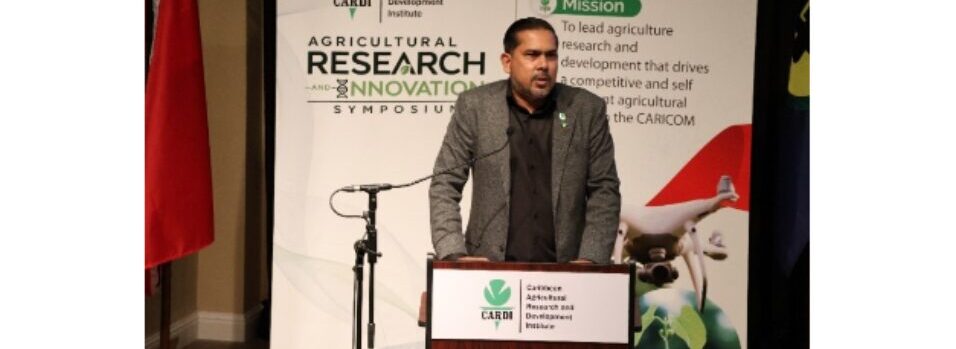
Against a backdrop of growing climate uncertainty, shifting global food markets and rising import dependence, the Caribbean Agricultural Research and Development Institute (CARDI) has kicked off its first-ever Agricultural Research and Innovation Symposium (ARIS), a landmark regional gathering that unites cross-sector stakeholders to reimagine the future of Caribbean agriculture.
Opening its doors on July 8 in Chaguanas, Trinidad and Tobago, the three-day event operates under the overarching theme “Advancing Agricultural Innovation for Sustainable and Climate-Resilient Food Systems”, designed to serve as a collaborative hub where lab-based research can connect directly with the farmers, policymakers and industry leaders who will put those findings into practice.
In his opening remarks, Hon. Lennox Andrews, Chairman of CARDI’s Board of Governors and Grenada’s Minister of Agriculture, framed the symposium as a critical response to the cascading challenges facing the region’s agricultural sector. “Climate change, evolving pest and disease pressures, and global market disruptions demand that we embrace science, innovation and collaboration as essential tools for securing the future of Caribbean agriculture,” Andrews said. He emphasized that the research on display at ARIS underscores CARDI’s core mission to develop practical, on-the-ground solutions that boost farm productivity, reinforce regional food systems, and protect the livelihoods of smallholder and commercial farmers alike. Andrews also called for sustained investment in the institute, noting that delivering consistent, impactful solutions requires adequate long-term resourcing.
For CARDI Executive Director Ansari Hosein, the inaugural symposium marks the start of a new, more accessible tradition for the regional research body. “It brings together our scientists from across the region to share the results of research conducted over the last 2 years in our Member States and, more importantly, to engage directly with farmers, policymakers, development partners and the private sector,” Hosein explained. Outlining CARDI’s core mandate, he added, “Our objective is to ensure that research moves beyond the laboratory and delivers tangible benefits for food and nutrition security, climate resilience and agricultural competitiveness throughout the Caribbean.”
Speaking on behalf of Trinidad and Tobago’s Minister of Agriculture and Fisheries, Ministerial Advisor Ravi Pooran Maharaj lauded the symposium for filling a critical gap as a regional coordination platform. “The Caribbean’s future food security depends upon our collective ability to transform research into action,” Maharaj said. “This Symposium provides an important platform where researchers, policymakers, innovators, and practitioners can exchange ideas, strengthen partnerships, and accelerate the adoption of technologies that will help transform agriculture across Trinidad and Tobago and the wider Caribbean.” He echoed calls for greater adoption of climate-smart practices, noting that modern regional agriculture must lean into improved crop varieties, precision farming techniques and sustainable production methods to build resistance to shocks.
Michelle Anne Thomas, Permanent Secretary in Trinidad and Tobago’s Ministry of Agriculture and Fisheries, echoed Maharaj’s praise, emphasizing that cross-sector collaboration is non-negotiable for solving the Caribbean’s most pressing agricultural challenges. “The challenges facing Caribbean agriculture require strong partnerships between researchers, policymakers and producers,” Thomas said. “By creating opportunities to share knowledge and practical solutions, initiatives such as this Symposium help ensure that scientific research informs policy, strengthens national agricultural programmes and delivers meaningful benefits for farmers and consumers across the Region.”
The symposium featured three targeted technical sessions that spotlight two years of CARDI research across its 14 member states, covering the region’s highest-priority agricultural challenges. A core focus of the event was reducing the Caribbean’s heavy reliance on imported food and feed: researchers shared findings from feasibility and productivity studies on commercially growing white potatoes in Grenada, tropical wheat in Belize, as well as improved varieties of lettuce, corn, silage, dasheen and black-eyed peas tailored to regional growing conditions.
Digital agriculture and emerging technology also took center stage at ARIS. Discussions and presentations covered a range of forward-looking topics, including strategies to attract younger generations to agricultural careers, digital management platforms for livestock feed, AI-powered tools for rapid crop disease diagnosis, and upgraded digital extension services designed to give farmers real-time data to make more informed production decisions.
In closing, CARDI reaffirmed its long-term commitment to delivering science-backed, practical solutions that strengthen regional food and nutrition security, lift farmer incomes, and boost the global competitiveness of Caribbean agricultural products. The institute announced plans to make the ARIS symposium a recurring event to continue advancing collaborative innovation across the region.