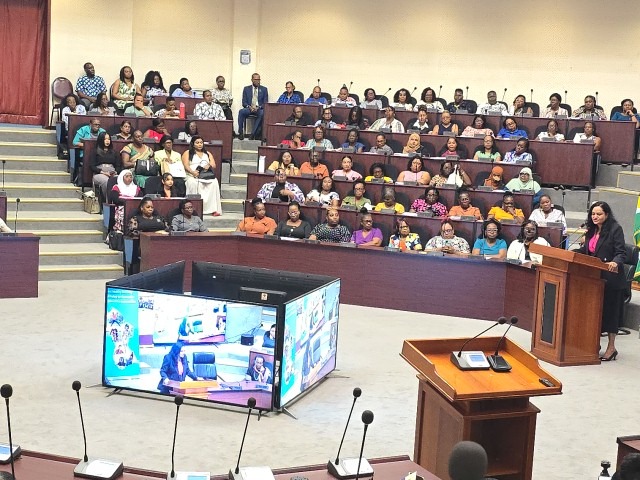
On Wednesday, July 8, 2026, Guyana’s national Early Childhood Development Conference opened in Georgetown, bringing together policymakers, international partners, community caregivers and child welfare advocates to advance the country’s early childhood development (ECD) agenda. The event, hosted by Guyana’s Childcare and Protection Agency (CPA) in partnership with UNICEF and the Government of Canada, delivered new public health guidance for young children while highlighting progress on the country’s landmark National Integrated Early Childhood Development Policy.
Speaking to attendees at the conference opening, Minister of Human Services and Social Security Dr. Vindhya Persaud issued a clear public warning: children under 2 years old must be completely barred from using smartphones, tablets and other personal digital devices, citing critical developmental risks during this period of early brain growth.
“Many parents reach for a phone or tablet to calm an active or fussy young child, but this habit carries real long-term consequences,” Dr. Persaud told delegates. “The first two years of life are a foundational period for brain development. Every stimulus a child encounters shapes their long-term cognitive and social growth, and unregulated screen time from digital devices is not a healthy input. If you are giving young children these devices, it is time to stop.” For children older than two, the minister recommended capping total screen time to just two hours per week to balance exposure with healthy developmental activity.
Beyond screen time guidance, the conference highlighted the government’s ongoing investment in accessible, high-quality community-based early childhood care across the country. A core pillar of this work is the GY$1.2 billion ECD co-investment initiative, which provides financing to local care centre owners to upgrade facilities, purchase child-friendly learning furniture, access professional training, and expand sustainable operations. To date, 700 care providers have already registered to access the funding, which is designed to build safe, welcoming learning and play spaces while keeping care affordable for working families.
Dr. Persaud emphasized that the initiative’s core requirement for receiving public co-investment is that services remain accessible to all community members. “Locating these centres in the heart of local communities eliminates transportation barriers for parents, and lets families build trust with the caregivers looking after their children,” she explained. “Our goal is to make high-quality early care affordable and accessible for every family, regardless of income.”
As of the conference, Guyana has formally licensed 352 early childhood care centres, with another 376 providers completing registration. Twenty-five facilities have been designated as Centres of Excellence, staffed by specially trained ECD professionals. The government has already disbursed the equivalent of GY$10 million to 100 centre owners to support their upgrade to the higher Centres of Excellence standards. Additionally, 460 families with children enrolled in registered, licensed care centres have received three months of financial support totaling GY$25 million, to help families access safe, regulated care arrangements.
Levine Gouveia, Director of Children Services at CPA, outlined the five core pillars of Guyana’s National Integrated Early Childhood Development Policy: cross-sectoral collaboration and coordination, child safety and security, universal access, service quality, and inclusive care for all children. The policy also integrates targeted work across child health and nutrition, parenting and family support, ECD research, and infrastructure expansion, Gouveia explained. “All these work streams come together to build a robust child protection and development system for our youngest children, from birth through the pre-nursery years up to age three,” she said.
Adam Loyer, Chargé D’Affaires at Canada’s High Commission to Guyana, noted that Canadian support has helped expand quality ECD services to more than 48,000 children and over 35,000 parents and caregivers across Guyana. ECD programming has now reached 156 Guyanese communities, exceeding the original outreach target set when the policy initiative launched. Loyer called the formal adoption of Guyana’s National Integrated Early Childhood Development Policy one of the most significant milestones of the partnership to date.
Anna Azaryeva Valente, UNICEF Representative for Guyana and Suriname, echoed partners’ commitments to advancing ECD work, while noting that significant gaps remain to be addressed. While Guyana has made notable progress addressing systemic social challenges affecting children, Valente said many vulnerable communities still lack access to quality ECD services, and service quality can be improved across multiple regions.
“There are still key milestones ahead of us: improving child health, nutrition and protection across all communities, empowering parents and caregivers with information and ongoing support rather than just assigning responsibility, grounding our work in evidence, and securing sustainable long-term public investment in early childhood services backed by clear policy and guidelines,” Valente said. She urged conference attendees, including ECD experts, caregivers, parents and service providers, to engage actively throughout the event: identify unmet needs, critique existing frameworks, ask critical questions, and help set collective priorities for future ECD investment across the country.