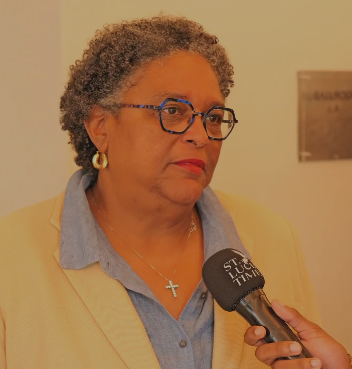
As leaders of the Caribbean Community (CARICOM) concluded their 51st annual summit in Saint Lucia this week, Prime Minister Mia Mottley of Barbados released key early data on the bloc’s landmark enhanced free movement initiative, pushing back against pre-implementation warnings that the policy would unleash an unprecedented flood of cross-border migration.
Launched on October 1 last year by four founding participating states — Barbados, Belize, Dominica, and St. Vincent and the Grenadines — the regime represents a major step forward in CARICOM’s decades-long push for deeper regional integration. Enshrined in the Enhanced Cooperation Protocol of the Revised Treaty of Chaguaramas, the arrangement grants eligible nationals from participating member states the right to live and work indefinitely across any participating country without requiring a formal work permit.
When the policy was first proposed, it sparked heated debate across the region. Proponents framed the initiative as a targeted solution to widespread labour and skills gaps across smaller Caribbean economies, arguing that free movement of workers would unlock shared economic growth and strengthen regional supply chains. But critics raised urgent alarms, warning that open movement would overwhelm local job markets, strain public housing and social services in more desirable destination countries, and displace native workers.
Speaking to reporters on the final day of the summit, Mottley shared the first official public uptake figures: fewer than 1,000 people across the four founding states have utilized the regime to relocate for work so far, contradicting the most dire predictions from opponents. The vast majority of movers have chosen to relocate to Barbados, a trend Mottley says aligns perfectly with the island nation’s core economic needs.
Barbados has long grappled with structural labour and skills shortages driven by its relatively small native population, Mottley explained, noting that addressing this gap was a primary motivation for the country’s early participation in the initiative. “As I’ve said over and over, Barbados has a skills deficit, and therefore, to that extent, one of the reasons why we signed on to the Revised Treaty of Chaguaramas in the first place was to facilitate the movement of people to bridge the fact that inherently our population numbers are low and by extension our skills levels are low,” she said.
Far from stalling after its initial launch, the free movement regime is now set to expand, Mottley confirmed. Two additional CARICOM member states are moving forward with accession: Grenada has already formally submitted its letter of intent to join, while host nation Saint Lucia has publicly signaled it will begin the domestic process to join the arrangement in the near future.
Mottley framed this gradual, wave-based expansion as a natural parallel to CARICOM’s own 50-year history of incremental growth. The bloc was originally established in 1973 as a successor to the Caribbean Free Trade Association (CARIFTA), launching with just four founding members: Barbados, Guyana, Trinidad and Tobago, and Jamaica. Over the following decades, as Eastern Caribbean states gained independence and more regional economies joined, CARICOM grew to its current size of 15 full members, including Haiti and Suriname. The Bahamas remains a participant only in CARICOM’s functional cooperation framework and has never joined the bloc’s common market or the CARICOM Single Market and Economy (CSME).
“It has been a good experience so far,” Mottley told reporters. Echoing her long-standing rejection of large-scale migration fears, she noted, “The numbers show that there are less than 1,000 people who have used it so far, and that’s why we said this is not going to open floodgates.” She added that the regime continues to gather momentum, matching the incremental, steady growth that has defined CARICOM since its founding: “So I expect that this will, just like CARICOM started in 1974 with four countries, then another six or seven joined, and then another one and another two. So these things happen in waves, but we’re happy with it.”