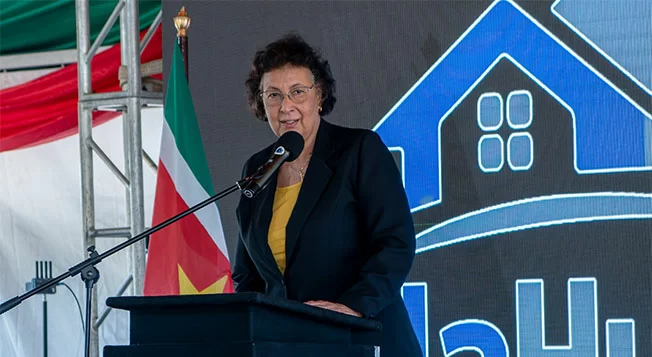
On July 9, the government of Suriname officially inaugurated its long-awaited National Housing Program in Reeberg, a landmark initiative designed to address the country’s growing acute housing shortage by expanding access to affordable financing for homebuyers and homeowners.
At the core of the new policy is the activation of the National Housing Fund, a legal entity established in 2019 that had remained non-operational until the launch event. The fund will enable low- and middle-income households to access subsidized mortgages through local commercial banks, with preferential interest rates tailored to income brackets. Households with a combined net monthly income of up to 2,000 Surinamese dollars (SRD) qualify for a 3% interest rate, while those earning between SRD 2,001 and SRD 3,500 can access mortgages at 5% interest. Maximum loan amounts are capped at SRD 750,000 for lower-income applicants and SRD 1.2 million for middle-income applicants. Financing is available not only for new home construction and purchases, but also for renovations and expansions of existing properties, with repayment terms stretching up to 30 years to keep monthly installments manageable.
During the launch ceremony, officials also unveiled the program’s official logo and held the ceremonial first stone laying for model homes at the Reeberg housing development project in Wanica. President Jennifer Simons, who contributed to drafting the National Housing Fund legislation during her tenure as a member of parliament, framed housing as a fundamental social issue that underpins community and family stability. She emphasized that the program was intentionally enshrined in national law to ensure long-term sustainability, allowing future administrations to continue expanding housing construction and to guarantee that all applicants access financing based on transparent, objective criteria rather than political connections.
Simons moved to temper public expectations immediately, noting that the 2026 budget allocates just SRD 250 million to the initiative, enough to finance approximately 300 to 350 units this year. This initial allocation will not meet the full unmet demand for housing in the country, which officials estimate reaches roughly 30,000 households. To help the government refine its future planning and better match supply to actual need, Simons urged all prospective home seekers to complete official registration once the application portal goes live.
Vice President Gregory Rusland called the program’s launch the fulfillment of a long-held national priority, noting that addressing the housing crisis was marked as a top policy goal from the very first discussions surrounding the formation of the current administration. “A home is far more than just a roof over one’s head,” Rusland said. “It provides stability, security, and the foundation for strong, thriving families.” He echoed Simons’ commitment to depoliticizing access to housing finance, stressing that the program will be open to all Surinamese citizens who meet eligibility criteria regardless of their political affiliation. Like the president, Rusland acknowledged that the full housing crisis will not be resolved in a single government term, but emphasized that the initiative lays a durable, structural foundation to outperform housing policies implemented by previous administrations.
National Housing Fund director Anoushka Ramdjilal confirmed that the previously dormant fund is now fully operational, with a dual mandate: to expand access to affordable housing for low- and middle-income Surinamese, and to stimulate growth in the domestic construction sector. Sigmund Proeve, chair of the fund’s supervisory board, added that applicants retain full freedom to choose their own contractor and participating bank, and that the fund will enforce strict oversight of both construction quality and public fund management to ensure accountability.
Public Works and Spatial Planning Minister Stephen Tsang described the program as a critical step toward decoupling homeownership access from political patronage, while also noting that it will deliver a meaningful economic boost by driving activity in the construction sector and creating new local jobs. Social Affairs and Housing Minister Diana Pokie reinforced the urgency of the initiative, highlighting that the country’s backlog of unmet housing demand has reached approximately 30,000 households, with vulnerable groups including low-income families and people living with disabilities as the government’s primary focus.
In the coming weeks, the government will launch a dedicated public information website and national outreach campaign to inform prospective applicants of eligibility requirements, application procedures, and available home models. Applications will be submitted through participating local banks rather than directly to the National Housing Fund, streamlining the process for applicants and leveraging existing financial infrastructure.