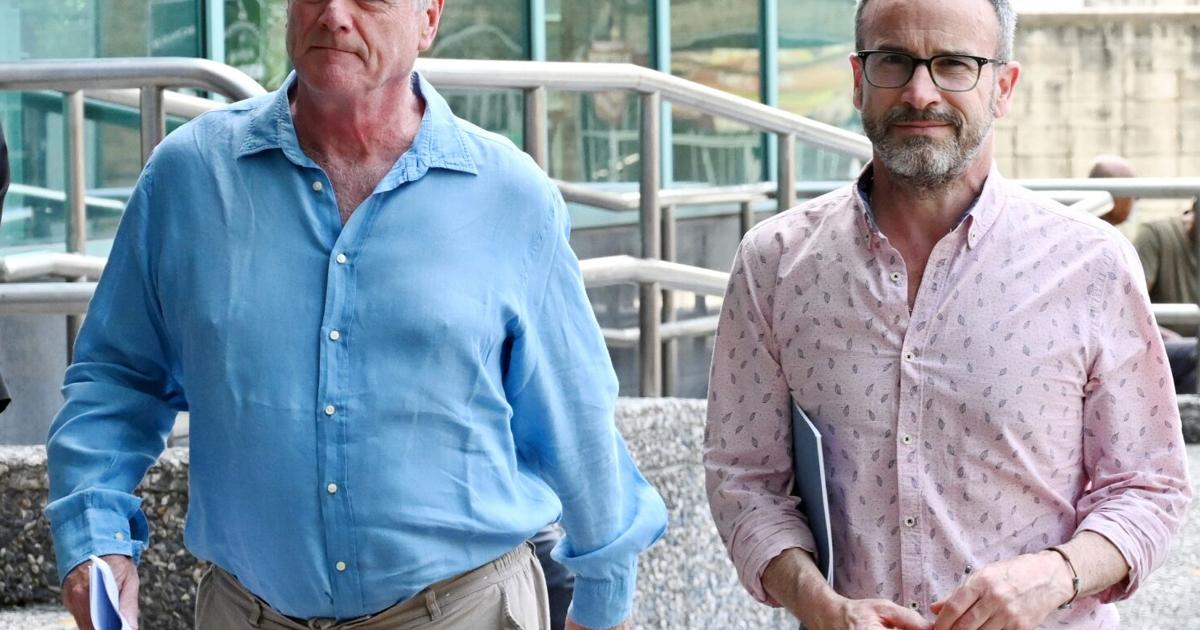
A high-profile legal battle over alleged state destabilization and an assassination conspiracy against Trinidad and Tobago’s top government leadership took a key step forward this week, as Attorney General John Jeremie held an extended meeting with two senior King’s Counsel brought in from the United Kingdom to represent the State in the case.
The closed-door meeting, which ran for multiple hours, took place at the Office of the Attorney General in Port of Spain, bringing Jeremie together with Sir James Raymond Eadie KC and Robert Stephen Strang KC. The pair join National Gas Company chairman Gerald Ramdeen to complete the State’s three-member legal team, which received formal case briefings from Jeremie ahead of their official admission to the local bar.
According to official documentation, the two KCs were formally approved to practice law specifically for this high-stakes case, listed as matter CV2026-02618: Dominic Hadeed & Genevieve Hadeed v The Commissioner of Police. The authorization was granted by Jeremie under Section 15A of Trinidad and Tobago’s Legal Profession Act, following required consultations with the Chief Justice. Official legal notices confirming their eligibility were published in the Government Gazette on June 30, and both barristers were scheduled to be formally called to the Trinidad and Tobago Bar the day after the meeting.
Both legal figures carry extensive credentials from the UK legal system. Eadie, a member of the Honourable Society of the Middle Temple, was admitted to practice before the Bar of England and Wales in 1984. Strang, also a Middle Temple member admitted to the UK bar in 2003, has a well-documented track record of high-profile wins, including successfully representing former prime minister Dr Keith Rowley in a 16-year-long land dispute tied to Tobago’s Alma Estate. Working alongside attorneys Ramesh Lawrence Maharaj and Dr Margaret Rose, Strang secured a final victory for Rowley before the UK-based Privy Council, the highest appellate court for Trinidad and Tobago.
The case the KCs have been brought in to argue stems from serious allegations brought by the State against local businessman Dominic Hadeed, owner of Blue Waters Products Ltd, his wife Genevieve Hadeed, and their relative Star Sabga. The three are accused of conspiring to assassinate senior government officials, with the detention order against Genevieve Hadeed specifically claiming she made public statements calling for the death of current Prime Minister Kamla Persad-Bissessar. State intelligence alleges the trio planned a series of violent acts to murder top government leaders and destabilize the country’s elected government.
The preventive detention orders (PDOs) at the center of the legal challenge were signed by Homeland Security Minister Roger Alexander under the 2026 Emergency Powers Regulations, implemented during an active state of emergency. Dominic and Genevieve Hadeed were arrested at their West Trinidad home last Wednesday, and have remained in custody since. Dominic Hadeed is currently being held at the Remand Yard of Golden Grove Prison, while Genevieve Hadeed and Star Sabga are detained at Golden Grove’s Women’s Prison.
This is not the first ruling in the ongoing legal saga. Earlier this week, High Court Justice Frank Seepersad dismissed the Hadeeds’ initial bid for immediate release via a habeas corpus application, ruling that the PDOs issued against the couple during the state of emergency were lawful. In a detailed 24-page judgment, Seepersad rejected the couple’s core argument that their initial arrest was unlawful, which would have invalidated the subsequent detention orders. The judge found that entries in the official police station diary directly contradicted claims that the pair were never informed they were being detained under the Emergency Powers Regulations, and confirmed that the initial 48-hour detention and subsequent seven-day extension authorized by a senior police officer met all legal requirements.
Seepersad emphasized in his ruling that while he upheld the legality of the current detention, emergency powers do not place the executive branch of government beyond judicial oversight. He also clarified that even if the initial arrest had been found unlawful — a finding he did not make — that procedural issue would not automatically invalidate the PDOs issued against the pair.
The habeas corpus ruling only addressed the immediate question of whether the Hadeeds should be released from custody pending the full case. A separate substantive constitutional challenge remains pending, which will ask the High Court to rule on broader questions of whether the State’s actions in issuing and executing the PDOs comply with the country’s constitution. In that challenge, the Hadeeds argue their constitutional rights were violated by their detention under the state of emergency, and the court will ultimately decide whether the Homeland Security Minister and Commissioner of Police acted within their legal authority under the Emergency Powers Regulations, whether the searches and detention were lawful, and whether the Hadeeds received all constitutionally guaranteed protections.
Seepersad explicitly ruled that these broader constitutional questions were not resolved in the habeas corpus proceedings, and directed that the constitutional challenge be heard by a separate High Court judge. The case is scheduled for its next procedural hearing on July 27, with both legal teams required to submit full written arguments to the court before that date. The Hadeeds are currently represented by a team led by Senior Counsel Douglas Mendes, Gilbert Peterson, and Faris Al-Rawi, alongside a group of supporting instructing attorneys.