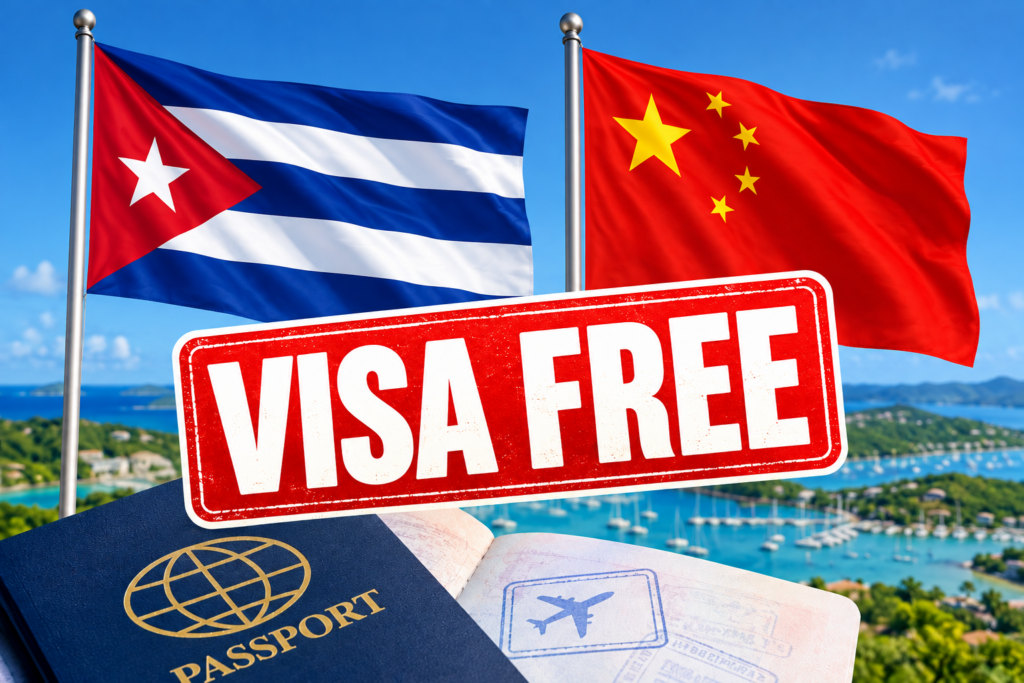
In a policy update released by its national Department of Immigration, the Caribbean nation of Antigua and Barbuda has introduced a new visa waiver arrangement that allows Cuban and Chinese citizens to enter the country for short-term visits without a pre-arrival entry visa. This policy amendment opens greater travel access for passport holders from both nations, though strict regulatory frameworks remain in place to govern different categories of travel.
Under the core terms of the new policy, the visa-free privilege applies exclusively to visits that do not exceed 30 consecutive days. Travelers who already plan to stay longer than this 30-day window before their departure are required to secure the appropriate category of visa prior to arriving in Antigua and Barbuda. Importantly, immigration officials have emphasized that the 30-day visa-free entry does not grant an automatic right to extend a stay beyond the initial permitted period. All travelers, regardless of whether they use the visa-free pathway, are still required to pass through standard immigration screening and meet all admissibility requirements upon arrival at any port of entry.
Beyond the 30-day visa-free option, Cuban and Chinese nationals have two additional alternative entry pathways to suit longer or different travel needs. For trips planned to last up to 90 days, eligible travelers can apply for an Antigua and Barbuda electronic visa in advance. Additionally, citizens of both countries who hold valid active visas or permanent residence permits issued by the United States, United Kingdom, Canada, or any Schengen Area member state are eligible to apply for a visa on arrival upon entering Antigua and Barbuda. This option also permits an initial maximum stay of 30 days, and carries a set fee of 100 U.S. dollars, or 260 Eastern Caribbean dollars.
Separate, more flexible provisions apply to Cuban and Chinese nationals who already hold legal resident status in Antigua and Barbuda. Under the updated rules, any individual with active lawful resident status may re-enter the country without applying for a new entry visa. For example, a Cuban national holding a valid work permit will be admitted for a stay aligned with the validity period of their permit, rather than being restricted to the 30-day limit that applies to short-term visitors. For those whose legal immigration status has expired, authorities may grant a grace period of up to 30 days to regularize their status, with decisions made on a case-by-case basis.
For visitors who entered via the visa-free program and later decide to extend their stay beyond the initial 30-day limit, the Department of Immigration has outlined a clear application process that does not require applicants to obtain a new entry visa. However, officials stress that extensions are not granted automatically. All applications must be submitted before the original 30-day permitted period expires, and formal approval from immigration authorities is required to remain in the country legally.
The extension process requires applicants to schedule an appointment with the Department of Immigration, attend the appointment in person to submit required documentation, outline the specific reasons for requesting an extended stay, and complete a formal interview with an immigration officer. All applicants must also pass mandatory background and security checks, which may involve sharing applicant information with the Joint Regional Communications Centre (JRCC) and other relevant regional security agencies. Immigration decision-makers will review all supporting documentation, the stated reasons for the extension, and the results of security screenings before issuing a final ruling.
If an extension application is approved, applicants are required to pay a set extension fee of 300 Eastern Caribbean dollars, plus any applicable outstanding charges. In cases where applicants are also seeking to change their immigration status during the extension process, an additional fee of 1,500 Eastern Caribbean dollars applies. Once all fees are paid and all procedural requirements are completed, the approved extension will be granted. If an application is rejected, the applicant will receive formal notification and be given a specified window to leave the country voluntarily. Failure to depart within this timeframe may result in immigration enforcement action or formal deportation proceedings.
In a closing warning, the Department of Immigration underlined that submitting an extension application does not itself grant legal permission to remain in the country beyond the original authorized period. Any individual who stays past the expiry of their permitted stay without formal approved extension is considered to have violated immigration terms, and may face financial penalties, arrest, enforcement action, or deportation. This updated guidance balances improved travel access for short-term visitors from Cuba and China with clear regulatory protocols to manage longer stays, resident re-entry, status adjustments, and compliance with national immigration rules.