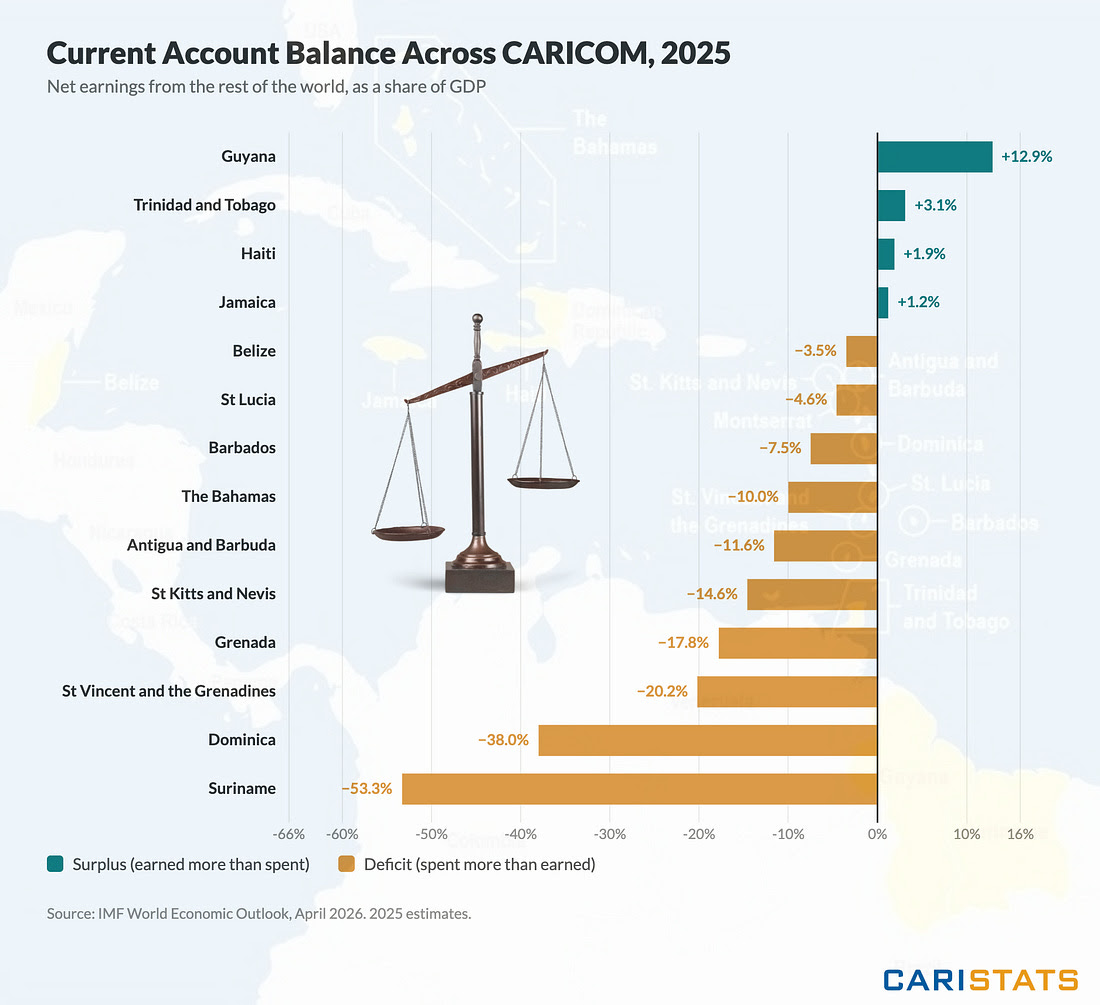
New 2025 economic data compiled from the International Monetary Fund’s April 2026 World Economic Outlook shows a stark divide across the Caribbean Community (CARICOM) bloc: just four of its 14 member states recorded current account surpluses, meaning they earned more revenue from global markets and cross-border transactions than they spent on foreign goods, services and transfers. The remaining ten nations ran sustained current account deficits, a pattern that has become the norm for most small, open economies in the region. For context, a country’s current account balance aggregates the total value of its exports of goods and services, cross-border income flows such as remittances, and subtracts total spending on imports and outgoing international transfers. A surplus signals a net positive inflow of foreign currency, while a deficit means the country spends more abroad than it brings in.
Among the four surplus economies, Guyana stands out as the clear leader, posting a current account surplus equal to 12.9% of its total gross domestic product, fueled almost entirely by booming crude oil exports that have transformed the small Caribbean nation’s economic profile in recent years. Next in line is Trinidad and Tobago, another regional energy powerhouse, which recorded a smaller but still solid surplus of 3.1% of GDP, driven by its long-standing oil and natural gas export sectors. The two remaining surpluses are far more modest, and rely on very different economic drivers: Haiti’s surplus comes almost exclusively from remittances sent home by Haitians living and working abroad, while Jamaica’s surplus is supported by a combination of remittances and international tourism revenue.
For the other ten CARICOM members, current account deficits are the status quo, with the gaps between foreign earnings and spending covered by a mix of international tourism receipts and foreign direct investment. Belize recorded the smallest deficit among the group, at just 3.5% of GDP, a relatively manageable gap for the small tourism-dependent economy. At the opposite end of the spectrum, two nations posted extremely deep deficits: Dominica recorded a deficit equal to 38% of GDP, while Suriname’s deficit hit 53% of GDP. Importantly, CARISTATS notes these large deficits do not signal economic distress in either country: both stems from heavy capital spending on imported infrastructure and energy development equipment, financed by large inflows of foreign capital that offset the current account gap.
The overall trend underscores a long-standing structural divide across the CARICOM bloc: the only economies that consistently earn more from the world than they spend are those with abundant energy reserves to export or those that rely heavily on remittances from overseas workers, while the majority of member states, most of which depend on tourism as their primary foreign exchange earner, continue to import more goods and services than they generate from international activity. This data release comes from independent regional statistics project CARISTATS, which publishes its economic analysis for free to the public. The organization has called for voluntary future subscription pledges from readers who value its work, with no charges applied until payment systems are formally activated.