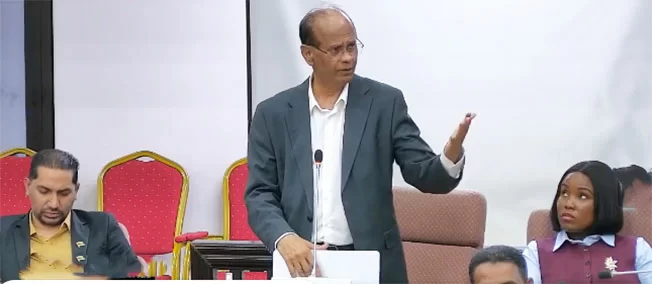
A routine policy discussion over permit processing for small-scale entrepreneurs in Suriname’s National Assembly descended into full-scale political chaos on Tuesday, leaving the chamber adjourned indefinitely after bitter clashes between ruling coalition and opposition lawmakers. What began as pointed criticism from National Democratic Party (NDP) opposition leader Rabin Parmessar targeting Economic Affairs, Entrepreneurship and Technological Innovation Minister Andrew Baasaron quickly escalated into hours of acrimonious back-and-forth over parliamentary conduct and allegations of unfair treatment of applicants.
Presiding over the session was Ivanildo Plein, the assembly’s second deputy vice-chairperson. As tensions spiraled out of control, Plein was forced to call multiple recesses, eventually requested assistance from police, and formally adjourned the meeting when members of the ruling coalition’s VHP party began walking out of the chamber.
During the opening of the debate, Minister Baasaron laid out the current context of the permit approval process, explaining that delays in reviewing applications often stem from the ministry’s reliance on input and clearance from multiple independent government bodies, including the Public Health Bureau, fire department, and National Environmental Authority. He told the assembly that the government is actively working to streamline and fully digitize the entire permitting workflow to cut wait times.
Parmessar rejected the minister’s explanation, arguing that small business owners and independent artisans are being forced to wait unreasonably long for approvals, while other applications are processed far more quickly through what he implied was preferential treatment. He pressed the minister to set clear, binding processing timelines for applicants that meet all regulatory requirements, claiming small entrepreneurs are currently being sidelined by the government’s broken system.
The confrontation grew more heated when Plein attempted to end Parmessar’s remarks to open the floor for other lawmakers, triggering shouts and cross-arguments from both sides that forced the first recess. When the session reconvened, NDP legislator Silvana Afonsoewa called on the presiding officer to ensure the minister directly addressed the widespread concerns of small business owners, noting that young entrepreneurs who have had pending applications for months are closely following the debate to see how the government will resolve the crisis. She acknowledged that Parmessar had become emotional during his opening comments, adding that the NDP caucus had discussed the incident during the recess.
The dispute expanded beyond the permit policy when VHP legislator Mahinder Jogi accused Parmessar of using inappropriate, unparliamentary language during a heated exchange in the first recess. Jogi referenced a past incident where he was forced to leave the chamber after making off-microphone inappropriate remarks, demanding that the same disciplinary standards be applied equally to all assembly members, regardless of party affiliation. Jogi warned that without consistent enforcement, parliament would devolve into an unregulated space where members can say anything without consequence.
Plein responded that he had not personally heard the alleged offensive remarks, so he could not impose disciplinary action. He confirmed that after a second recess, he checked with the assembly’s audio department to review any video or audio recording of the incident, but found no evidence: official recordings only capture remarks made during active sessions, not conversations during recesses, when no recording equipment is active. “I protect no one, and I will not protect anyone,” Plein told the chamber, adding that disciplinary action would follow immediately if any violation is proven.
Afonsoewa later confirmed that a verbal altercation had occurred between Parmessar and another legislator during the recess, noting she was standing near the exchange. She clarified that no remarks were captured by a microphone, and proposed that the NDP caucus handle the matter internally to prevent a similar incident from happening again. The VHP rejected this offer, with VHP legislator Dew Sharman arguing that Afonsoewa’s confirmation itself proved the incident occurred, claiming NDP legislator Ebu Jones left the chamber in anger after the exchange. VHP lawmakers continued to insist that the presiding officer enforce consistent rules for inappropriate conduct, regardless of whether it happened during a recess or off-microphone.
As tensions continued to rise, Plein announced he had called in police assistance and met with on-site officers after another recess. He told the assembly that during recess negotiations, the parties had agreed the VHP would deliver a statement before the session resumed to preserve order, and he accepted this arrangement to allow debate on the pending bill to continue.
Bronto Somohardjo, leader of the PL party, a coalition member, subsequently apologized to the Surinamese public on behalf of the coalition for the chaotic scenes in the assembly. But he also accused the opposition of intentionally stalling the session and attacking the presiding officer to block legislation from being passed, calling on the chamber to refocus on reviewing the bill under discussion. Those remarks immediately triggered new irritation among VHP lawmakers.
VHP leader Asis Gajadien said Somohardjo’s comments had made a bad situation “worse”, warning that parliament could not be allowed to become a “free-for-all shouting match” where any remark is acceptable during sessions or recesses. Gajadien issued a formal warning that he would direct his entire caucus to walk out of the session if no resolution was found. The debate was originally scheduled to review an amendment to Suriname’s 1912 Industrial Property Regulation bill.
Parmessar later attempted to refocus the chamber back on the original permitting issue and the pending bill. He acknowledged that his criticism of the minister may have been overly sharp, but stressed that his intensity stemmed from his commitment to advocating for struggling small business owners. He repeated his call for the government to answer his original questions, and said the bill was important enough to continue debate, urging the assembly to return to calmer proceedings.
The de-escalation attempt ultimately failed. When Gajadier attempted to speak again and Plein observed VHP members beginning to exit the chamber, he concluded the session could not continue. “What I am going to propose is that we adjourn this meeting to a date to be determined later,” Plein stated, before formally adjourning the assembly.