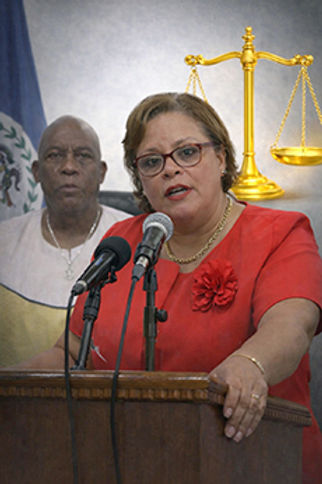
A high-stakes constitutional dispute over the independence of Belize’s government oversight bodies has placed new pressure on the incumbent administration, with Opposition Leader Tracy Taegar-Panton warning that ongoing interference is rapidly eroding public confidence in the country’s key public institutions.
Panton shared her concerns during a Tuesday press briefing held by the United Democratic Party, when she was asked to respond to a legal claim filed by former Ombudsman Major Gilbert Swaso against the Government of Belize. Swaso launched the court proceedings in early 2026, arguing that the government’s decision not to renew his appointment, which expired at the end of December 2025, violates the constitutional independence of the Ombudsman’s Office.
Court documents detail the sequence of events that preceded the non-renewal: Swaso issued a landmark Freedom of Information Act (FOIA) ruling ordering the government to release records detailing legal fees paid to private attorneys hired for redistricting-related litigation. The ruling came in response to a request from public-interest litigant Jerry Enriquez, who had fought for months to access the public records. The Attorney General’s Ministry immediately challenged the ruling at the Court of Appeal, where the case remains unresolved.
Following the FOIA ruling and additional reports Swaso completed on a separate government matter, senior government officials raised objections to his decisions during a December 2025 meeting with Minister of Public Service, Constitutional and Political Reform Henry Charles Usher. Just two days after that meeting, Swaso was formally notified that his appointment would not be extended when his term ended that month. The former ombudsman argues this action amounts to unlawful retaliation and unlawful interference with a constitutionally protected independent office, and he is asking the court to issue formal declarations confirming the independent protections the office is owed under Belize’s constitution. He is also challenging decisions related to compensation during his tenure and raising questions about the legality of actions taken against his office.
As of when the lawsuit was filed, the ombudsman position had sat vacant for more than 160 days following the expiration of Swaso’s term. This prolonged vacancy has disrupted core operations of the office, which acts as the country’s primary independent avenue for citizens to file complaints against government departments and public authorities, including resolving disputes under the FOIA.
Panton declined to directly comment on the specific legal merits of Swaso’s claim, but emphasized that the broader issue at stake is the ability of all Belizean oversight institutions to operate without political interference. She named the Ombudsman’s Office, the Office of the Contractor General, the Integrity Commission, the Joint Public Accounts Committee, and the Office of the Auditor General as five critical bodies tasked with upholding government accountability and transparency.
Panton stressed that these oversight mechanisms must function at optimal capacity and within their established legal frameworks to protect Belize’s democratic institutions and guarantee citizens the right to be heard on issues that impact their daily lives. She argued that without autonomous oversight, the public cannot access critical government information or seek redress through official channels without relying on political favor or intervention.
“The trust and confidence that Belizeans have in our public institutions are fading, and fading quickly, because the public institutions are not working in the interest of the people,” Panton told reporters. “These oversight mechanisms must be able to function with some autonomy, must be able to function within the confines of the law that governs that office, so that the people of this country can have direct access and be able to ask the questions.”