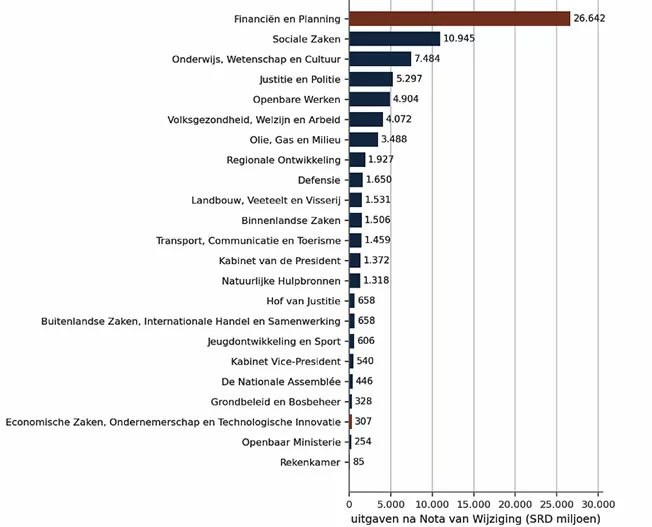
On August 12, an independent policy analysis released by veteran Surinamese researcher Vincent Roep offered a comprehensive assessment of the South American nation’s 2026 national budget, concluding that the fiscal plan lays a strengthened financial and institutional foundation for long-term development while leaving critical gaps on the path from post-crisis recovery to sustained, inclusive economic transformation ahead of the anticipated launch of the country’s oil economy.
Roep’s full report, titled *Suriname 2026 National Budget: Integrated Policy Analysis of Fiscal Policy, Sustainable Economic Development and Preparation for the Oil Economy*, was designed to contribute evidence-based insight to public debate over the quality of Suriname’s fiscal planning and the budget’s ability to support the country’s long-term economic growth trajectory. The analysis arrives at a pivotal juncture for Suriname: the country has secured preliminary macroeconomic stabilization and restored fiscal discipline following years of economic volatility, and now faces the dual challenge of consolidating those gains while leveraging limited fiscal space to advance inclusive sustainable development and prepare for an anticipated influx of oil revenues.
Unlike traditional budget assessments that focus solely on short-term financial balance, Roep’s analysis evaluates the 2026 budget based on its ability to create enabling conditions for broad-based economic transformation and shared societal prosperity, aligned with global best practices for resource-rich developing nations. For the study, Roep systematically analyzed four core government documents—the 2026 national budget, 2026 fiscal strategy, 2026 annual financial plan, and 2026 national debt plan—using an integrated evaluation framework developed from guidance and insights from leading global institutions including the International Monetary Fund, World Bank, OECD, United Nations, and the Natural Resource Governance Institute.
The framework assessed the budget across six core strategic criteria: macroeconomic stability and fiscal sustainability, social development and human capital investment, entrepreneurship support, economic structural strengthening, good governance and institutional quality, and local content development and preparation for the oil economy. Drawing on decades of research on small and medium enterprise (SME) development and resource-rich economy fiscal planning, Roep anchored each dimension in peer-reviewed international literature on sustainable development for resource-dependent nations.
The analysis assigned the 2026 budget an overall score of 6.7 out of 10, corresponding to a rating of “reasonably good”. Breakdown scores by criteria were 7.0 for macroeconomic stability and fiscal sustainability, 8.0 for social development and human capital, 6.0 for entrepreneurship support, 7.0 for economic structural strengthening, 6.0 for good governance and institutional quality, and 6.0 for local content and oil economy preparation.
The report characterizes the 2026 budget as a stabilization-focused fiscal plan with clear development ambitions. Key strengths highlighted by the assessment include the government’s sustained commitment to fiscal discipline, ongoing strengthening of public finances, targeted investments in education, healthcare and social protection, expanded capacity for public institutions, and the ongoing development of Suriname’s Savings and Stability Fund to manage future oil revenues responsibly. All of these elements are recognized as critical foundational requirements for long-term sustainable economic growth.
At the same time, the analysis identifies significant gaps in the budget’s strategic framework for full economic transformation. While policy priorities such as innovation, digitalization, productivity growth, entrepreneurship development, SME support and economic diversification are acknowledged in current planning, they have not yet been integrated into a cohesive long-term national strategy. The report also notes that measurable performance indicators and clear institutional and organizational frameworks for budget implementation remain underdeveloped, a caveat aligned with the study’s ex ante mandate: the report does not assess actual implementation outcomes, only the quality of pre-release planning.
A core focus of the analysis is Suriname’s preparation for its emerging oil sector. The assessment credits the government for making visible progress on institutional preparations and prioritizing responsible management of future oil revenues, but finds that key elements including local content requirements, domestic supplier development, workforce skills upgrading, and strategies to link oil revenues to broad economic diversification remain insufficiently developed.
The report emphasizes that the long-term developmental impact of Suriname’s oil reserves will depend not on the volume of revenues generated, but on how those revenues are deployed. The study’s framework defines local content as far more than basic local participation in the sector: it encompasses entrepreneurship development, skills training, domestic supply chain growth, and broader economic diversification, all of which are required to ensure oil revenues lift broad societal welfare rather than concentrating gains.
In its concluding recommendations, the report calls on Suriname to accelerate the transition from post-crisis financial stabilization to a full, national economic transformation strategy over the coming years. Key policy priorities identified for urgent action include expanded investments in human capital, innovation, digitalization, entrepreneurship development, economic diversification, institutional strengthening, and a robust, actionable local content policy for the oil sector.
Roep, the report’s author, earned his PhD in 2008 from Anton de Kom University of Suriname, where he has worked as an independent researcher for decades. In addition to publishing academic research, he supervises graduate students in business administration, with a core research focus on SME development in Suriname.