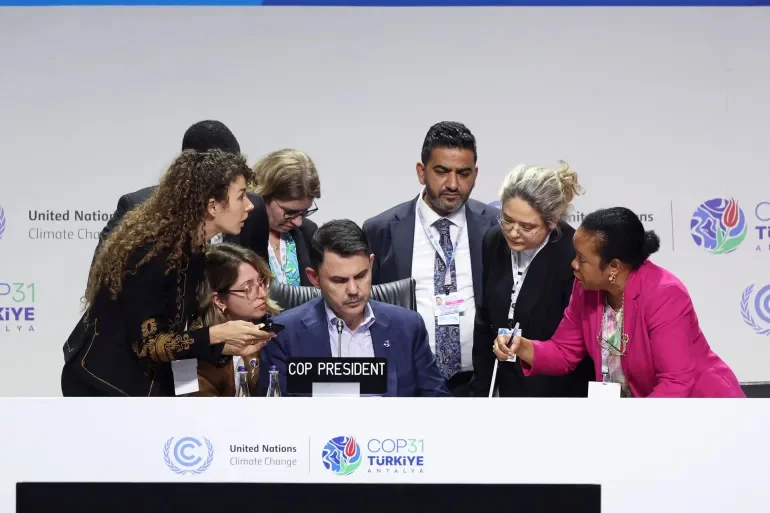
Held in Antalya, Turkey, the 31st United Nations Climate Change Conference (COP31) formally wrapped up on Sunday, 48 hours behind its originally scheduled Friday closing date, after nearly 200 participating nations failed to reach consensus on a unified global framework for climate action. Murat Kurum, Turkey’s environment minister and co-president of COP31, presided over the extended high-stakes talks, which collapsed over irreconcilable divisions over references to phasing out fossil fuels, climate adaptation funding, and the timeline for upcoming IPCC scientific assessments. The flagship proposed final document, dubbed the Antalya Pact, was ultimately abandoned after the European Union, alongside the United Kingdom, France, Panama, and dozens of vulnerable small island developing states (SIDS), raised formal objections. Speaking on behalf of the rotating EU presidency, Irish Minister for Climate and Energy Darragh O’Brien emphasized that any credible climate agreement must explicitly name fossil fuels — coal, oil, and gas, the documented primary drivers of global warming — to align with established climate science, and criticized the final draft for omitting all direct references to these energy sources entirely. Over 130 nations had originally pushed to retain language mandating an accelerated phase-out of fossil fuels, a commitment first agreed unanimously at COP28 in Dubai in 2023, but the final compromise draft only made a vague passing reference to the 2023 Dubai accords without reaffirming the fossil fuel transition pledge. Major oil and gas exporting nations including Saudi Arabia and Russia had staunchly opposed any explicit fossil fuel language, arguing that binding phase-out targets would threaten their national economic stability and domestic energy security. Two additional flashpoints further widened rifts between negotiating blocs: first, disagreements over a proposed target to raise the global share of electricity in total final energy consumption to 35% by 2035, with many nations insisting the electrification push must be explicitly tied to rapid expansion of renewable energy, given that 33% of global electricity is still generated from coal and 20% from natural gas, meaning unregulated electrification would not guarantee emissions cuts. Second, the removal of a $120 billion annual climate adaptation funding target for low-income nations from the final draft sparked widespread anger among developing states, which bear almost no historical responsibility for greenhouse gas emissions but face the worst impacts of extreme drought, coastal flooding, heatwaves, and sea-level rise. Negotiators also clashed over the timeline for the next round of IPCC scientific assessment reports, with Saudi Arabia, India, and Kenya pushing to delay their release beyond the 2028 global stocktake review of collective climate progress. While the landmark overarching Antalya Pact was not adopted, the conference did deliver limited standalone agreements, including a formal framework for a just energy transition that establishes protections for workers employed in fossil fuel-dependent industries as economies shift toward low-carbon systems. The lack of a unified high-level political declaration leaves no clear shared roadmap to raise global climate ambition for the coming years, a particularly devastating outcome for vulnerable SIDS and developing nations in the Caribbean that were counting on coordinated global commitments to advance clean energy transitions and unlock critical adaptation funding. For dual-positioned nations such as Suriname, which is home to newly developed oil and gas reserves but also extremely vulnerable to coastal erosion and extreme weather, the impasse prolongs the difficult balancing act of leveraging fossil fuel revenues for economic development while safeguarding its fragile ecosystems and at-risk coastal communities. The outcome of COP31 underscores the persistent, deep geopolitical divides that continue to stall collective global progress on urgent climate action.
COP31 eindigt zonder klimaatakkoord na onenigheid over fossiele brandstoffen