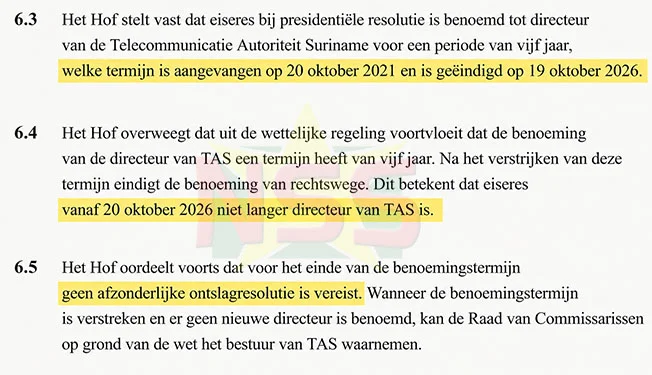
In a landmark judicial ruling issued on a recent Friday, Suriname’s Hof van Justitie (High Court of Justice) has formally dismissed all seven legal grievances filed by Wendy Jap-A-Joe, former director of the Telecommunications Authority Suriname (TAS), and fully validated the earlier summary judgment issued by the lower cantonal court on 26 October, with additional clarifying legal reasoning to reinforce the decision. The court’s core finding confirms that Jap-A-Joe’s five-year statutory tenure as TAS director, which commenced on 20 October 2021 per her official 1 September 2021 appointment resolution, legally expired on 19 October 2026, and that the TAS Supervisory Board (Raad van Commissarissen, RvC) holds full legal authority to oversee the authority’s operations starting 20 October to prevent a leadership vacuum. Jap-A-Joe’s central legal argument, that an open-ended employment contract signed on 1 November 2021 with then supervisory board chair Harish Monorath extended her tenure beyond the statutory five-year window, was deemed legally inadmissible by the court. The ruling explicitly notes that Suriname’s Telecommunications Facilities Act outlines clear, binding procedures for director appointments that cannot be circumvented by a private employment agreement to extend executive authority past a legislated end date. Further review of case files confirmed the 2021 employment contract was never finalized in compliance with mandatory legal requirements: Section 4(4) of the Telecommunications Facilities Act mandates that all director employment terms must be formally set by the relevant minister following consultation with the RvC and explicit approval from the Council of Ministers, a step that was never completed for Jap-A-Joe’s agreement. The court contrasted this irregular process with her 2016 appointment as TAS deputy director, which followed full regulatory protocols with the full participation of all required governing bodies. The court also rejected Jap-A-Joe’s secondary claim that she could automatically revert to her prior deputy director role after her director tenure ended, ruling that by voluntarily accepting the 2021 director position, she had implicitly agreed to terminate her prior deputy post, as the two full-time executive roles cannot legally be held by the same individual simultaneously. Additional grievances filed by Jap-A-Joe against the RvC’s 16 October directive ordering her to complete a formal handover of duties by 19 October were also dismissed. The court ruled that advance notice for a structured leadership transition is a standard, reasonable administrative practice designed to protect TAS’s operational continuity and avoid disruptions to Suriname’s telecommunications regulatory functions. Balancing the personal interests of Jap-A-Joe against the public operational interests of the national telecommunications regulator, the court confirmed that the lower court’s interim measures, which bar Jap-A-Joe from acting in any official capacity on behalf of TAS, entering TAS premises, and require her to surrender all company assets including confidential dossiers, digital records, official vehicles, keys, and equipment, are fully proportionate and legally justified to prevent operational harm to the authority. Jap-A-Joe has been ordered to pay a total of SRD 18,000 in combined appeal court legal costs, split equally between two separate cases: SRD 9,000 for proceedings against the state and RvC members, and an additional SRD 9,000 for the case filed against TAS. The three-judge panel overseeing the case was led by presiding judge Sieglien Wijnhard, with panel members Jenne Jensen and Alida Johanns. Following the ruling, TAS’s legal representative Gerold Sewcharan confirmed that the full terms of the original lower court summary judgment can now be enforced without delay, while court press officer Ingrid Lachitjaran noted that the ruling also sets clear, binding legal precedents defining the statutory limits of TAS director tenures and the official authority of the RvC. The court clarified that a full, final ruling on the underlying validity of the disputed 2021 employment contract will be delivered at a later date during the upcoming full substantive civil proceedings.