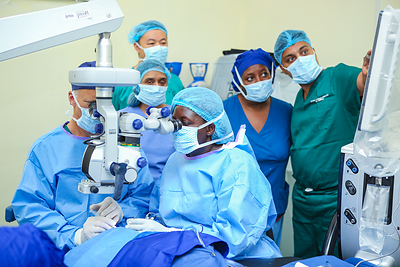
Leading global eye care nonprofit Orbis International has unveiled a landmark four-year, $32 million combined financial and technical investment roadmap spanning 2027 to 2030, designed to fortify under-resourced national eye health systems and democratize access to high-quality vision care for marginalized populations worldwide. The transformative pledge, announced in conjunction with the inaugural Global Summit for Eye Health hosted by Antigua and Barbuda in technical partnership with the World Health Organization (WHO), is projected to deliver measurable improvements in eye health outcomes for over 18 million individuals, while upskilling more than 250,000 frontline eye health professionals across 200+ countries and territories.
The high-profile summit convenes cross-sector stakeholders including heads of state, public health agencies, private industry leaders, civil society organizations, and global philanthropic funders to align collective action toward eliminating preventable vision loss that currently impacts 1 billion people globally. Orbis has formally endorsed the landmark St. John’s Global Compact for Eye Health, a multi-stakeholder framework that sets binding shared targets for coordinated action, sustained investment, and transparent accountability to close global eye care gaps. The organization’s newly announced operational commitments translate that formal endorsement into tangible, community-centered programming focused on three interconnected priority pillars: targeted workforce development, equitable high-quality cataract care, and ethically governed integration of digital and artificial intelligence tools into routine clinical services.
“Historically, ambitious global eye health pledges have too often remained confined to policy documents, but this summit creates a tangible platform to turn shared aspirations into on-the-ground, lasting impact,” stated Kathleen Sherwin, President and CEO of Orbis International. “By pooling our specialized expertise and dedicated resources, we will support national governments to build the resilient, locally led workforce and integrated health systems required to deliver permanent, equitable improvements in eye health. In all our work, we will prioritize the groups that are systematically excluded from care: women, girls, geographically isolated communities, and other underserved populations that bear a disproportionate burden of preventable vision loss.”
Rooted in the core principle that sustainable, long-term progress in eye health cannot rely on short-term external interventions, Orbis’s strategy centers on building local national capacity: ensuring every country has the trained personnel, clinical infrastructure, and operational systems to deliver quality eye care independently long after individual external program cycles conclude. The organization will execute this work in close, collaborative partnership with national ministries of health, WHO, the International Agency for the Prevention of Blindness (IAPB), grassroots civil society groups, professional eye care associations, and responsible private sector partners, centering country-defined priorities and community-led solutions at every stage of implementation.
The first core pillar of the commitment addresses the single largest systemic barrier to universal eye care: the global shortage of skilled, certified eye health workers. By 2030, Orbis will deliver structured, ongoing professional development for 250,000 eye care professionals globally, with heavy reliance on Cybersight, the world’s most widely adopted digital eye health platform that unites remote learning, one-on-one clinical mentorship, AI-powered diagnostic support, and real-time telehealth consultation to strengthen health systems at unprecedented scale. Orbis will maintain completely free public access to Cybersight through 2030, a contribution valued at $15 million over the four-year period, and will make the platform’s full suite of capabilities available to power IAPB’s global network of training and professional development initiatives.
“We are facing an unrecognized global public health crisis in eye care: a catastrophic gap in trained personnel to treat and stop the preventable conditions that cause irreversible blindness,” explained Hunter Cherwek, Chief Medical Officer at Orbis International. “As populations age and the prevalence of sight-threatening conditions rises at an unprecedented rate, demand for skilled eye health providers is surging faster than most national health systems can keep up. These targeted commitments directly support governments to scale their domestic workforce, and Cybersight eliminates geographic barriers to deliver world-class training to providers no matter how remote their practice setting is.”
The second priority pillar allocates $17 million in combined funding and technical support to expand access to high-quality cataract care, the single leading cause of preventable blindness worldwide. Timely, properly performed cataract surgery can fully restore vision for affected patients, but millions of people in low- and middle-income countries still lack access to safe, affordable procedures. Orbis’s targeted investment will strengthen workforce capacity, standardize surgical quality protocols, build long-term institutional clinical capacity, and scale equitable access to cataract services, directly advancing WHO’s 2030 global cataract elimination targets and the broader SEE 2045 global initiative to end avoidable blindness. In partnership with global eye health leader Alcon, Orbis will deliver comprehensive cataract training that blends hands-on clinical placement, interactive digital learning, structured mentorship, and state-of-the-art surgical simulation tools to build provider competence and confidence.
“The chasm between what modern eye care technology can deliver and what marginalized patients can actually access is one of the most urgent unaddressed public health challenges of our era,” noted David J. Endicott, Chief Executive Officer of Alcon. “Closing that gap cannot be achieved by any single organization: it requires coordinated cross-sector collaboration, sustained targeted investment, and a shared commitment to building the local workforce and clinical infrastructure needed to bring quality eye care to every community, no matter their income or location.”
The third innovative pillar of Orbis’s 2027-2030 strategy focuses on the responsible, ethical integration of artificial intelligence tools into routine primary care, kicking off with a pioneering partnership with the Government of Antigua and Barbuda to embed AI-assisted diabetic retinopathy screening into national routine diabetes care pathways, aligned with the Prime Minister’s Vision Initiative. The joint project aims to achieve 80% screening coverage for all patients accessing national diabetes care services by 2030, with fully connected, seamless referral, diagnosis, treatment, and ongoing follow-up pathways for patients identified with sight-threatening retinal complications. Orbis will also systematically collect real-world evidence and share actionable implementation lessons from the Antigua and Barbuda program to guide the responsible, ethical adoption and safe scaling of similar AI-integrated eye care models across other national health systems worldwide.
“Antigua and Barbuda is immensely proud to deepen our longstanding partnership with Orbis International to build an eye care system that is universally accessible, equitable, and sustainable for every citizen,” stated Walton Webson, Permanent Representative of Antigua and Barbuda to the United Nations. “This collaborative effort launching in 2027 will advance AI-powered diabetic retinopathy screening, strengthen local clinical capacity, and dramatically expand early detection of preventable vision loss. With additional support from our global partners, we will design a comprehensive, adaptable eye care model that can be replicated across the Caribbean and other Small Island Developing States. Our ambition is unambiguous: to protect sight, expand economic and social opportunity for all our people, and prove that small island nations can lead the world in inclusive, people-centered health innovation. No one should lose their sight, or their chance to build a thriving future, to a condition we already have the tools to prevent or treat.”
Across all 16 direct partner countries, Orbis will deliver targeted hands-on support to strengthen government-led health institutions, while Cybersight will continue to deliver free learning and clinical support to users in over 200 countries and territories. The full 2027-2030 workplan covers priority clinical areas including cataract treatment, diabetic retinopathy screening and care, childhood eye health services, and refractive error correction, with intentional outreach to ensure historically excluded communities are not left behind. For over 40 years, Orbis has delivered sight-saving care and training through its iconic Flying Eye Hospital, a fully equipped teaching hospital housed in a converted aircraft that brings world-class clinical expertise to the world’s most remote communities. Today, the organization combines that on-the-ground clinical work with cutting-edge digital innovation and cross-sector partnerships to deliver on its core mission: to eliminate the 90% of global vision loss that is fully preventable with timely, accessible care.