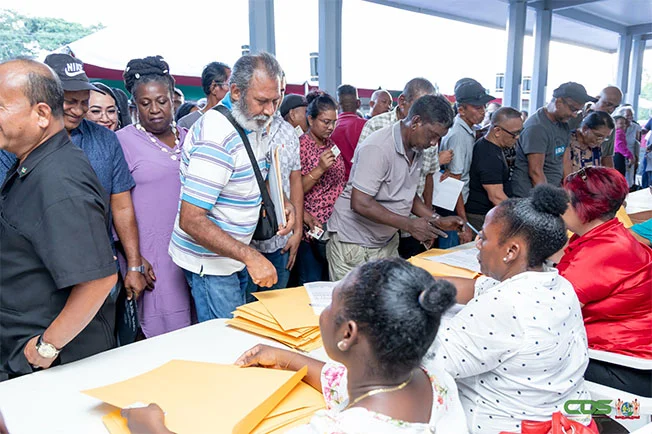
On October 31, Suriname’s government announced a comprehensive set of land sector reforms during a public ceremony distributing official land titles to more than 900 residents of the Wanica district, held at the District Commissioner’s office on Tawajarieweg. Delivering remarks on behalf of President Jennifer Simons, Minister Melvin Bouva laid out a multi-pronged agenda starting with a full formal audit of all land conversion transactions conducted between 2020 and 2025, with a specific focus on state-owned public domain land transferred to private companies and non-profit foundations with no verifiable public benefit tied to the deals. The new policy framework is explicitly designed to crack down on rampant land speculation by tying all future public land allocations directly to verified, immediate on-the-ground usage, closing loopholes that have allowed parties to hoard undeveloped parcels for resale at inflated markup. Joining Bouva at the event was Uraiqit Ramsaran, interim Minister of Land Policy and Forest Management, who acknowledged longstanding systemic failures in the country’s land administration system that have left thousands of ordinary citizens waiting years for their land applications to be processed, trapped in legal limbo with no formal security of tenure. Ramsaran outlined plans to roll out full digitalization of land records and administrative workflows to cut processing times, boost transparency, and eliminate the backlog of pending applications, noting that no Surinamese resident should face years of uncertainty over the status of their land claim in the digital era. Beyond streamlining administrative procedures, the administration is drafting a fully modernized legal code for land governance that will strengthen legal protections for long-term land leaseholders, reduce bureaucratic red tape for application reviews, and guarantee clearer tenure rights for all citizens. The reforms also integrate land allocation directly into the government’s national affordable housing strategy, linked to the broader National Housing Program that provides subsidized construction financing, prepares vacant parcels with full utility connections and supporting public infrastructure, and eliminates the common barrier of residents holding formal land titles but lacking the basic access to roads, water, or power required to build a home. Ramsaran emphasized that the day’s title distribution was far more than a routine administrative handover: “Today we are not just passing out a form or a land permit, we are handing people the foundation to turn their life goals into reality.” He added that the reform agenda will ensure every Surinamese person has a fair, equal opportunity to access land within clear legal parameters, while upholding strict safeguards to protect the country’s rich natural ecological resources. Taken together, the full package of new policies will not only speed up fair access to land for ordinary citizens, but also give the national government far greater oversight over every stage of public domain land acquisition, transfer, and usage to prevent misuse for private gain at the expense of the public good.