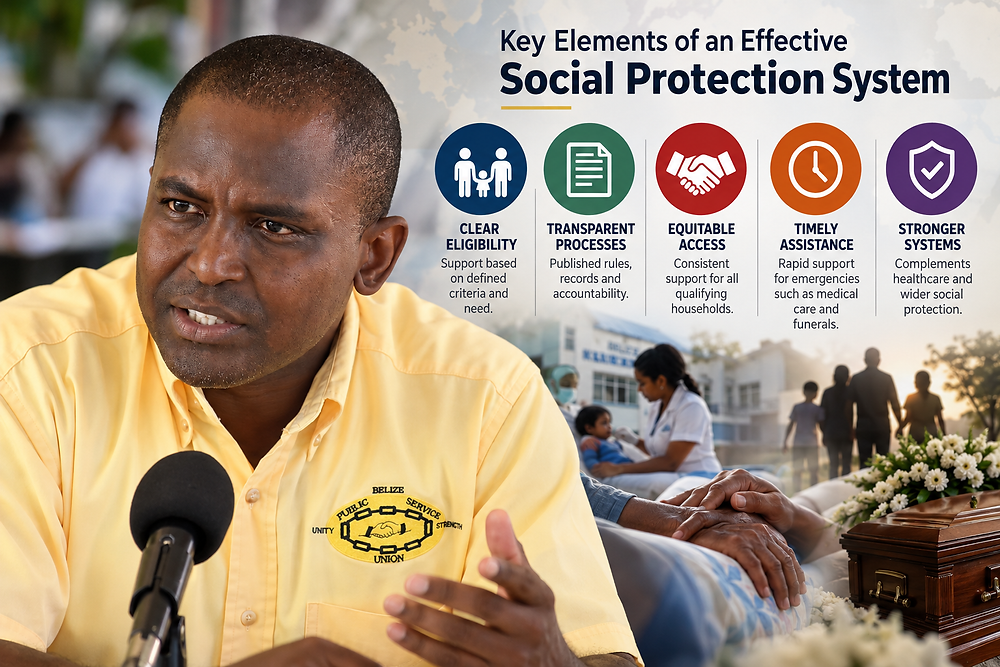
On October 21, 2026, Belize’s Public Service Union (PSU) published a formal statement on its official Facebook page pushing for major reform to the country’s emergency social assistance framework, demanding a shift from ministerial discretionary aid to a transparent, institutionally managed system.
The core of the union’s criticism targets the current practice of letting elected officials control emergency financial aid for pressing needs including unexpected medical bills and funeral costs. While the PSU explicitly affirms that supporting households struggling with financial hardship remains a critical public priority, it warns that the current discretionary model creates systemic risks to fairness, transparency, and overall effectiveness of Belize’s social protection infrastructure.
Under the current arrangement, applicants seeking emergency aid reach out directly to their local elected representative, with approval decisions resting entirely on the officeholder’s personal judgment and available funding. The PSU highlights that this structure lacks three critical components: publicly available clear eligibility rules, accessible public records of distributed aid, and formal appeal pathways for applicants who are denied support. This gap can lead to deeply unequal outcomes: two households facing identical financial emergencies may receive drastically different results based solely on their personal connections to political representatives, rather than their actual level of need. The union emphasizes that public assistance should be allocated based on proven vulnerability, not access to political power or personal networks.
To address these flaws, the PSU has proposed shifting all resources currently allocated to discretionary aid into formally established, standardized social protection programs. Drawing on global best practices for institutional social protection, the union suggests creating dedicated, standalone programs for emergency medical support and burial assistance, both run according to publicly disclosed eligibility rules and uniform administrative procedures. Under this proposed model, eligible applicants would submit requests through designated public agencies instead of relying on personal appeals to ministers or local area representatives.
Eligibility assessments would be conducted against consistent, pre-established criteria including total household income, the scale and nature of the emergency, overall household financial vulnerability, and the availability of other forms of support. Formalized programs would also codify maximum aid amounts, required documentation, standardized processing timelines, and clear appeal processes for rejected applications. While the proposal acknowledges that limited administrative discretion would still be necessary for extraordinary, one-off cases, it would place all discretionary decision-making within a formal framework of public accountability and oversight. Crucially, a rules-based system would also allow the Belizean government to track aid distribution, verify that resources are actually reaching the most vulnerable households, and adjust program allocations to match real on-the-ground social needs.
Beyond transparency concerns, the PSU’s statement also raises broader questions about gaps in Belize’s existing social protection infrastructure. The union argues that the widespread need for households to seek direct assistance from elected officials for essential emergency costs is itself a signal that existing institutional support systems are failing to meet community needs. While discretionary emergency aid can provide immediate short-term relief, it does not address the underlying structural factors that leave households vulnerable to unexpected expenses in the first place. For example, repeated reliance on discretionary aid for medical bills points to larger systemic issues around healthcare affordability, stagnant household incomes, and lack of access to consistent institutional social support. Similarly, high demand for funeral assistance reflects the lack of savings buffers for low-income households across the country.
From a public policy perspective, these patterns raise urgent questions about whether current social protection programs are sufficiently funded, accessible, and responsive to emergency needs. The PSU’s proposal goes far beyond simply shifting administrative responsibility from elected officials to civil servants; it requires building new programs with sustained adequate financing, clear role delineation for administrative bodies, and rapid response mechanisms for urgent requests.
At its core, the PSU’s push for reform rests on a broader principle: access to publicly funded social assistance should not be contingent on the personal intervention of an elected official. Instead, eligible households should be able to access support through predictable, institutional processes, bound by transparent eligibility rules and available program resourcing. To date, Prime Minister John Briceño has defended existing constituency development funding, framing it as a mechanism that allows area representatives from both of Belize’s major political parties to respond directly to local community needs, including small-scale infrastructure projects.