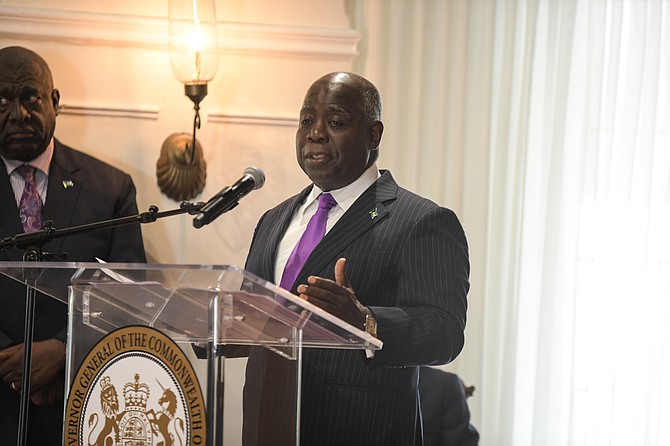
Nassau, The Bahamas – Prime Minister Philip “Brave” Davis made a historic announcement to the House of Assembly yesterday, confirming that The Bahamas has recorded its first fiscal surplus since gaining independence more than half a century ago. For the 2025/2026 fiscal cycle, the country closed its books with a $39.3 million surplus, a milestone that caps years of gradual deficit reduction following the dual economic shocks of Hurricane Dorian and the global COVID-19 pandemic. But the celebratory tone of the announcement quickly dissolved into partisan confrontation, as opposition lawmakers launched fierce claims that the government manipulated accounting standards to inflate the country’s fiscal health by omitting hundreds of millions in public spending.
Presenting the Ministry of Finance’s June 2026 Monthly Fiscal Summary Report to the chamber, Davis framed the surplus – which equals 0.2% of the nation’s gross domestic product – as a dramatic reversal of the country’s recent fiscal trajectory. Just five years prior, in 2020/2021, The Bahamas grappled with a $1.3 billion deficit, driven by catastrophic disaster recovery costs and widespread pandemic-related economic shutdowns. Since that peak, the government has steadily narrowed the gap: the deficit fell to $721.7 million in 2021/2022, then $534.6 million in 2022/2023, $194 million in 2023/2024, and $84.8 million in 2024/2025, before tipping into surplus for the current reporting period. Davis added that the country recorded consecutive monthly surpluses from January through June 2026, with the final quarter of the fiscal year delivering a $196.6 million surplus to push the full-year result into positive territory.
Breaking down the numbers outlined in the fiscal report, total annual revenue jumped 16.6% year-over-year to hit $3.96 billion, coming in 1.7% above the government’s original budget projections. Total expenditure rose 12.6% to $3.92 billion. Tax revenue grew 13% to $3.42 billion, led by a 14.9% increase in value-added tax (VAT) collections that reached $1.65 billion. Non-tax revenue saw a far steeper 45.4% climb, hitting $543.3 million. Davis attributed the revenue growth to enhanced tax enforcement and stricter compliance measures, noting that a new Domestic Minimum Top-Up Tax applied to large multinational corporations operating in The Bahamas generated an extra $68.6 million in revenue in June alone. Recurrent public expenditure rose 9.7% to $3.51 billion, while capital expenditure grew 45.2% to $414.9 million, and annual public debt interest payments totalled $674.7 million. Davis also highlighted that international financial institutions have already recognized the country’s fiscal progress: Moody’s upgraded The Bahamas’ credit rating to Ba3 with a stable outlook in April 2026, and S&P Global issued a similar upgrade in September 2025.
Opposition lawmakers immediately rejected the government’s framing, dismissing the result as a misleading “false surplus” designed to distract from ongoing economic struggles facing ordinary Bahamian households. Kwasi Thompson, Member of Parliament for East Grand Bahama and a former finance minister, questioned whether a $310 million capital investment project referenced by Finance Minister Simon Wilson was intentionally excluded from the year’s expenditure calculations. Thompson argued that the government failed to account for all public spending, and raised suspicions that hundreds of millions in outstanding public bills were intentionally left unpaid at the end of June to inflate the surplus result. He further called out the government’s management of the $700 million National Investment Fund (NIF), demanding full public disclosure of all outstanding government obligations by the end of June to verify whether unpaid liabilities actually exceed the reported $39.3 million surplus. Beyond the accounting questions, Thompson challenged the government’s decision to celebrate the milestone at all, pointing to ongoing struggles with skyrocketing fuel costs and a persistent national cost of living crisis. “The cost of living is continuing to hammer our people. Inflation continues to increase, and so I think it should not be celebrated until we are able to solve sufficiently the cost of living crisis,” Thompson stated.
Davis pushed back firmly against these criticisms, emphasizing that all fiscal data is available for independent review, and accused Thompson of rejecting the government’s accounting without conducting a proper review of the released materials. He defended the career Ministry of Finance officials who compiled the report, noting that many of the same civil servants held their positions when Thompson served as finance minister. Thompson countered that the decision to omit the $310 million in capital spending was a political policy choice, not an error by career public servants.
The partisan clash quickly expanded beyond the surplus numbers to a broader confrontation over the work of parliament’s Public Accounts Committee (PAC), which is chaired by Opposition leader and Marco City MP Michael Pintard. Davis criticized Pintard for discussing the committee’s ongoing investigations into public fund management publicly before the probe is completed, arguing that all questions about the NIF should be resolved through the PAC process. Pintard rejected the criticism, arguing that the committee has already shown significant restraint in its public updates and has not disclosed any confidential information. He added that the PAC has twice written to the Speaker of the House requesting permission to broadcast its committee meetings live to the public, arguing that open hearings would allow all Bahamians to judge testimony about public fund management for themselves. Pintard joined Thompson in dismissing the surplus as “contrived”, arguing that all NIF spending must be included to get an accurate picture of the country’s overall fiscal position, noting that “The NIF is an account created by the Prime Minister, and it is the Ministry of Finance and the Treasury that’s managing that.” Davis denied that he pressured the Speaker to block live broadcasts of PAC proceedings, though he agreed with the Speaker’s decision, accusing the Opposition of attempting to turn the public hearings into a political “reality show” for partisan gain.
Tensions boiled over earlier in the parliamentary session when Thompson interrupted Kingsley Smith, MP for West Grand Bahama, during his remarks on the PAC dispute. Deputy Speaker Sylvanus Petty repeatedly ordered Thompson to return to his seat, triggering a walkout protest: all Free National Movement (FNM) opposition MPs stood in solidarity with Thompson as he challenged the ruling that Smith be allowed to continue speaking. Petty warned that non-compliant members would be removed from the chamber, forcing a two-minute suspension of parliamentary proceedings to de-escalate the confrontation.
Despite the heated partisan clash, Davis reaffirmed that the published fiscal figures can withstand full independent scrutiny. He noted that the first surplus in a generation will strengthen The Bahamas’ ability to respond to future national emergencies, reducing the need to rely on high-cost emergency borrowing to address crises. Even so, the prime minister acknowledged that further fiscal reforms remain necessary to address the country’s ongoing public debt burden, improve performance at state-owned enterprises, and strengthen overall fiscal transparency for the Bahamian public.