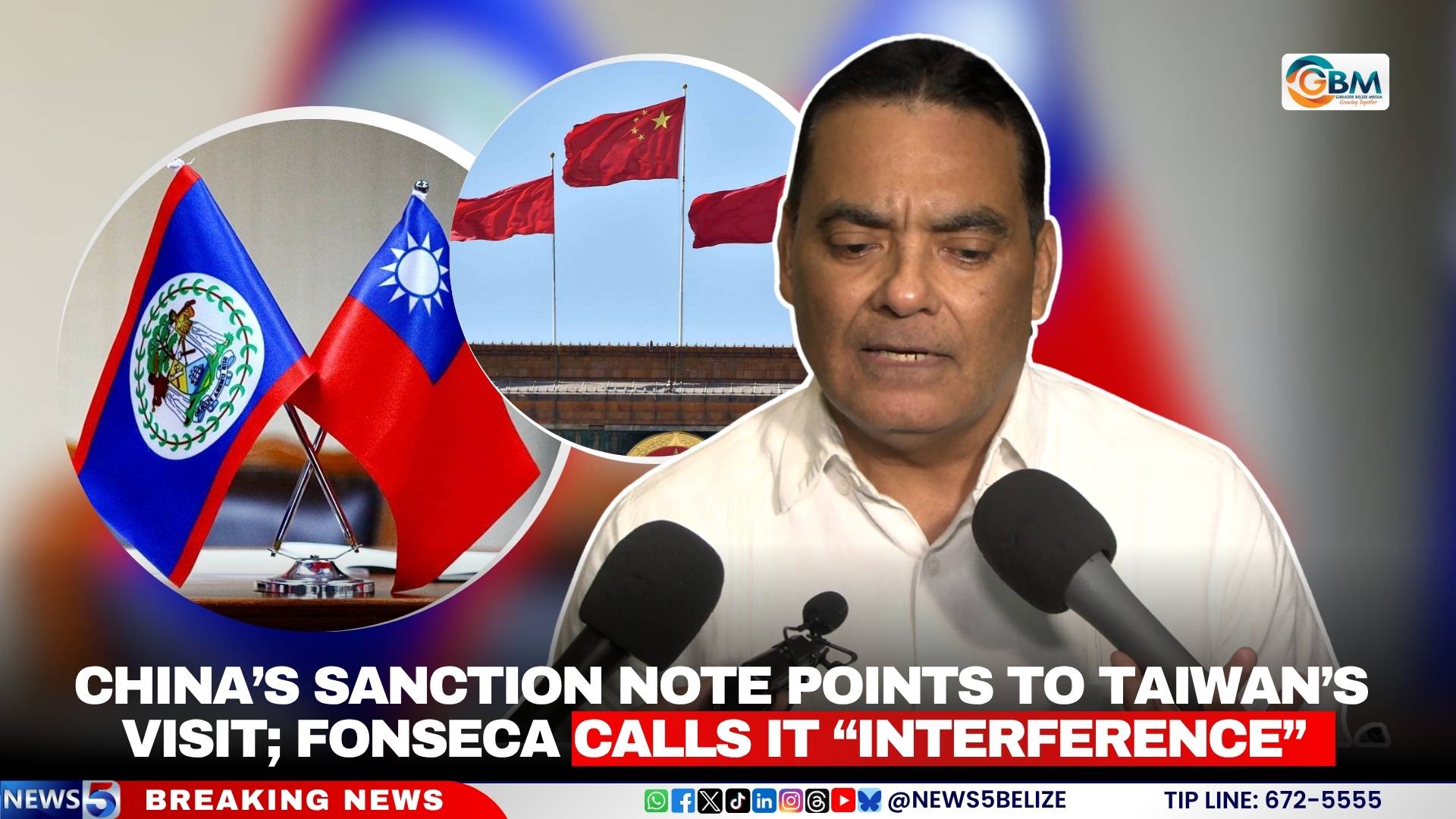
On October 13, 2026, a formal diplomatic notification of sanctions issued by China against Belizean Foreign Minister Francis Fonseca was delivered, with the measure directly linked to the recent official visit of Taiwan’s foreign minister to the Central American nation. In an exclusive interview with local outlet News 5, Fonseca detailed that the official sanction note was transmitted from China’s embassy in Jamaica to Belize’s national protocol office, explicitly tying the action to Belize’s decision to host Lin Chia-lung, Taiwan’s foreign minister, during an official trip in September 2026.
Fonseca told reporters he first received word of the punitive measures via an early morning message at approximately 5:30 a.m. local time, recalling that his immediate response was one of genuine surprise. “My initial reaction was shock, really. Where did this come from? So I was surprised,” he stated.
Global news agency Reuters later confirmed that China’s Ministry of Foreign Affairs simultaneously announced sanctions on both Fonseca and Paraguay’s communications minister, targeting the two officials over their respective countries’ official diplomatic ties with Taiwan. The punitive restrictions include a blanket denial of entry visas to China’s Hong Kong and Macau special administrative regions, alongside a formal ban on all Chinese state and private entities engaging in any commercial or business dealings with the two individuals. A spokesperson for China’s foreign ministry labeled the two officials as “pawns” advancing Taiwan’s international agenda.
In response to the sanctions, Fonseca noted that the restrictions will have little to no personal impact on him: he holds no investments or assets in mainland China, and has never traveled to the Chinese mainland. “It doesn’t affect me personally, and obviously, I do not have any assets in China,” he said. “But it is a very serious matter.”
The Belizean top diplomat framed the sanctions as a direct violation of his country’s sovereign right to conduct independent foreign policy and choose its own international partners. “This is an act really of interference with our right, our sovereign right as a nation to chart our own course when it comes to foreign policy,” Fonseca emphasized. He went on to warn that small developing states face heightened vulnerability if such incursions on sovereign decision-making are allowed to proceed unchecked, arguing “If we allow those fundamental principles to be undermined, especially as small states, then we are all less secure; all small states are less secure.”
Fonseca pushed back against widespread speculation that the sanctions could spill over to disrupt bilateral trade between China and Belize, where China ranks as one of the largest sources of imported consumer and industrial goods. “There is no evidence at all that there will be any impact on any of those issues, trade issues, economic issues,” he said. “It has no impact on the country; it has no impact on Belizeans.”
While Belize’s government has issued an official condemnation of the sanctions, Fonseca confirmed that the country will not implement reciprocal punitive measures against China. “In Belize, we respond to these measures with calm and with principle,” he explained.
Fonseca also expressed public appreciation for a recent statement from the U.S. State Department that condemned the Chinese sanctions against Belizean officials. He added that Belizean diplomatic authorities are currently conducting formal briefings for key regional and hemispheric bodies, including the Caribbean Community (CARICOM), the Central American Integration System (SICA), and the Organization of American States (OAS).
To date, Taiwan maintains 12 remaining official diplomatic allies across the globe, and Belize and Paraguay are the only two of these nations whose senior officials have been targeted by Chinese sanctions. When asked to speculate on Beijing’s strategic rationale for targeting his country now, Fonseca said Belize’s government remains concerned by the action but declined to comment on unconfirmed motivations.
Fonseca reaffirmed that Belize’s 37-year formal diplomatic relationship with Taiwan remains unshaken, pointing to a suite of new bilateral cooperation agreements signed during Lin’s recent visit. The new pacts cover a broad range of sectors including educational development, public health, agricultural advancement, climate change adaptation, and affordable housing expansion. “Our relationship with Taiwan continues to be very, very strong,” Fonseca stressed. “It is a relationship that the Belizean people support.”