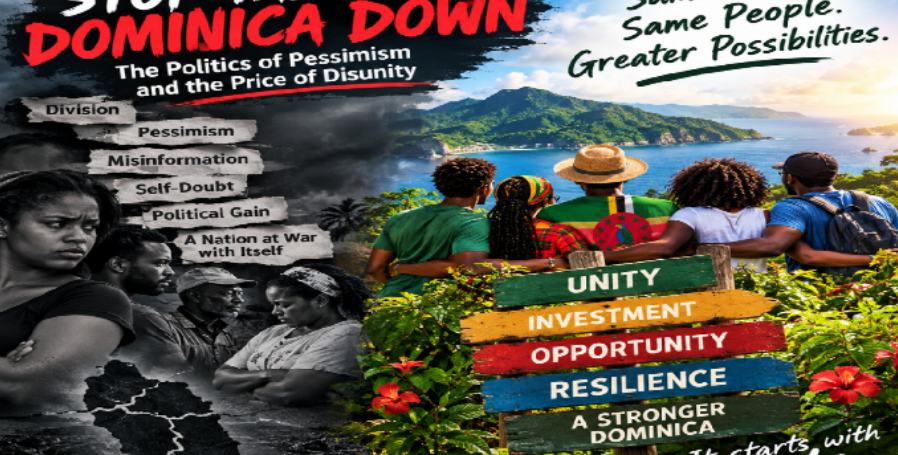
Across the national discourse of Dominica, a subtle yet deeply damaging pattern has begun to take hold: one that jeopardizes both domestic unity and the nation’s ability to tackle the pressing challenges that lie ahead. This culture of internal fragmentation, persistent fatalism, and automatic negative assumptions about Waitikubuli (the native name for Dominica) has eroded collective purpose. Too often, Dominican citizens turn against one another, spread unfounded suspicion, repeat worn narratives of national decline, and let pessimism overshadow opportunities for progress. What makes this trend particularly alarming is that it is frequently amplified by actors seeking elected office in Parliament, turning what should be constructive debate into a counterproductive, even dangerous, force. At a moment when small island developing states like Dominica face escalating economic, environmental, and geopolitical pressures, the luxury of endless internal division is one the nation simply cannot afford. To build a resilient, prosperous future, Dominicans must reject the politics of despair and recommit to a shared national vision. Crucially, this rejection of doom does not require silencing criticism; it demands refusing to let constant criticism replace constructive, solution-focused action. Leading political science scholarship offers critical context for this pivotal moment in Dominica’s national development. In his seminal works *Making Democracy Work* and *Bowling Alone*, Robert Putnam outlines how social capital—built through mutual trust, collaborative action, and active civic engagement—strengthens democratic institutions and creates the conditions for broad-based societal prosperity. Where widespread mistrust and disengagement take root, collective problem-solving becomes nearly impossible. Similarly, Steven Levitsky and Daniel Ziblatt, authors of *How Democracies Die*, warn that democratic norms erode rapidly when political leaders exploit existing divides and frame political opponents as existential enemies rather than legitimate competitors. Francis Fukuyama’s *Identity: The Demand for Dignity and the Politics of Resentment* further expands this framework, exploring how narratives of identity, demands for recognition, and levels of social cohesion directly shape political stability and institutional effectiveness. Taken together, these scholarly perspectives reinforce a foundational truth: no nation can reach its full potential when its people are constantly divided against one another, or when pervasive negative self-perception becomes the defining feature of national identity. One of the most dangerous, underrecognized threats to Dominica’s continued development is the intentional spread of disinformation and pervasive narratives of national decay, doom, and despair. Political actors and special interest groups frequently exploit public anxiety by exaggerating crises, distoring verifiable facts, and framing the nation as irredeemably failing. When these narratives are deployed solely to erode public confidence and gain partisan advantage, they do nothing to strengthen democracy. Instead, they deepen societal mistrust, discourage active constructive participation, and shift national focus away from practical solutions toward self-defeating political conflict. It is critical to acknowledge this threat without tarring all criticism of the Dominican government or state as malicious. All governments deserve rigorous public scrutiny, policy failures must be exposed, and poor decisions must be challenged. But there is a clear line between exposing a problem to solve it, and exaggerating a problem to convince the public that no solution exists. The first is the mark of responsible citizenship; the second is an exercise in national demoralization. Dominicans must not allow legitimate public concern to be exploited for partisan gain, nor should they platform political actors who offer nothing but fear, resentment, and baseless accusations. While these internal cultural and political divides create unnecessary obstacles, Dominica does face very real, urgent external challenges that demand collective action. Climate vulnerability remains an existential threat, as increasingly intense tropical storms batter the nation’s infrastructure, disrupt livelihoods, and strain the national economy. Meaningful economic transformation requires targeted innovation, attracted foreign and domestic investment, and strategic diversification beyond Dominica’s traditional economic sectors. Demographic pressures—including widespread out-migration, an aging population, a shrinking domestic labor pool, and a narrow tax base—further constrain productivity and long-term growth. Adding to these pressures, global geopolitical uncertainty and recurring international economic shocks complicate efforts to expand shared prosperity. These challenges are severe, and pretending they do not exist would be irresponsible. But none of these obstacles can be overcome by cultivating mistrust, attacking fellow citizens, or endlessly repeating how grim the nation’s circumstances are. Solving them requires clear-eyed analysis, disciplined policy implementation, cross-partisan collaboration, and a shared commitment to progress. What Dominica needs is criticism that maps a path forward, not cynicism that convinces people no path exists. Beyond these challenges, Dominica holds extraordinary inherent strengths that position it to thrive in the long term. The Dominican people have already proven their extraordinary resilience, repeatedly rebuilding their communities and economy after devastating climate disasters and other adversities. The nation’s abundant natural resources and intact environmental assets create a unique opportunity to become a global leader in sustainable development and the rapidly growing green economy. Dominica’s small size, often framed as a critical limitation, actually enables greater policy agility and closer, more productive collaboration between communities and state institutions. The nation’s strong shared cultural identity also fosters a powerful sense of belonging that can serve as a foundation for collective action. These strengths are not an excuse for complacency; they are assets to be protected, developed, and converted into tangible improvements in quality of life for all Dominican citizens. National pride only carries meaning when it inspires people to do the hard work of building a better country. So what concrete steps can individual Dominican citizens take to advance the national project of unity, shared prosperity, and long-term resilience? First, every citizen can actively challenge disinformation and resist the automatic reflex of national self-denigration. All people should question sensationalist claims, verify information through credible independent sources, and refuse to amplify narratives designed to mislead or demoralize the public. In an era where misinformation spreads at unprecedented speed through social media and private messaging groups, responsible citizenship requires intentional discernment and self-restraint. Citizens must also reconsider the language they use to describe themselves and their nation. Dominica is not merely a small island doomed to struggle against insurmountable odds; it is a nation of people capable of extraordinary innovation, adaptation, and achievement. No longer must Dominica see itself as a minor “minnow” in the Caribbean; it can emerge as a leading example of what intentional resilience, rigorous environmental stewardship, and forward-thinking ecological modernization can accomplish. It is long past time to retire the cynical oft-repeated phrase “Only in the Commonwealth” that frames the nation as uniquely cursed. If a problem exists, Dominicans can identify it, understand its roots, and fix it—there is no need to turn every challenge into another excuse for national self-denigration. Second, Dominicans must rediscover the value of collective domestic investment in their nation’s future. Meaningful development requires more than government spending and public programs; it requires citizens willing to mobilize their own resources, take calculated risks, and invest in local productive enterprises. Worker cooperatives, community-owned businesses, sustainable agricultural ventures, and partnerships with the Dominican diaspora can unlock much-needed capital for local innovation and entrepreneurship. Even small groups of two friends or three family members pooling their savings can create economic opportunities that no single individual could launch alone. It is worth asking: how is it that foreign investors with no personal ties to Dominica can pool capital to launch local businesses, while so many Dominican citizens remain reluctant to invest their own savings in productive domestic ventures? There are of course valid reasons for personal saving, and no one should be pressured into making an investment they cannot afford. But it is important to ask whether excessive risk aversion is preventing Dominicans from recognizing and pursuing viable local opportunities. Economic patriotism is not an abstract sentiment; it is demonstrated by where you choose to invest, which local businesses you support, what skills you invest in developing, and how you collaborate to create new opportunities for your community. A nation cannot build stronger farms, more competitive businesses, better schools, or more effective institutions if its people constantly deny their own capabilities and collective potential. No country can build its future on public spending alone; it must also mobilize the initiative, enterprise, and resources of its entire population. Third, Dominican citizens must work to cultivate widespread civic trust and responsible political participation. This means engaging in public discourse constructively, holding elected leaders accountable without descending into unproductive cynicism and personal insults, and recognizing that disagreement does not have to lead to division—much less all-out political warfare. Citizens must separate a political opponent’s policy positions from their inherent worth as a fellow Dominican. Democracy depends not only on the quality of its formal institutions, but on the conduct of the people who sustain those institutions. What Dominica needs is a mature patriotism: one that is willing to acknowledge the nation’s weaknesses, courageous enough to address those weaknesses head-on, and generous enough to maintain mutual trust while doing that hard work. National unity does not require uniform opinion; it requires a willingness to work together for the common good despite legitimate differences. Fourth, Dominicans must turn national pride into practical, tangible action. A forward-looking vision of national resilience requires targeted investment in infrastructure, public education, skills development, economic diversification, and preparedness for future climate and economic shocks. It requires citizens to participate in local community initiatives, support ethical local enterprises, mentor young Dominicans, and contribute their knowledge and talents to national development. Properly understood, patriotism is neither blind loyalty to the ruling party nor uncritical support for any sitting government. It is a commitment to the collective well-being of the nation and a willingness to contribute to its advancement, no matter which party holds political office. It is a form of civic virtue expressed through active engagement in the life of your community. So get involved, get to work, and create change in your own neighborhood and community. Organize a local beach or neighborhood clean-up, help a young person learn a marketable skill, support a local small business owner, strengthen a local community organization, or bring neighbors together to solve a shared problem. Large-scale national change starts at the local level. National transformation is not something we can only demand from our leaders; it is something we build together through our own daily actions. Ultimately, the challenge facing Dominica is not merely political or economic. It is also psychological and cultural. Will Dominicans see themselves as a fractured people condemned to perpetual struggle, or as a community capable of overcoming any adversity through collective effort? Nationhood is never a finished product; it is an ongoing project, sustained through shared sacrifice, mutual respect, and a consistent commitment to the common good. Dominica’s future will depend in part on government policy choices, institutional performance, and the global opportunities available to the Dominican people. But it will also depend on whether Dominicans can develop the collective confidence, mutual trust, and shared agency needed to seize those opportunities when they arise. No nation can control every external economic or climate shock, but every nation can control whether it responds to adversity by uniting or tearing itself apart. As Dominica prepares to mark its political independence, it is a moment to reflect not only on how far the nation has come, but on what kind of nation Dominicans want to build for future generations. Dominicans must reject the lazy temptation to confuse pessimism with intelligence, cynicism with patriotism, or relentless unproductive criticism with meaningful contribution. Citizens must refuse to be manipulated by political actors who benefit from sowing discord, while remaining vigilant against genuine policy failures and systemic injustice. Above all, Dominicans must choose to believe in their collective capacity to succeed—and turn that belief into action. The greatest threat to Dominica is not legitimate criticism, honest disagreement, or even the formidable external challenges the nation faces. It is the failure to turn differences into a source of strength, and collective potential into a force for shared progress. Indeed, Dominica’s greatest asset is not just the natural beauty of its island or the proven resilience of its people, but its unique ability to come together, act with shared purpose, and build a better future for all. Let the nation renew its commitment to the enduring national ideal: “All for Each and Each for All. Written by Ambassador Dr. Gerard Jean-Jacques, who holds a PhD in Political Science from Université Laval, Quebec, Canada, and serves as Dominica’s Ambassador to CARICOM and Commissioner to the OECS. His areas of specialization include Public Policy and Public Management, Democracy, and Public Governance.
COMMENTARY: Stop trashing Dominica – The politics of pessimism and the price of disunity