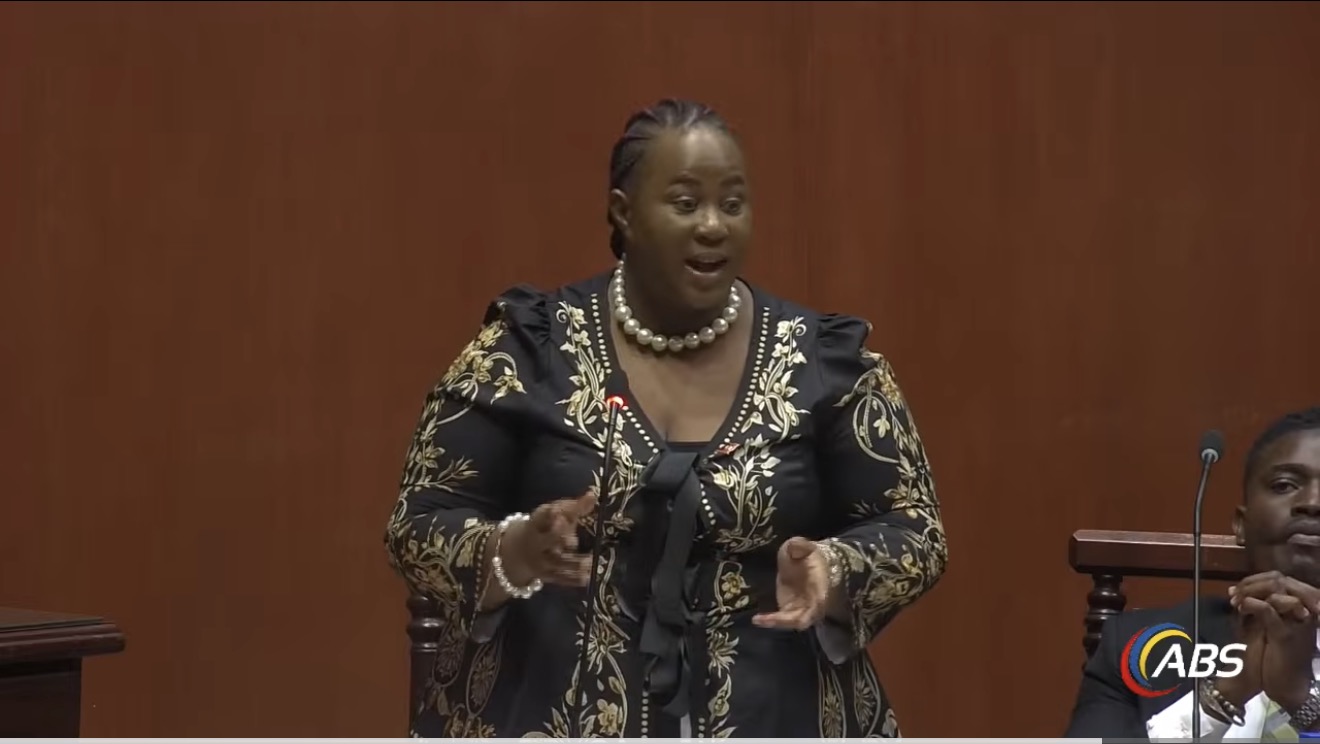
During heated Senate deliberations over Antigua and Barbuda’s landmark 2026 Firearms Amendment Bill, Senator Tiffany Strann-Peters has opened up about a deeply personal tragedy to make the case for greater public accountability in curbing gun violence, sharing that the 2012 murder of her close friend Melissa Hunt could have been avoided if a witness had reported an illegal firearm before the killing took place.
Strann-Peters walked fellow legislators through the fateful details of September 5, 2012, the day Hunt was shot and killed in the John Hughes neighborhood. Earlier that same day, she had spoken with Hunt, who was searching for Gerber brand apple juice to prepare for her 11-month-old daughter. When Hunt could not find her preferred product, Strann-Peters offered a suggestion for an alternative, an ordinary moment that now stands as one of her last memories of her friend.
Later that evening, while working her shift at the local Dixie retail outlet, Strann-Peters called Hunt’s home to check in. When the person who answered the phone told her Hunt could not come to the line, she initially assumed it was a bad joke—until Hunt’s mother arrived at the store in tears, confirming the devastating news that Hunt had been killed. More than a decade later, the senator says the grief still lingers. “It still aches to this day,” she told the chamber. While people learn to adapt to life after loss, she added, the pain of preventable violence never fully fades.
Court testimony from the case revealed that less than two hours before Hunt was killed, the perpetrator Errol Barnes was seen handing a black revolver to another woman. That witness never reported the illegal weapon to law enforcement, a failure that Strann-Peters says directly enabled the killing. “If we were taking our responsibility seriously of when you know something, you say something, this is a crime that could have been prevented,” Strann-Peters argued. “The gun was in your hands. You saw it. And you had the opportunity to call the police.”
Hunt’s death left her infant daughter without a mother; today, that little girl is 15 years old, and has never gotten the chance to build a relationship with the parent who was taken from her too soon. For Strann-Peters, this tragedy exposes a broader societal failure: a widespread culture of silence when community members know about illegal firearms or planned violent activity. She has urged all residents and citizens of Antigua and Barbuda to break that silence, emphasizing that speaking up can save lives—including one’s own. “When we see something, that we say something,” she said. “Because the life you save may just be your very own.”
The senator expressed strong support for the proposed bill, which would introduce a mandatory minimum 15-year prison sentence for anyone found in possession of a firearm or ammunition with intent to cause injury. Strann-Peters went even further, noting she would back raising the mandatory minimum to 20 years, and believes a maximum sentence of 40 years for these offenses is entirely justifiable.
Even with harsher penalties, however, Strann-Peters stressed that tougher laws alone cannot resolve Antigua and Barbuda’s gun violence crisis. She pointed out that the island nation’s first foundational firearms legislation was passed all the way back in 1971, and penalties for illegal gun possession have steadily increased in the decades since—yet violence persists, in large part due to a lack of public cooperation.
Cutting gun crime, she argued, is not the exclusive responsibility of law enforcement or government officials. “It is not a one-person job,” she said. “It is not only the job of the police, but it is all of us that would assist in policing and ensuring that we create and continue to maintain the safe Antigua and Barbuda and this paradise that we all love.”