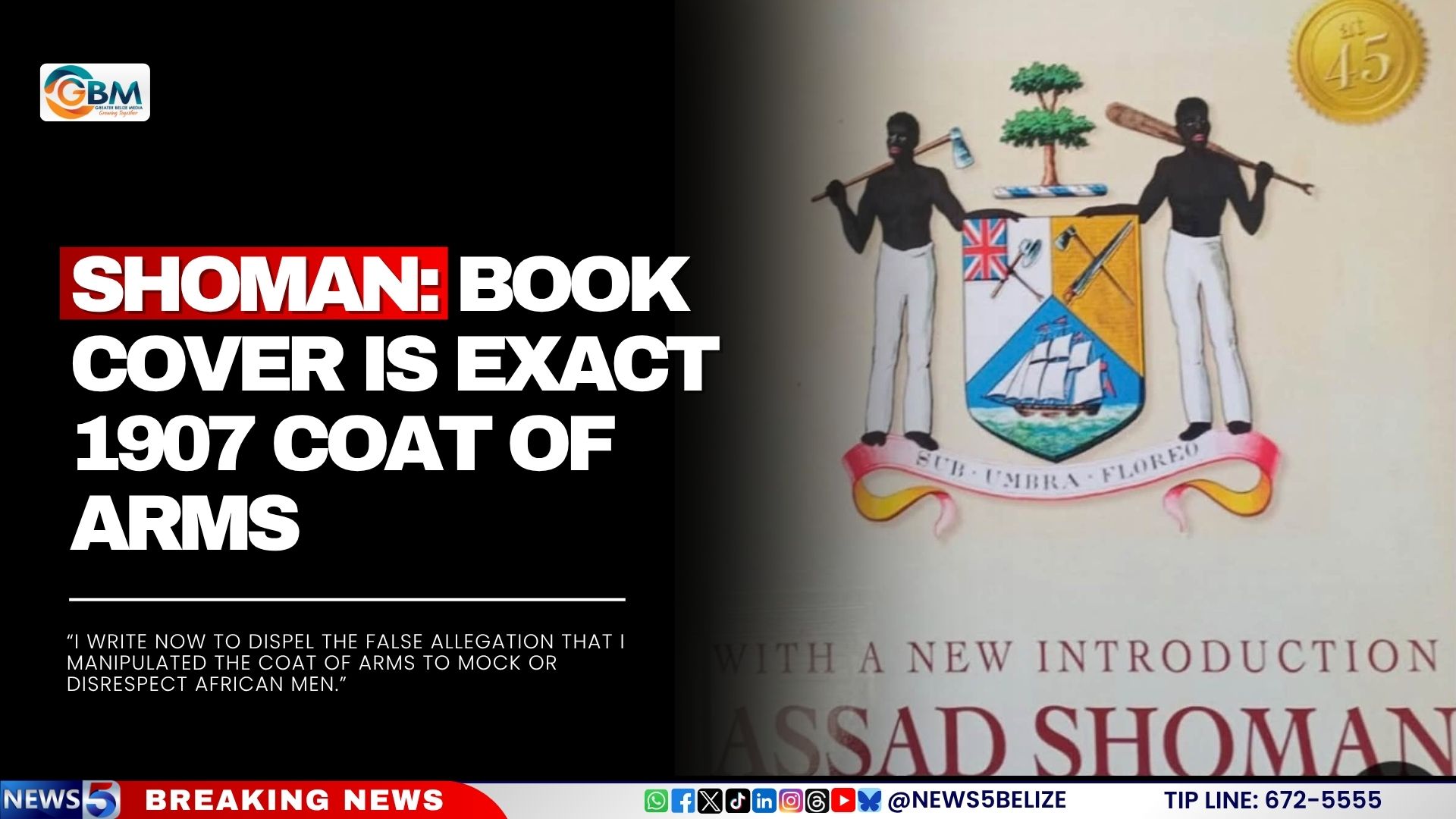
A public controversy has erupted in Belize over the cover art of a new history book, pitting author Assad Shoman against the National Kriol Council (NKC) over a decades-old colonial coat of arms image accused of perpetuating harmful racial stereotypes.
The dispute centers on the Sapphire edition of Shoman’s work *A History of Belize in Thirteen Chapters*, which uses the 1907 British Honduras Coat of Arms as its front cover. The NKC has publicly objected to the image, claiming it includes exaggerated racial imagery that echoes the degrading caricatures long used to dehumanize, ridicule, and strip dignity from people of African descent. The organization has called on Shoman and his publisher to provide a formal explanation for why the controversial image was selected for the book’s cover.
In a public open letter shared with the NKC and distributed to local media, Shoman has pushed back firmly against the council’s accusations, denying any intent to mock or disrespect people of African descent. He says the image printed on the book cover is not an altered or manipulated version of the 1907 coat of arms—it is an exact, authentic reproduction of the original official design.
Shoman traces his first encounter with the 1907 coat of arms back to a 2019 public lecture delivered by Nigel Encalada, then director of the Institute of Social and Cultural Research at Belize’s National Institute of Culture and History (NICH). During that talk, Encalada presented the design as the authentic official coat of arms issued by royal warrant in the United Kingdom in 1907. Shoman notes that no attendees at that 2019 event raised objections to the racial depiction in the historical design.
The author explains his decision to use the controversial image is rooted in the core thesis of his book: that colonial rule was inherently racist and exploitative by design. The 1907 coat of arms frames Black African figures as “hewers of wood,” a colonial trope that Shoman says perfectly illustrates how the colonial state portrayed Afro-Belizean workers. Shoman emphasizes that his body of work is dedicated to honoring the long history of resistance by Belizean ancestors against colonial oppression, from slave revolts and mass uprisings to 20th century working-class movements.
To support his claim of the image’s authenticity, Shoman says he formally applied to London’s College of Arms, the official heraldic authority for the United Kingdom, to obtain an officially photographed copy of the 1907 design and secure a legal license to reproduce it. A detailed note on pages 14 and 15 of the book outlines this process, and Shoman included official email correspondence from the College of Arms confirming the image’s authenticity with his open letter, urging the NKC to reach out to the London-based institution directly to verify his claims.
Weeks before the controversy broke, Shoman adds, he shared the draft cover design with around 50 Belizean Studies teachers. According to Shoman, the group broadly agreed that the image would spark much-needed public conversations about decolonization, and none raised formal objections to the design.
“My purpose in using the image was to invite readers to confront colonial imagery directly—to see how Afro‑Belizean labourers were depicted by the colonial state and to reflect on how such depictions echo in our present national symbols,” Shoman wrote in his open letter.
The NKC has stood firm in its criticism, responding that the harmful caricature at the center of the debate does a disservice to the legacy of Belizean ancestors. “Our ancestors were not caricatures,” the council said in a public statement. “They were people whose labour, resilience, resistance, knowledge, and cultural contributions helped shape Belize.”