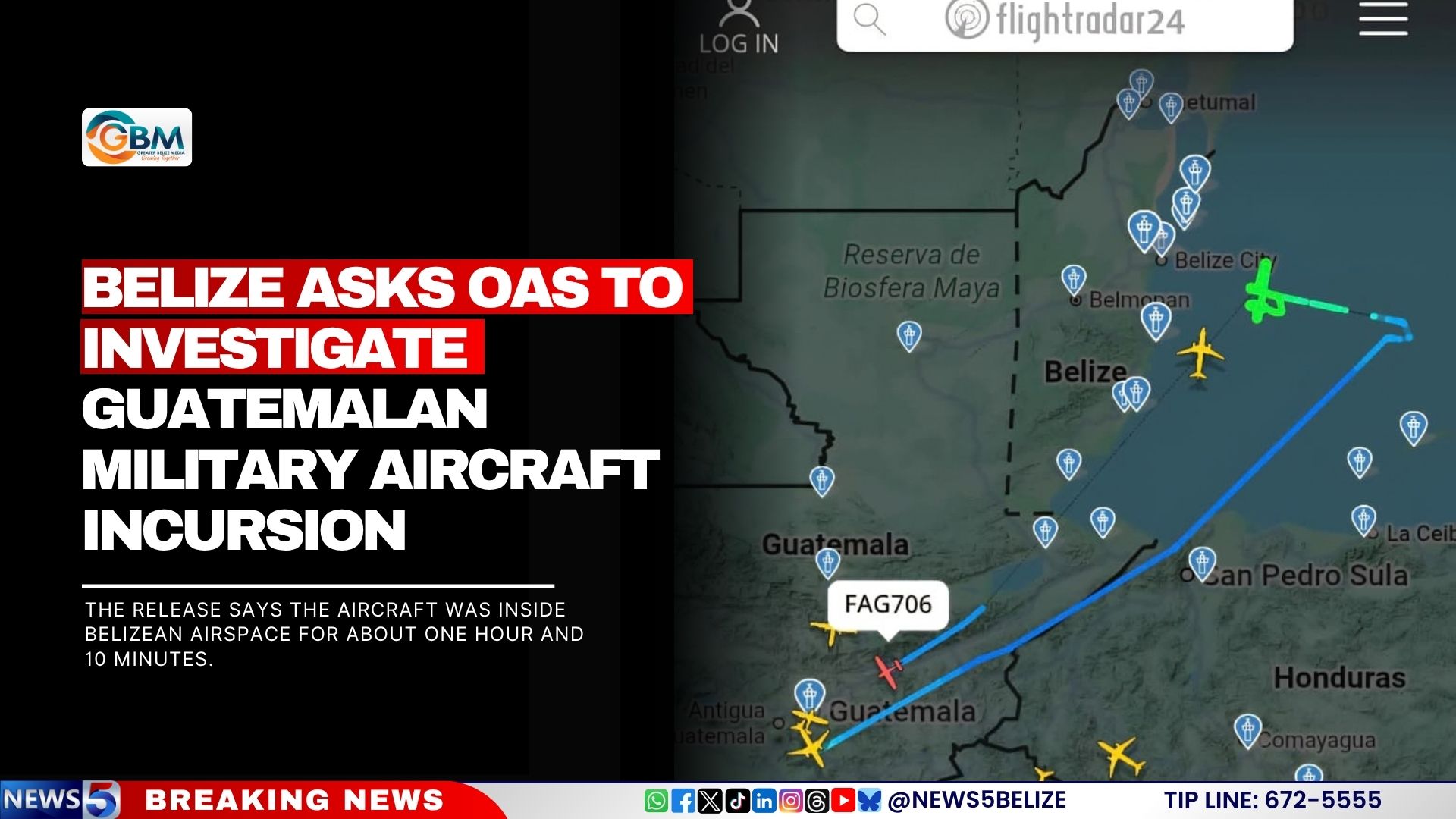
In an official cabinet statement released on Tuesday, Belize’s top national security body has formally instructed the country’s Ministry of Foreign Affairs to launch a request to the Organization of American States (OAS) for a full investigation into an unauthorized entry of a Guatemalan military aircraft into Belizean airspace that took place late last month. The incursion, which occurred on September 24, has reignited tensions over territorial integrity between the two neighboring Central American nations, amid a pattern of repeated cross-border encounters in recent months.
Prime Minister John Briceño led an emergency, out-of-cycle meeting of Belize’s National Security Council on October 5, one day before the public statement was issued. During the meeting, council members reviewed comprehensive primary and secondary radar recordings that verified the incursion. The data confirms the aircraft in question belongs to the Guatemalan Armed Forces, with the registered tail number FAG706. The flight took place as part of a regional counternarcotics operation that Belize was never included in, according to the official release.
Based on verifiable radar data collected by Belizean authorities, the release outlines a precise timeline of the unauthorized flight. At 7:29 p.m. local time, the military jet entered Belizean airspace from the east at an altitude of 4,000 feet. Roughly 38 minutes after entering, at 8:07 p.m., the aircraft’s crew disabled its transponder, a move explicitly intended to avoid detection by secondary radar systems. Just three minutes later, Belize’s primary radar systems successfully tracked the jet. After being detected, the aircraft altered its course to travel southwest, passing within close proximity of Punta Ycacos, a coastal community located in Belize’s southern Toledo District. By approximately 8:40 p.m., the jet exited Belizean territorial airspace, putting the total duration of the incursion at one hour and 11 minutes.
This new formal request for an OAS investigation follows an earlier demand from Belize’s Foreign Ministry that the intergovernmental body seek clarification on the incident directly from Guatemalan officials. The cabinet statement confirms Belize will maintain full transparency throughout the probe, making all collected radar data and other relevant evidence available to OAS investigators.
The National Security Council took the opportunity to reaffirm Belize’s long-standing commitment to collaborative regional counternarcotics work alongside neighboring partner nations. However, the statement made clear that the government cannot accept this latest violation of its territorial sovereignty, pointing to a string of similar incidents in recent months: multiple unauthorized entries by Guatemalan Armed Forces into Belize’s southern maritime territory, and repeated threats of armed force along the Sarstoon River, a long-disputed border region between the two countries.
Belize’s government called on Guatemalan authorities to adhere to long-established bilateral confidence-building frameworks that have helped prevent escalation along the border for decades. The statement emphasized that upholding these agreements is critical to maintaining the regional peace and stability required to effectively tackle shared, evolving security challenges, including the transnational drug trade. Notably, the official release does not speculate on the purpose of the Guatemalan jet’s unauthorized flight into Belizean airspace, as no clear explanation for the incursion has been confirmed. So far, Guatemalan officials have issued a flat denial that the flight ever took place.