Suriname’s government is moving forward with plans to secure hundreds of millions of U.S. dollars in new domestic and foreign loans, according to the recently published 2027 National State Debt Plan. The planned financing is earmarked to cover a projected SRD 10.8 billion budget deficit next year, with allocated funds targeted at critical public sectors including education, cross-border infrastructure, waste management, and general budget support. The plan also outlines how much remaining funding the country can draw down from pre-existing international loan agreements in 2027.
The document divides available financing into two clear categories: undisbursed funds from already approved existing loans, and new financing that remains in the preparation pipeline. For 2027, a maximum of $195.7 million can still be withdrawn from active foreign project and program loans, the plan confirms. The Inter-American Development Bank (IDB) holds the largest share of this remaining funding, with $139.6 million still available for disbursement. Other lenders contributing to this total include the Islamic Development Bank with $21.2 million, the OPEC Fund for International Development with $13 million, France’s development agency AFD with $8 million, and the Saudi Fund for Development with $5.3 million.
As of the end of June 2026, the total undisbursed balance across all existing foreign loans stood at $520.7 million. However, all these funds are tied to specific pre-approved projects and programs, meaning they cannot be reallocated to other unplanned uses without formal amendments to the original agreements.
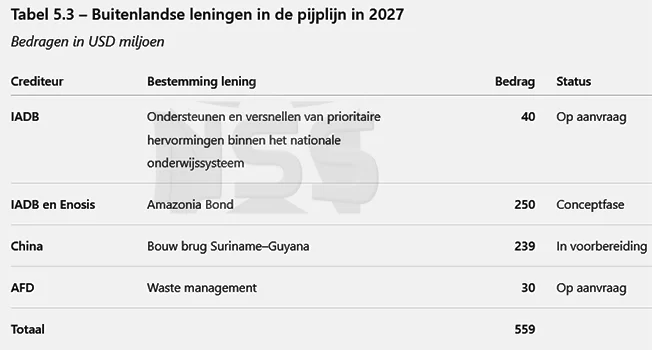
Beyond existing funding, the 2027 plan lists $559 million in new foreign loans that are currently in the pipeline, at various stages of preparation or application. Unlike the already approved funding, these new loans are not guaranteed to be fully disbursed within 2027, with many spread across multiple years of drawdowns.
Among the proposed new foreign financing, $40 million from the IDB is earmarked to support and accelerate priority reforms to Suriname’s national education system. A $250 million Amazonia Bond, arranged in partnership between the IDB and Enosis, is still in the conceptual phase, according to the plan. A $239 million financing package from China, earmarked for the construction of a cross-border bridge connecting Suriname and Guyana, is officially listed as “in preparation.” Additionally, Suriname has applied for a $30 million loan from AFD to upgrade the country’s national waste management systems.
On the domestic financing front, the government has also planned $291.5 million in new domestic loans that are in preparation. The largest portion of this domestic funding, $230.9 million, is earmarked as general budget support arranged through local commercial banks. Other planned domestic financing supports national infrastructure projects: $50.3 million is slated for the National Infrastructure Program through Kuldipsingh, while $10.3 million is earmarked for the Monkshoop project and broader National Infrastructure Program through Tjongalanga. Smaller amounts are also listed to cover outstanding debts to domestic entities including LHB, Caremco, and Chotelal.
The 2027 State Debt Plan explicitly notes that not all pipeline financing has been finalized, and disbursement for project and program loans is often spread across multiple calendar years. For this reason, the total listed pipeline amounts should not be interpreted as full new debt that will be fully contracted or disbursed in 2027 alone.
Suriname’s current debt-to-GDP ratio remains far above the original statutory ceiling of 60%, a context that shapes the government’s 2027 financing framework. As of the end of June 2026, the country’s statutory debt-to-GDP ratio stood at 119.6%, according to the plan. An amendment to the State Debt Act passed in October 2025 allows for temporary exceeding of the debt ceiling through December 31, 2027, to let the government enter new debt obligations to cover its financing needs.
Alongside its immediate borrowing plans, the Surinamese government has outlined a longer-term goal to expand and deepen the local capital market. The policy objective is to gradually meet a larger share of future financing needs through domestic borrowing, which will reduce the country’s exposure to foreign exchange risk in its overall national debt portfolio.