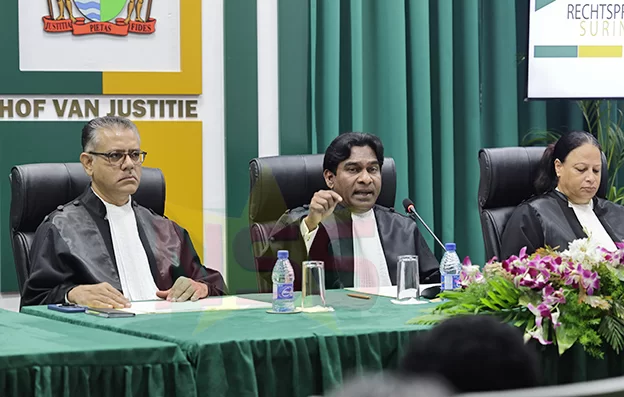
At the official opening of the Suriname Court of Justice’s new judicial term, court president Iwan Rasoelbaks has raised urgent alarms over proposed political changes to the country’s judiciary, singling out two core reform plans as particularly high-risk: the creation of a third-tier court of cassation and restructuring of the Public Prosecution Service (Openbaar Ministerie, OM). Repeating a previous call for careful reflection and cross-stakeholder consultation, Rasoelbaks emphasized that misaligned reforms could seriously weaken Suriname’s entire legal framework.
While both the Court of Justice and Suriname’s government and parliament support the introduction of cassation jurisdiction as a third appellate instance, deep divides remain over how the new body should be structured. For the court to fulfill its mandate properly, Rasoelbaks argues, it must be built on two non-negotiable foundations: judicial independence and professional expertise.
The Court of Justice’s proposal requires that justices appointed to the third-tier body hold life tenure and have at least 10 years of prior judicial experience. Without these guardrails, Rasoelbaks warned, the new court will lack sufficient expertise and independence, leading to an overall weakening of the national legal system and stunting its long-term development.
Crucially, Rasoelbaks stressed that the government should not hold unilateral power to appoint or dismiss third-tier justices without prior advice or nomination from the court itself. Allowing unvetted executive appointments, he cautioned, would leave the new appellate body weaker than the second-instance Court of Justice, creating a risk that would boomerang against the very politicians who weakened the system once a new government takes office.
Beyond the new third court, Rasoelbaks also outlined significant concerns over proposed changes to the Public Prosecution Service, stressing that the prosecution body’s institutional independence must not be eroded. Following the Court’s position, the appointment and dismissal of the Prosecutor General should only proceed with advice or nomination from the Court of Justice. Failing to enshrine this requirement, Rasoelbaks said, would undermine the OM’s ability to carry out independent prosecutorial work, and would also carry the same dangerous boomerang effect that unaccounted reforms create.
The Court does not object to a proposed seven-year rotation system for the Prosecutor General, provided that other deputy prosecutors are not given life tenure. Rasoelbaks explained that life appointments for deputy prosecutors would erode the OM’s overall strength and independence, adding that “the boomerang effect lurks here too. Do not discard what works; the world turns in a circle.”
The Court also formalized its call for the Council of the Public Prosecution Service to be constitutionally enshrined, with further details formalized in organic law. Without this foundational legal protection, Rasoelbaks argued, the government’s broader prosecution and detention policies will never get off the ground and will remain unimplementable.
In his annual address at the opening of the new term, Rasoelbaks also turned to internal restructuring of the judiciary. Currently, single judges often rule alone on high-stakes, complex cases, a practice that Rasoelbaks said has generated widespread public frustration and requires urgent change.
He called for multi-judge panels, where a group of justices collectively review each case, to be firmly established in first-instance court proceedings. If this reform is not directly codified in law, he warned, it will lead to systemic stagnation and inappropriate institutional dependence.
Rasoelbaks also reiterated two longstanding institutional requests: adding more vice presidents to the Court of Justice and expanding the number of deputy prosecutors at the OM. These changes, he explained, would improve governance and leadership across all branches of both institutions. Without additional leadership positions, sector-level management of both organizations and core judicial processes will remain inefficient, and the intended goal of strengthening the judiciary will never be achieved.
Supporting administrative bodies for the judiciary, including the Court’s executive office and the Board of the Judiciary, also require formal legal guarantees of autonomy, Rasoelbaks added. Without codified independence for these administrative bodies, the system will again face stagnation and inappropriate dependence on political actors.
All proposed judicial modernization reforms, Rasoelbaks emphasized, must be developed as a cohesive, interconnected package, with clear and fair transition rules put in place. Without a systematic and cohesive legislative approach, the entire modernization effort risks becoming completely unworkable. The Court of Justice has already submitted concrete proposals to adjust the country’s organizational judicial legislation to meet these standards.
Looking ahead to the 2026-2027 judicial year, Rasoelbaks reaffirmed the Court’s ongoing commitment to building an independent, expert, and accessible judicial system for all Surinamese people. He expressed clear hope that Suriname’s rule of law will be protected and strengthened in the coming term, closing his address by saying: “I ask the Almighty for strength and wisdom to protect, guide, and support Suriname’s rule of law through this new judicial term.”