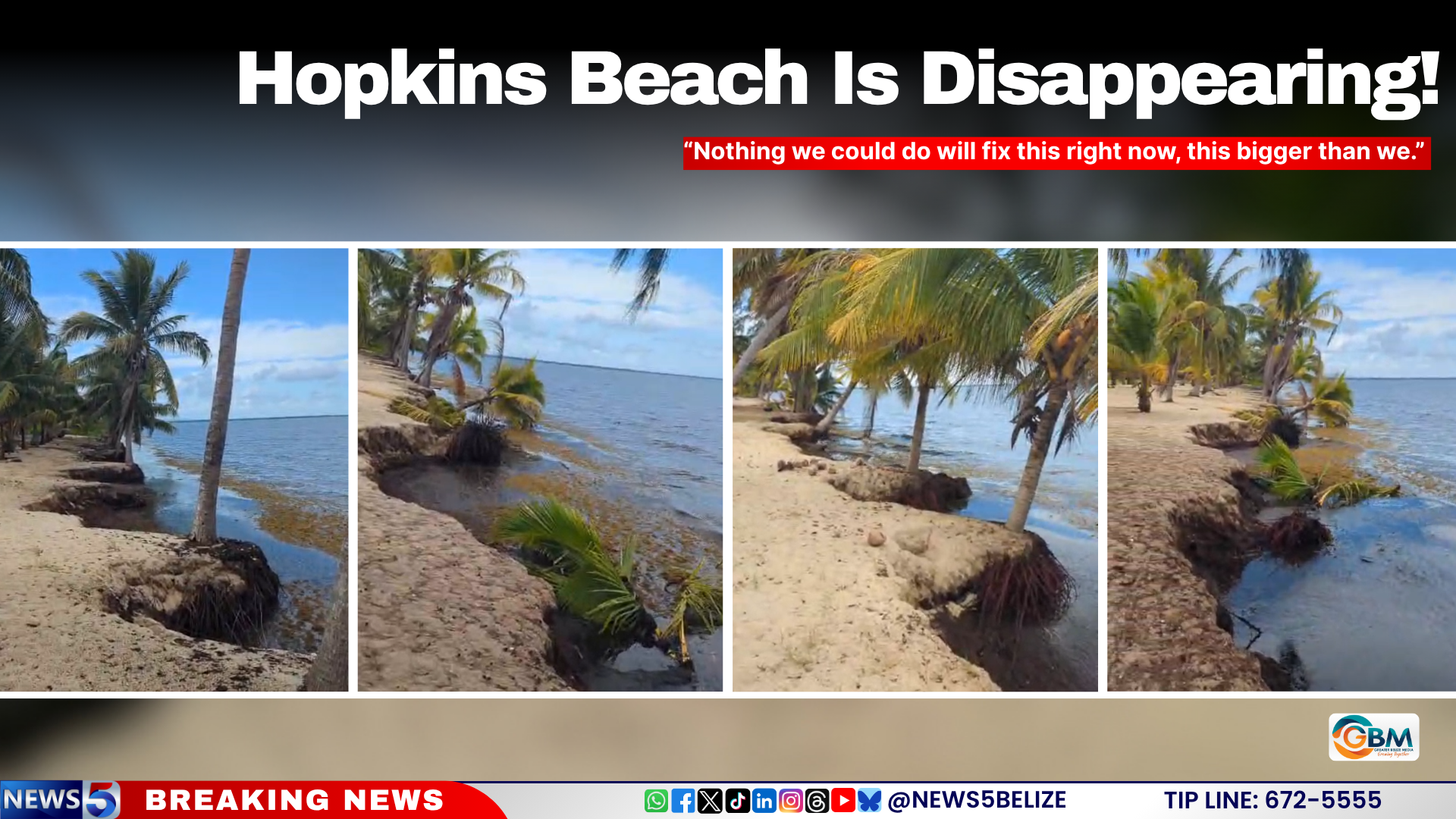
In Stann Creek District, a popular coastal tourism destination in Belize, a worsening environmental crisis is unfolding at Hopkins Village, where unprecedented beach erosion and a surging sargassum influx are rapidly eating away at the area’s most valuable natural asset.
Local residents report the current situation is the most severe they have witnessed in years. Oswin Nunez, a six-year resident of the southern shoreline near Cabana Village, has watched the sandy coastline retreat dramatically in just a matter of months. What was once a broad, expansive stretch of sand in front of his property has shrunk drastically in recent weeks. Recalling the scale of the loss, Nunez noted that two years ago, a marine biologist surveying a sea turtle nest on his stretch of shore recorded roughly 60 to 65 feet of sand between the nest and the ocean’s edge. Today, he estimates between 30 and 40 feet of that beach has vanished entirely.
Unlike the natural cyclical shifts in shoreline Nunez has observed in the past, where sand would retreat temporarily and gradually return, this current permanent loss shows no signs of reversal. “We see it come, we see it go, we see it come back. This time it did go and it’s not coming back,” Nunez explained. The erosion is not evenly distributed across the village: while the southern stretch of Hopkins is facing catastrophic loss, the northern section of coastline has not experienced the same level of depletion.
Ella Carr, chairwoman of the Hopkins Village Council, confirmed the severity of the crisis, echoing resident accounts that erosion is concentrated heavily on the village’s southern end. Carr reported that some sections of the southern shore have lost around eight feet of sand, while other vulnerable stretches have seen up to 16 feet of erosion disappear into the Caribbean. Local hotels, the backbone of the area’s tourism economy, have already reached out to the council to report devastating beach loss on their properties. “I’ve got calls already. They said that they have lost a lot of their beach and it’s looking terrible,” Carr said, noting that the degradation is already damaging the appeal of Hopkins as a top coastal tourism destination, putting local livelihoods at risk.
Compounding the erosion crisis is a persistent, overwhelming invasion of sargassum that has washed ashore in massive quantities. The rotting seaweed releases a strong, foul odor that local residents say has become unmanageable in daily life. “The stench that you smell daily, it’s overwhelming, just a little bit too much,” Nunez described.
For the small local governing body, the crisis outstrips existing resources and capabilities. The Hopkins Village Council lacks the specialized heavy equipment needed to clear the massive volumes of sargassum and address the large-scale erosion, so local leaders are now calling for urgent external assistance. “We would love to get more help, further help, because Hopkins is a resilient community, but we cannot do this alone,” Carr said. A scheduled council meeting to discuss the crisis, originally planned for the date of the report, was canceled, leaving the community in limbo as the situation worsens.
Even if intervention eventually stabilizes the shoreline, Nunez fears the damage is already permanent. “Even if it comes back to normal, it will never give you back the amount of sand that we already lost, never build up back to the level where it’s at right now,” he said. While Nunez does not believe the rising water will reach his home in the near term, he has begun planning mitigation efforts of his own, planning to plant additional trees along the remaining shoreline to slow further loss. Still, he acknowledges that local action alone cannot reverse the large-scale crisis unfolding along the coast. “Nothing we could do will fix this right now, this is bigger than us,” Nunez said.