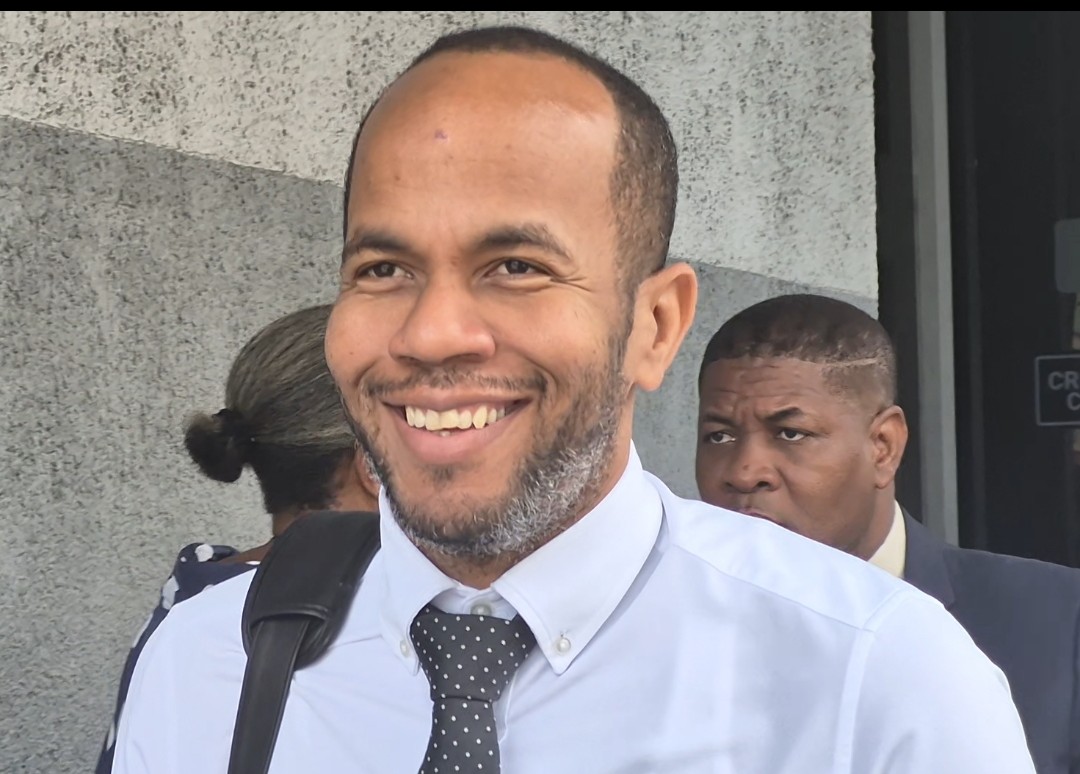
Outside the St. Vincent and the Grenadines High Court on Thursday, Luke Browne, one of two election petitioners and former Unity Labour Party (ULP) candidate for the East Kingstown constituency, delivered sharp public remarks following the conclusion of closing arguments in a pair of consolidated legal challenges targeting the November general election victories of senior New Democratic Party (NDP) officials. Browne, alongside co-petitioner Augustus Carlos Williams, who ran as the ULP’s candidate for the Northern Grenadines seat, is seeking to invalidate the parliamentary seats of sitting Prime Minister Godwin Friday and Foreign Affairs Minister Dwight Fitzgerald Bramble, arguing that the pair violated Section 26(1)(a) of the national Constitution. The constitutional clause bars individuals who hold voluntary naturalized citizenship of a foreign state from serving as members of Parliament, and Browne emphasized that both Friday and Bramble had secured Canadian citizenship through formal naturalization processes long before voters headed to the polls.
Browne stressed that the ULP camp had publicly flagged the dual citizenship issue well in advance of the general election, giving both NDP leaders ample time to formally renounce their Canadian status to demonstrate undivided allegiance to St. Vincent and the Grenadines. Their deliberate failure to complete that renunciation process, he argued, amounted to blatant recklessness and a complete disregard for the sacred trust placed in them by the national electorate, forcing all involved parties to endure months of costly, protracted court proceedings that could have been entirely avoided. He noted that both he and Williams chose to exercise their constitutional right to file the formal election petitions to resolve the matter, and praised their legal team, led by Trinidad and Tobago Senior Counsel Stuart Young with local support from legal representatives Al Elliot and Carlos James, for delivering exceptionally rigorous, clear-eyed representation throughout the case.
During closing arguments, the core point of contention centered on the legal definition of a “foreign power” under the national Constitution, with counsel for Friday and Bramble advancing arguments that sought to challenge the classification of Canada as a qualifying foreign state for the purposes of the dual citizenship disqualification rule. Browne derided that line of argument as deeply patronizing to the intelligence of ordinary Vincentian citizens, pointing out that Canada is geographically and politically entirely distinct from the nation’s own territories including Bequia, Union Island, Mayreau, and Mustique. He further cited established regional Caribbean jurisprudence, specifically a landmark Antigua and Barbuda ruling that found former prime minister Baldwin Spencer ineligible for office due to his Canadian citizenship, as binding precedent that clearly confirms Canada qualifies as a foreign power under regional constitutional norms.
Browne also raised concerns about the undue financial burden the high-profile litigation will impose on Vincentian taxpayers, noting that Friday and Bramble had retained a team of five foreign legal professionals in addition to their local counsel, driving up public costs for a court case that was entirely avoidable had the pair renounced their Canadian citizenship prior to the election. While expressing full confidence that the petitioners have built a robust, legally sound case, Browne declined to speculate on the final ruling from presiding High Court Judge Gertel Thom, who has formally reserved her decision to a later unannounced date. He praised Thom as an exceptionally experienced jurist with deep familiarity with both local constitutional law and the precedents of the Eastern Caribbean Court of Appeal, saying the petitioners had full trust in her ability to deliver a fully transparent, just ruling. In contrast, the legal team representing Friday and Bramble, led by prominent Senior Counsel Anand Ramlogan, has consistently argued throughout the proceedings that the pair’s Canadian citizenship does not meet the constitutional threshold for disqualification, and that the election petitions represent an unjustified attempt to override the democratic will expressed by Vincentian voters at the polls.