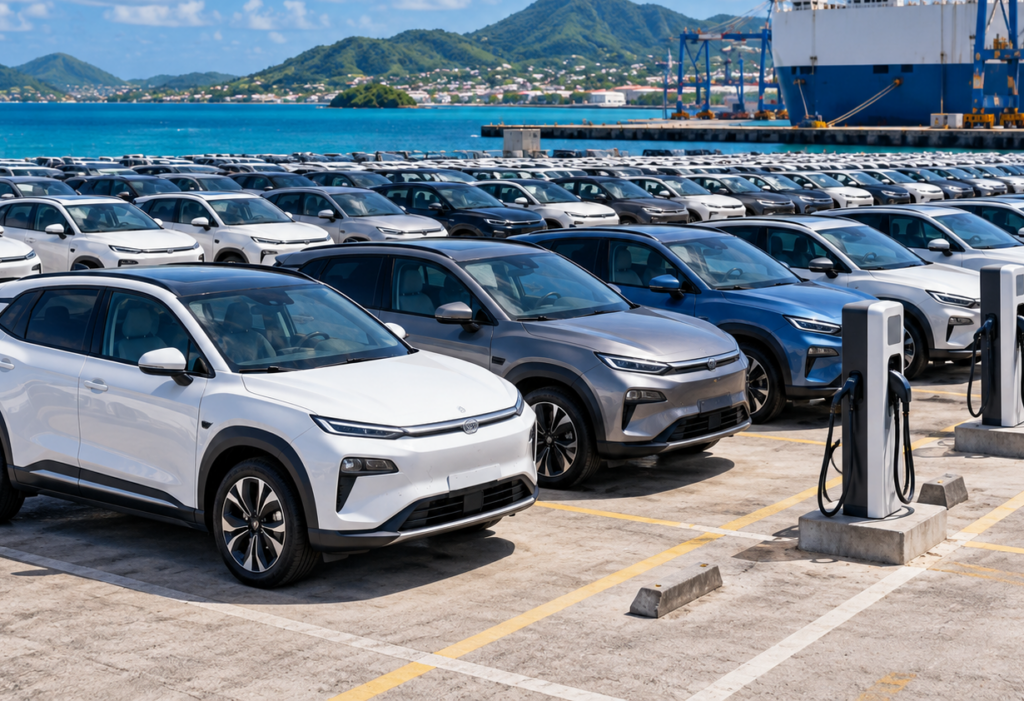
Against a backdrop of volatile global fossil fuel prices and growing regional momentum to transition to clean energy, Prime Minister Gaston Browne of Antigua and Barbuda has put forward a bold collaborative proposal: that all member states of the Organization of Eastern Caribbean States (OECS) pool their demand for electric vehicles to negotiate bulk pricing that would be out of reach for individual nations. The idea was first shared by Browne during an appearance Saturday on the Pointe FM current affairs program *Browne and Browne*, where he detailed outcomes from a recent trip to the United States focused on securing international backing for regional renewable energy projects. During his travels, Browne held discussions with representatives from Octopus, a United Kingdom-based energy firm with growing interests in Caribbean clean energy development, covering electric vehicle deployment across the region. Browne emphasized that small island nations like those in the OECS hold very little individual bargaining power when negotiating large vehicle purchases. A collective bulk order, he argued, would flip the dynamic, giving the bloc far more leverage to lock in reduced per-unit costs. To illustrate the scale of collective impact the initiative could deliver, Browne pointed to a target of roughly 100,000 electric vehicles purchased jointly across the region. Though the prime minister’s remarks were cut off mid-broadcast before he could share additional details, he did not share projected per-vehicle prices or estimates of how much the bloc could save through the collaboration. The 100,000 vehicle figure was framed by Browne as an illustrative example of potential scale, not a formal finalized order for the bloc. As of his public remarks, no participating OECS governments have been confirmed, no framework for financing or procurement has been outlined, no allocation plan for distributed vehicles has been shared, and no timeline for negotiating a regional cooperative agreement has been set. Browne also stopped short of announcing any binding purchase contract with Octopus for the initiative, noting only that the UK firm has provided a small fleet of electric vehicles for an upcoming gathering of regional leaders. No details were shared on the size of that temporary fleet or any long-term supply arrangements between Octopus and OECS states. Browne’s joint EV proposal is just one component of a broader regional push to address longstanding challenges around energy cost and reliability across the Caribbean. He noted that OECS nations are currently actively pursuing international grants and low-interest financing to expand utility-scale solar energy generation and develop untapped geothermal energy reserves across the volcanically active region. The recent steep upward trend in global diesel prices, he added, has created new urgency to accelerate the transition away from imported fossil fuels. For Antigua and Barbuda specifically, Browne confirmed that the government currently maintains consumer subsidies for diesel to offset rising global costs, and has separately explored expanding national fuel reserves to mitigate potential supply chain disruptions. If advanced and implemented, a regional electric vehicle transition would help address the long-term structural challenge of fossil fuel import dependence across the bloc, though Browne offered no clear timeline for when the proposal would be drafted into a formal document for OECS member states to consider. Many regional policy analysts note that collective procurement initiatives have a track record of delivering cost savings for small island developing states, which often face higher import costs than larger economies due to their small market size, making the joint EV plan a promising potential step forward for Caribbean clean energy transition.
Antigua and Barbuda wants OECS to Pool Electric Vehicle Orders to Cut Costs