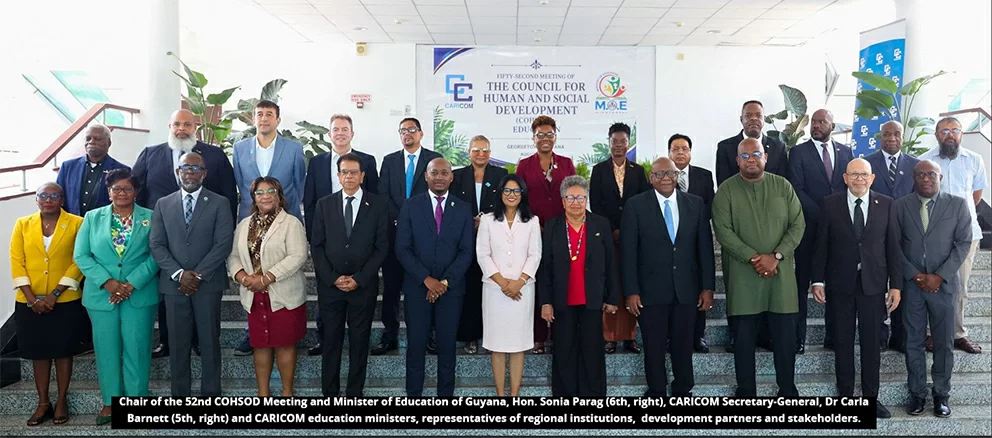
On Wednesday, education ministers from across the Caribbean Community (CARICOM) convened in Georgetown, Guyana, for the opening of the 52nd meeting of the Council for Human and Social Development – Education, a two-day gathering that coincides with the annual International Youth Day to amplify focus on youth opportunity across the region. Dirk Currie, Minister of Education, Science and Culture, is among the high-level delegates participating in the meeting, which is chaired by Guyana’s own Minister of Education Sonia Parag.
This year’s summit centers on the unifying theme “Educating for Life, Purpose and Caribbean Progress.” During the opening plenary session, Parag pushed back against the narrow framing of education as mere knowledge transfer and exam preparation, arguing that 21st-century schooling must prioritize equipping learners with transferable critical thinking skills, adaptive capacity to navigate a rapidly shifting global landscape, and the tools to contribute meaningfully to their local and national communities.
In addition to cabinet-level education ministers from CARICOM member states, the gathering brings together representatives from regional educational bodies, international partner organizations, and a wide range of education sector stakeholders. Key topics on the meeting’s working agenda include the expansion of micro-credentialing programs across the region, the development of standardized regional education assessments, strengthening primary and secondary mathematics curricula, and expanding structured professional development opportunities for in-service teachers throughout CARICOM member nations.
CARICOM Secretary-General Carla Barnett used her opening address to shine a spotlight on Technical and Vocational Education and Training (TVET), a sector she framed as increasingly critical to the bloc’s economic resilience and employment outcomes. Barnett emphasized that technical, vocational, and digital literacy skills are growing in demand across every sector of the Caribbean economy, linking widespread access to high-quality TVET directly to improved job placement and long-term economic stability for member states. “TVET is recognized as a strategic investment in the resilience and competitiveness of the entire region,” Barnett stated in her remarks.
Barnett shared her optimism that the two-day meeting will deliver actionable policy frameworks to strengthen national education systems across the bloc, and advance a shared regional vision for education: an inclusive learning environment that values every student, fosters cross-border and cross-institutional collaboration, and prepares all Caribbean citizens to thrive in an increasingly interconnected, dynamic global economy.
The timing of the summit, which overlaps with International Youth Day, underscores the urgent priority CARICOM places on expanding accessible, inclusive education, mental health support, and economic opportunity for young people across the region. Ultimately, the meeting forms a key part of CARICOM’s ongoing effort to refine regional education policy, with the core goal of equipping young Caribbean people with the skills and knowledge they need to flourish amid global change and drive long-term sustainable development across the Caribbean bloc.