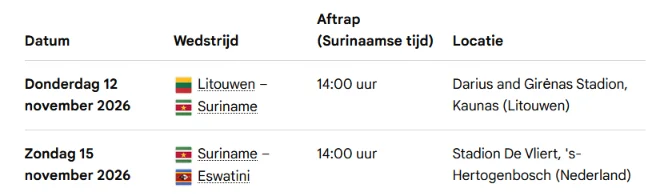
Published on 12 November at 00:59 by sports analyst Mireille Hoepel, this report breaks down recent developments for Suriname’s men’s national football team, nicknamed the Green Guardians, ahead of the upcoming FIFA international window. After a string of initially proposed high-profile opponents dropped out for a variety of unstated logistical, scheduling, and competitive reasons, the team has locked in two confirmed tune-up fixtures: a Thursday away clash against Lithuania, followed by a Sunday neutral-site friendly against Eswatini hosted in the Netherlands.
The scheduling of these two practice matches comes as a major relief for the Surinamese football setup, which faced a very real risk of no pre-tournament preparation time after the team’s disastrous underperformance in Guatemala earlier this year, which put their training roadmap leading up to the critical Gold Cup play-in qualifiers in serious jeopardy. Hoepel notes that the decision to target opponents ranked lower on the official FIFA global rankings, rather than chasing higher-profile, supposedly stronger sides for headline-grabbing showdowns, is a shrewd strategic call by the national team’s technical staff.
Crucially, the analyst emphasizes that friendly matches are never designed to prioritize final scorelines above all else. The core goal of these tune-up fixtures is to let the coaching staff test and refine pre-planned tactical frameworks, which means a loss can still be deemed a successful outing if players execute the assigned game plans, just as a lopsided win can be considered a failure if the team ignores set tactical instructions. Fans and external observers are urged not to fixate exclusively on win-loss records, and instead track the tangible on-pitch growth of the squad. To keep the public aligned with these priorities, Hoepel argues the head coach must clearly communicate explicit performance targets ahead of the two friendlies, and publish a transparent post-series evaluation of whether those benchmarks were met.
Beyond tactical drilling, these two matches offer a rare low-stakes opportunity to integrate newly called-up players into the established squad, with extra focus on giving all selected goalkeepers sufficient competitive minutes to lock in the top choice for the high-stakes Gold Cup play-in fixtures. Lithuania, currently competing in the lowest tier of the UEFA Nations League, and Eswatini, whose recent competitive form has not yielded standout results, are both perfectly suited sparring partners for this development-focused mission, Hoepel notes, adding that past statistical performance alone does not negate their value as test opponents. While collecting two wins would be a welcome bonus, it is far from the primary objective of the camp.
That said, the analyst raises a pointed critique of the Surinamese Football Association (SVB)’s decision to host both friendlies entirely in Europe. The SVB has defended the call by noting that the vast majority of the Green Guardians’ first-team players are based at European clubs, so staging matches on the continent cuts down on travel fatigue and logistical complexity. But Hoepel argues the choice eliminates a critical training variable the team will face at home for Gold Cup qualifiers: the sweltering tropical heat of Suriname. Players who can comfortably play full 90 minutes plus extra time in cool European conditions often struggle with exhaustion just in the first half of matches played under Suriname’s high-temperature, humid climate, making the choice to forgo at least one domestic-based friendly a major missed preparation opportunity.