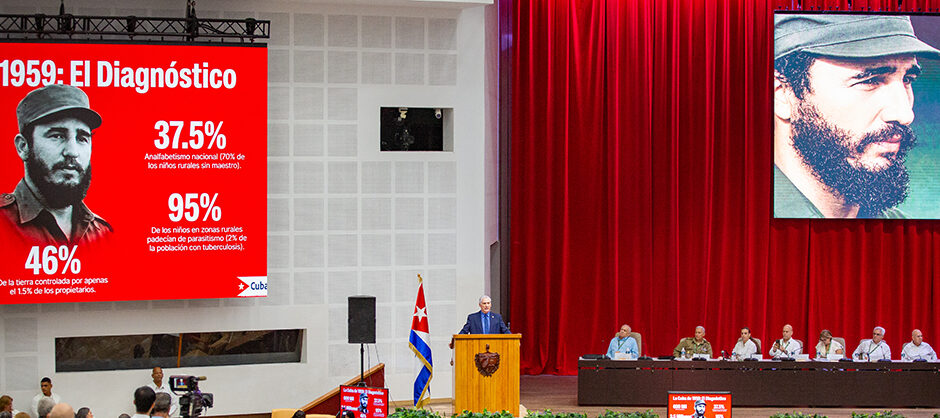
Havana, Cuba – This week marks the official kickoff of the first International Colloquium “Fidel: Legacy and Future”, a landmark global gathering convened to celebrate the centennial of the birth of iconic Cuban revolutionary leader Fidel Castro Ruz. Drawing more than 1,500 attendees from across the globe, including over 900 international delegates hailing from 63 nations, the event forms a core component of Cuba’s broader national calendar of commemorations honoring Castro’s life and decades-long influence on the island and global politics.
Opening the colloquium, Miguel Díaz-Canel Bermúdez, First Secretary of the Central Committee of the Communist Party of Cuba and President of the Republic, delivered a wide-ranging keynote address that contextualized Castro’s legacy against the dramatic transformation Cuba has undergone since the 1959 Cuban Revolution. To ground his remarks, Díaz-Canel contrasted the deep systemic inequities of pre-revolutionary Cuba with the far-reaching social gains the country has secured in the decades since the revolution.
Citing stark historical data, Díaz-Canel outlined the conditions that shaped pre-1959 Cuba: roughly 600,000 people were out of work, three million citizens lived without access to electricity, the national illiteracy rate hit 37.5%, 60% of rural children lacked access to qualified teachers, 85% of small-scale farmers were forced to pay rent to work their land, and a single elite landowner controlled more than one-third of the country’s productive territory.
Against that backdrop, Díaz-Canel emphasized that even with the persistent strain of the decades-long U.S. economic, financial, and commercial blockade, Cuba has maintained among the strongest social indicators in the region. Today, the country counts more than nine doctors per 1,000 residents, boasts a national life expectancy of 77.7 years, and has sent more than 600,000 healthcare professionals to provide care in 165 countries around the world, embodying Castro’s longstanding commitment to internationalist solidarity.
In reflecting on Castro’s enduring political and ideological legacy, Díaz-Canel highlighted three core principles Castro passed to the Cuban people: the certainty that transformative goals can only be achieved through unwavering defense of core beliefs, the conviction that international solidarity must be a defining value of the Cuban revolution, and the unshakable belief that socialism represents the only viable path to lifting all of humanity out of systemic poverty.
He further detailed Castro’s enduring positions on pressing global issues, including his critiques of unregulated globalization, early advocacy for environmental protection, support for scientific advancement, commitment to revolutionary unity across the Global South, and unwavering backing for national liberation movements across Africa and Palestine. Díaz-Canel stressed that Castro’s leadership was defined by radical personal integrity and sacrifice, noting “He led by example. He did not accumulate wealth, he did not betray his principles, he lived as he thought, and he died as he lived.”
Among the revolution’s signature achievements credited to Castro’s vision, Díaz-Canel named the nationwide literacy campaign that mobilized more than 150,000 Cubans to bring universal reading and writing skills to the population, the establishment of free universal healthcare, tuition-free education from primary school through university, and robust public investment in national cultural and athletic development programs.
Turning to the challenges facing Cuba and the wider world today, the president acknowledged that the global order is grappling with overlapping interconnected crises: accelerating climate change, systemic financial instability, growing resource scarcity, deepening social inequality, mass forced displacement, and eroding multilateral institutions. He reiterated longstanding Cuban criticism of U.S. policy toward the island, calling out the ongoing economic blockade, Cuba’s unjust inclusion on the U.S. list of state sponsors of terrorism, and persistent U.S. efforts to foment regime change on the island.
Díaz-Canel did not shy away from acknowledging the immediate economic and social difficulties facing ordinary Cuban citizens, including periodic power outages, potable water shortages, eroded purchasing power, fuel supply disruptions that have strained transportation and broader economic activity, and ongoing challenges accessing basic food staples. But he emphasized that the Cuban government’s priority is proactive problem-solving rather than fatalism, noting “We are not here to lament these hardships, but to change the things that cause us pain.”
Outlining ongoing policy efforts to address these challenges, he pointed to Cuba’s successful homegrown response to the COVID-19 pandemic, targeted investments to expand urban and suburban agricultural production to reduce food import dependence, and a suite of other policy adjustments designed to turn current economic constraints into long-term opportunities. He also highlighted the recent graduation of more than 30,000 new professionals from Cuban universities, including 705 students from other countries, demonstrating the island’s ongoing commitment to educational access.
Speaking to ongoing domestic economic restructuring, Díaz-Canel clarified that Cuba’s reform efforts are focused on boosting domestic production and growing national wealth while protecting the core social safety net that has defined the revolution for decades. “The restructuring process is intended to revitalize the economy, not to restore capitalism. There will be no privatization of enterprises; key sectors of production will remain under the control of the people, and the country’s sovereignty and independence will be fully preserved,” he said.
The president called on colloquium participants, both Cuban and international, to engage in open, rigorous debate about Cuba’s path forward and the shared challenges facing the Americas region. Closing his address, he emphasized that the future of Cuba rests in the hands of the Cuban people, noting “The future of our children, the dreams we must achieve, are in our hands.” He closed by echoing Castro’s own defiant commitment to Cuban sovereignty: “We are prepared to resist the imperialist blockade with dignity and on a grand scale for as many years as necessary. Cuba will remain true to the example of a Revolution that does not surrender.”