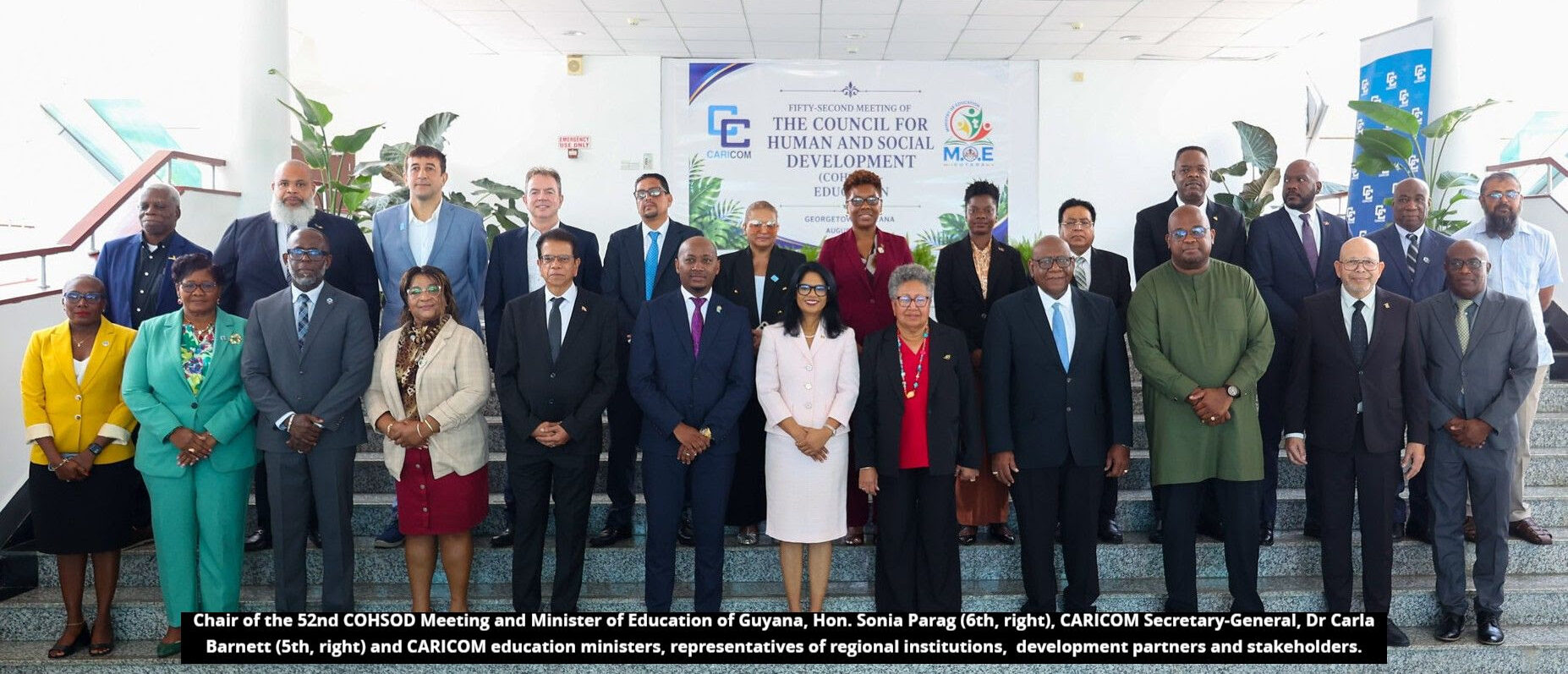
In a pivotal gathering focused on transforming regional learning outcomes, Caribbean education ministers and key regional stakeholders have convened in Georgetown, Guyana, for the 52nd Meeting of the CARICOM Council for Human and Social Development (COHSOD) focused on the education sector. The event, hosted under the overarching theme “Educating for life, purpose and Caribbean progress”, marks a collective shift away from the traditional model of education that centers primarily on examination performance, toward a more holistic approach that prepares learners for long-term success in a rapidly evolving global landscape. Chaired by Guyana’s Minister of Education Hon. Sonia Parag, the meeting brings together senior education officials from across CARICOM member states, representatives of leading regional educational institutions, international development partners, and community stakeholders to address pressing gaps in the regional education system.
In her opening address to delegates, Parag emphasized that the meeting’s theme pushes regional education leaders to re-evaluate core assumptions about what education should deliver. Rather than framing education as a linear process of knowledge memorization focused solely on passing standardized tests, Parag argued that systems must be redesigned to equip every learner with transferable foundational competencies. These include critical thinking skills, the confidence to challenge outdated norms, and the adaptive capacity to navigate constant economic, technological and social change. She further highlighted that non-academic learning pathways – including technical and vocational education and training (TVET), work-based apprenticeships, industry-aligned training programs, and targeted talent development initiatives – are critical components of a modern, inclusive education ecosystem that serves the diverse needs of all Caribbean learners.
CARICOM Secretary-General Dr. Carla Barnett echoed these priorities, drawing a direct connection between updated skills frameworks and the Caribbean region’s ability to address overlapping economic and environmental challenges. As Caribbean economies adapt to rapid technological advancement, persistent global economic uncertainty, and escalating climate-related pressures, Barnett noted that demand for technical, vocational, and digital skills has grown sharply across every sector. She framed this growing demand as a unique opportunity to close the persistent gap between education outcomes and employment needs, strengthening the link between learning, skills development, and accessible, decent work for Caribbean youth.
Barnett explained that expanding access to high-quality TVET delivers multiple interconnected benefits for the region: it equips young people with job-ready practical skills, boosts the overall resilience and global competitiveness of Caribbean economies, supports ongoing digital transformation, facilitates the transition to a green, climate-resilient economy, and drives innovation and productivity across sectors. Beyond economic gains, expanded TVET creates clear, accessible pathways to formal employment, entrepreneurship, and greater economic participation for groups that have historically been underserved by traditional academic education systems. She also noted that the region already has a strong foundational framework for skills development, including the widely recognized Caribbean Vocational Qualifications (CVQs), regional cross-border qualifications frameworks, and ongoing work by the Caribbean Association of National Training Agencies (CANTA). Leading regional educational institutions have already begun aligning their programming with this vision: the Caribbean Examinations Council has expanded its footprint in technical and vocational education, while The University of the West Indies has increasingly prioritized professional certification and deep industry engagement to better serve learner and employer needs.
Against the backdrop of the annual observance of International Youth Day, Barnett also emphasized that education alone is not enough to empower young Caribbean people to thrive. To build productive lives and take on leadership roles stewarding the region’s future, young people also need expanded access to decent work opportunities, accessible financing for entrepreneurial ventures, and integrated mental health support services that address the unique pressures facing the region’s youth population.
Over the course of the meeting, delegates are scheduled to deliberate on a range of high-priority policy topics, including the expansion of micro-credentialing programs to support lifelong learning, coordinated regional assessment frameworks to align standards across member states, targeted improvements to primary and secondary mathematics education, and evidence-based strategies to strengthen the teaching profession, support educator well-being, and elevate the status of teaching across the region. At the close of the gathering, CARICOM officials expressed optimism that the meeting will yield actionable, collaborative policies that strengthen national education systems while advancing a shared regional vision for inclusive learning. This vision centers on valuing every learner, fostering collaboration across students, teachers, and families, recognizing multiple equal pathways to success, deepening regional integration, and equipping all Caribbean citizens to succeed in a fast-changing world.