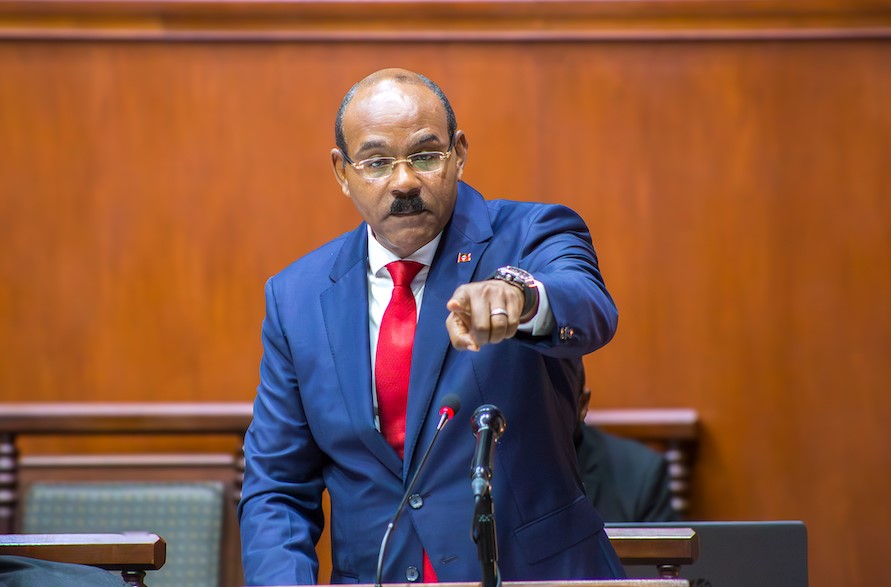
A major constitutional dispute has erupted in Antigua and Barbuda after the country’s top legal professional body publicly condemned Prime Minister Gaston Browne over a threatening deportation remark targeting an unnamed sitting judge. The Antigua and Barbuda Bar Association (ABBA), the official regulatory body for legal practitioners established under the 2008 Legal Profession Act, released a formal, detailed statement on August 12 calling on Browne to retract his threat and give a public guarantee that executive powers will never be weaponized to pressure, intimidate or retaliate against judicial officers for rulings made in the course of their lawful duties.
The controversy traces back to comments Browne made during a national security briefing on Sunday, where he was addressing rising rates of gun-related crime and public frustration over what he claims are overly lenient sentences handed down by the national courts. During the address, Browne singled out an unidentified judge, accusing the jurist of a consistent pattern of giving reduced sentences to convicted criminals. In direct remarks to the judge, Browne was quoted as saying: “Brother man, if you cannot follow the lead of parliament to give longer sentences, leave our country voluntarily otherwise we are going to deport you and make you persona non grata. You know who you are. This is the Prime Minister of the country saying this.”
While Browne has attempted to frame his comments as a non-interference in judicial affairs, the ABBA argues that this claim is completely incompatible with the explicit threat of deportation. In its statement, the association emphasized that the prime minister’s words represent a severe and unprecedented threat to judicial independence that directly violates the constitutional principle of separation of powers and the fundamental rule of law that underpins Antigua and Barbuda’s governance system.
Underlining that the national Constitution is the supreme law of the land, binding both the legislative and executive branches of government, the ABBA noted that the separation of powers is a foundational pillar of the Westminster system that forms the basis of Antigua and Barbuda’s constitutional framework. The association clarified that Parliament cannot transfer core judicial responsibilities to an unelected executive body that lacks the legal authority and qualification to exercise judicial power. Determining appropriate sentencing severity for convicted offenders, it stressed, is an exclusively judicial function that must remain entirely under the control of the courts. A judge who issues a sentence aligned with existing law, including official sentencing guidelines and the evidence presented in court, is fulfilling the exact constitutional role required of the judiciary by the separation of powers principle, the statement added.
The ABBA argued that Browne’s comments incorrectly frame the exercise of judicial independence as an act of insubordination, amounting to exactly the kind of executive overreach into judicial authority that the separation of powers doctrine was designed to prevent. The association reserved its harshest criticism for the threat of deportation and designation as persona non grata, noting that targeting a judge with expulsion over the lawful exercise of judicial discretion is a clear attempt by the executive branch to coerce the judiciary into compliance with political preferences. “A judge who faces the prospect of expulsion from the jurisdiction for delivering judgments within its discretion that displeases the executive cannot be said to be independent,” the statement read. The ABBA added that judicial officers must be free to rule on cases in accordance with the law without fear of personal retaliation from the executive.
The association further warned that the damage of this threat extends far beyond the individual judge named by Browne. Threatening a sitting judge with expulsion from the country sends a chilling message to the entire judiciary that their continued right to reside and serve in their post depends on aligning their rulings with executive preferences, a outcome the ABBA described as fundamentally opposed to the rule of law and the constitutional structure that governs the country’s court system.
The ABBA acknowledged that Parliament holds legitimate authority to shape national sentencing policy, including the power to enact legislation setting mandatory minimum or maximum sentences, as long as those measures comply with constitutional requirements. It also accepted that the executive branch is permitted to advocate for stricter sentencing through the formal legislative process. However, the association drew a clear, critical distinction between revising sentencing laws through constitutional parliamentary processes and attempting to coerce individual judges into handing down specific sentences in individual cases. “What Parliament and the executive may not do is direct individual judges, by threat or coercion, to impose sentences of a particular length in particular cases,” the statement read. The association concluded that Browne’s comments fall “squarely on the wrong side” of this line, crossing from legitimate legislative advocacy into unconstitutional executive coercion of the judiciary.
The ABBA also reminded the public that the process for appointing, retaining and removing judges is strictly governed by the Supreme Court Order Cap 422A, the Judicial and Legal Services Commission, all applicable regulations, and the national Constitution, requiring full due process in all circumstances. While the association acknowledged that Browne’s remarks could be dismissed as heated political rhetoric rather than a formal legal measure, and that no actual steps have yet been taken to deport the judge or declare them persona non grata, it stressed that constitutional damage does not depend on the threat being carried out. “A public threat by the head of government, directed at the judiciary, is itself an act of executive coercion that undermines judicial independence and the rule of law,” the statement said. The ABBA warned that such public remarks create an immediate chilling effect on judicial decision-making regardless of whether the threatened action is ultimately executed.
The association argued that legitimate concerns over sentencing practices should be addressed through proper constitutional and institutional channels, including legislative reform and formal appellate proceedings, rather than public threats against individual judges. Concluding its statement, the ABBA reiterated its full support for the judiciary as an independent branch of government, empowered to act without fear or favor from the legislative or executive branches.