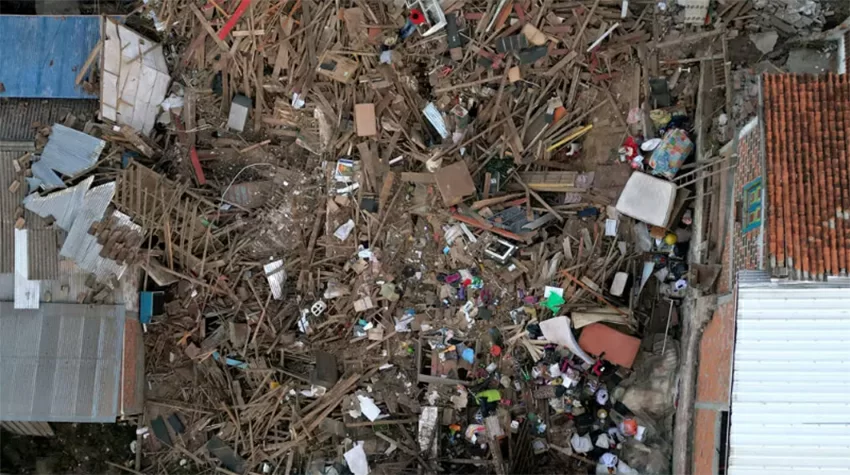
On August 12, Colombian authorities announced three days of national mourning following a catastrophic 7.4-magnitude earthquake that struck the country’s western region just two days earlier, marking the most powerful seismic event to hit the nation this century. As of the latest update, the disaster has claimed the lives of at least 216 people, left thousands displaced, and reduced entire residential blocks to rubble in hard-hit urban centers.
In a formal gesture of respect for all lives lost to the quake, the Colombian government has ordered flags lowered to half-mast at all public government buildings and diplomatic missions across the globe. Rescue teams, backed by heavy machinery, search dogs, and specialized equipment, have been working around the clock to sift through the wreckage of collapsed structures, with search efforts concentrated on the major cities of Pereira and Cali. Local volunteers have also joined the operation, forming human chains to clear debris by hand in a desperate push to locate any remaining trapped survivors before the narrow window for successful rescue closes.
The critical 72-hour window after a major earthquake, widely recognized as the period with the highest chance of pulling trapped people alive from rubble, is winding down, but teams have not given up hope. That hope was reinforced this week when 32-year-old Daniela Largo was pulled alive from the wreckage of a collapsed building. Largo’s mother recounted that a neighborhood resident first heard her cries for help, and local civilians began clearing debris before professional rescuers could arrive on scene, a collective effort that ultimately saved her life.
Aerial footage of Cali reveals the full scale of the destruction: entire neighborhood blocks lie in piles of rubble, crushed vehicles are buried under fallen concrete slabs and collapsed walls, and key public infrastructure has been crippled. The regional health system has been pushed to the breaking point by the disaster; the major Hospital Universitario del Valle in Cali suffered partial structural collapse, forcing medical teams to treat scores of injured patients in open-air areas outside the damaged facility.
Across the impacted region, a wave of grassroots solidarity has emerged to support response efforts. Thousands of local residents have mobilized to deliver bottled water, non-perishable food, and other essential supplies to neighborhoods hit hardest by the quake. Local blood banks have seen long lines of donors waiting to give to support injured patients, with many citing community solidarity as their motivation. “This is about wanting to help your community, your city, and your country,” explained Ferney Cabrera, one of the hundreds of donors who turned out to give blood.
Colombian President Abelardo de la Espriella has declared a national state of emergency in response to the disaster. During an official visit to the hard-hit city of Pereira, he pledged to provide rental assistance to displaced families who have lost their homes. The international community has also rallied to support Colombia’s response: the United States has committed $15.5 million in emergency aid, and messages of solidarity and offers of additional assistance have poured in from governments and organizations across the world.
To date, local authorities confirm that approximately 15,000 people have been displaced by the earthquake after their homes were destroyed or rendered uninhabitable. Most of these displaced residents are currently being housed in temporary emergency shelters across the region, while many others have set up informal camps in public parks out of fear of returning to damaged buildings.
Widespread fear of powerful aftershocks continues to grip local populations, and emergency response teams remain on high alert for new seismic activity that could further destabilize damaged structures and complicate ongoing search and recovery work. International humanitarian organizations have now deployed to the most impacted communities, providing critical medical care and emergency humanitarian support to residents in need.
Even as search operations continue and the nation observes a period of national mourning, early recovery work has gotten underway. Local workers and volunteers have begun clearing debris and repairing damaged basic infrastructure, but the massive scale of the destruction means full reconstruction will likely take many months. Throughout the crisis, affected communities have remained united in grief and determined to rebuild, standing together to overcome the tragedy and restore their lives.