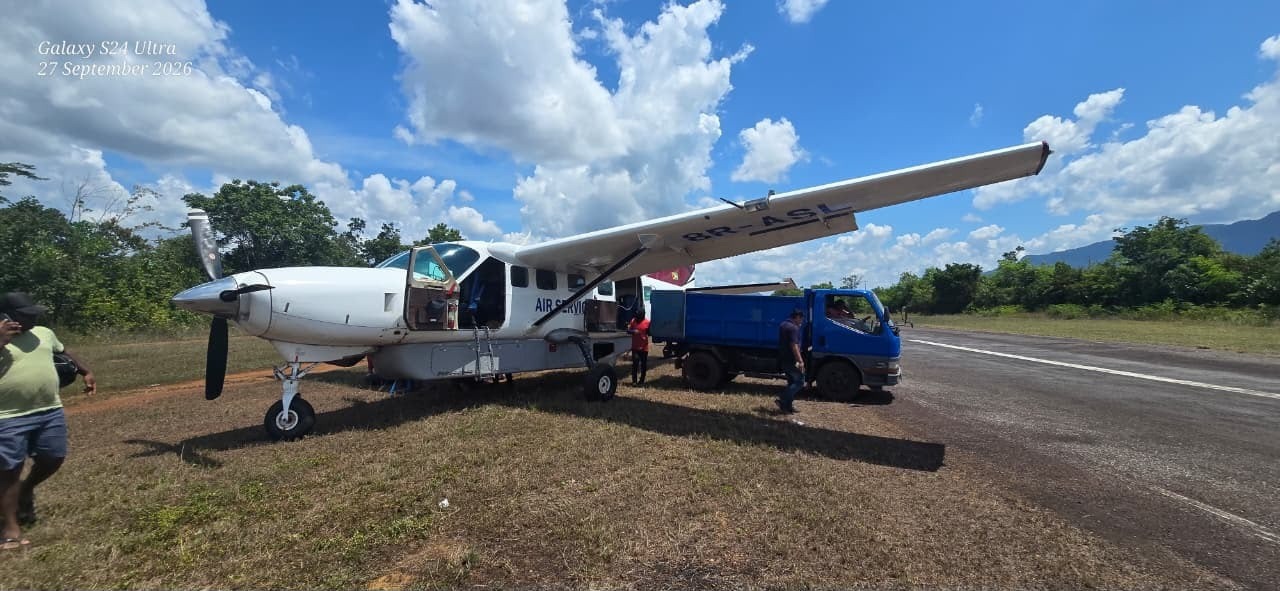
On a Sunday in late September 2026, an unexpected incident disrupted air operations at Guyana’s Mahdia airstrip, located in the remote Potaro-Siparuni (Region 8) area of the country. According to official statements from local law enforcement and aviation regulators, a single-engine Cessna 208B Grand Caravan operated by regional carrier Air Services Limited (ASL) encountered mechanical trouble that forced it off the runway, leaving the aircraft with only minor damage and all occupants unharmed.
The aircraft, registered under the markings 8R-ASL, was carrying one captain and five passengers when a tire puncture occurred during its takeoff attempt from the airstrip. Initial reports from the Guyana Police Force, which dispatched investigators to the site shortly after the incident, confirm that the plane overran the runway surface before veering off the paved strip and coming to a complete stop on the eastern perimeter of the airstrip. A photograph released by the police force shows visible skid marks leading from the runway to the aircraft’s resting position off the airstrip.
Contrary to many aviation incidents that result in serious harm or significant loss, this event had no negative outcomes for human life or cargo. Police confirmed in their official update that none of the six people on board suffered any injuries, and all cargo being transported by the plane remained intact with no reported damage. The aircraft itself only sustained superficial harm limited to its wheel assembly.
Following the incident, investigators from the Guyana Police Force documented the scene and collected official statements from the pilot, passengers, and other relevant parties to build a full account of what occurred. Representatives from the Guyana Civil Aviation Authority (GCAA) also confirmed that after the damaged wheel was replaced with a new unit, the aircraft was cleared to resume regular commercial operations, with no long-term disruption to ASL’s regional service.
The incident highlights the common mechanical challenges that can affect small regional aircraft operating at remote airstrips across Guyana’s interior, but also underscores the ability of local operators and regulators to respond quickly and mitigate risk to passengers and crew.