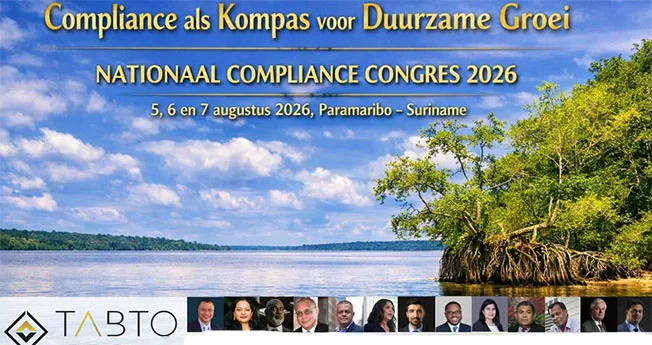
Leaders and industry stakeholders gathered in Suriname’s Oxygen Resort on Friday for the 6th National Compliance Congress, hosted by the TABTO Group, where a stark warning was issued: the country must accelerate the implementation and enforcement of anti-money laundering (AML) and counter-terrorism financing (CTF) measures to avoid international blacklisting and harsh sanctions that would impact every segment of society.
The conference brought together representatives from government, financial regulators, the banking sector, and private industry to assess Suriname’s progress toward meeting global financial transparency and integrity standards, and to outline remaining gaps that threaten the country’s economic standing. Opening the event with a keynote address on behalf of President Jennifer Simons, Vice President Gregory Rusland emphasized that meaningful compliance extends far beyond simply enacting new legislation on paper.
“At the end of the day, it does not matter how many rules we put in place – what matters is whether those rules actually deliver an honest society, a trustworthy government, and a resilient economy,” Rusland told attendees. He acknowledged that Suriname has made tangible progress in strengthening financial oversight and rolling out AML/CTF frameworks, but stressed that on-the-ground execution remains far behind schedule. Rusland added that widespread digitalization and improved governance are also critical to building a stable, attractive investment climate that can support long-term economic growth.
The core consensus from the congress’s National Compliance Debate echoed this assessment: existing legislation alone is insufficient to combat financial misconduct. When violations go uninvestigated and wrongdoers face no consistent consequences, regulations lose all deterrent effect, delegates agreed. The Anti-Corruption Commission noted that prevention efforts also weaken dramatically without consistent enforcement; if violations carry little to no penalty, public and business willingness to comply with rules erodes over time. Financial regulators in attendance further emphasized that any sanctions imposed for non-compliance must be effective, proportional, and sufficiently discouraging, noting that the ultimate goal is not to issue as many fines as possible, but to encourage consistent voluntary adherence to rules across all sectors.
Winston Wilson, senior partner at the TABTO Group, warned that Suriname cannot afford the economic fallout of falling short of international requirements. “If we are blacklisted, it will not only be banks and large corporations that feel the impact – every single citizen in Suriname will deal with the consequences,” Wilson said. To date, the country has completed 27 of 40 required international AML/CTF recommendations, but 29 additional pieces of legislation and state decrees still need to be finalized and implemented. “We have taken many important steps forward, but we still have a very long way to go,” he added.
Suriname is required to submit a new progress report to international oversight bodies in November, and global evaluators will focus not only on written policy changes, but on how effectively measures are working in practice. Wilson stressed that extra urgency is required amid the rapid development of Suriname’s emerging oil and gas sector. Strong institutions and a reliable, transparent financial system are non-negotiable to responsibly capitalize on the major economic opportunities this new sector is expected to bring, he said.
Debate attendees also highlighted two key gaps holding back progress: insufficient institutional capacity and missing critical regulatory frameworks. Regulators and enforcement agencies, delegates said, need greater access to expertise, staffing, and funding to carry out their mandates effectively. The Anti-Corruption Commission called for new legislation to protect whistleblowers, alongside stronger legal tools to investigate and process reports of financial misconduct. Most notably, Suriname still lacks a legally mandated Ultimate Beneficial Owner (UBO) register, which documents the actual owners of companies and other legal entities – a tool widely recognized as critical to disrupting money laundering, fraud, and other illicit financial activity.
Minister of Economic Affairs, Entrepreneurship and Technological Innovation Andrew Baasaron added that compliance is not a responsibility that falls only to government and financial institutions. “We must ensure our processes are in place, and that we can deliver on the ground what is needed to be transparent and meet international expectations,” Baasaron said. He also highlighted the need to support small and medium-sized enterprises (SMEs), which often lack the resources to meet new compliance requirements, noting that SMEs need targeted support for administrative processes, financial reporting, and banking relations to bring them into line with national rules.
Across all sessions, delegates repeatedly emphasized the need to invest in specialized skills development. Suriname needs a larger pool of qualified professionals working at regulators and enforcement bodies to not only create rules, but implement and uphold them consistently. The overarching message from the 6th National Compliance Congress was clear: while Suriname has made measurable progress on financial compliance, it must dramatically speed up its efforts. Coordinated action on legislation, oversight, enforcement, institutional strength, and political will is needed to ensure compliance does not remain only a commitment on paper.