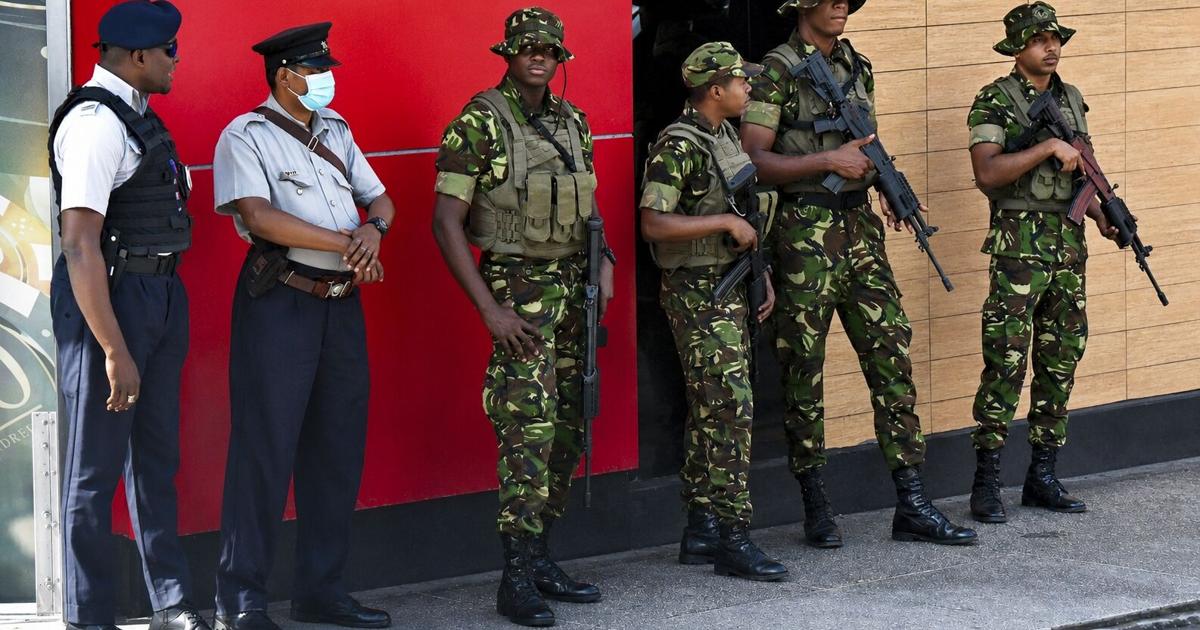
As the country’s existing state of emergency approaches its scheduled September 17 end, Prime Minister Kamla Persad-Bissessar of Trinidad and Tobago has announced a major new expansion of the government’s national anti-crime campaign: the rollout of 30 joint army-police posts across high-traffic intersections, major highways and key community hubs over the next four months.
This new security initiative marks the administration’s next step in crime mitigation, coming after two successive states of emergency implemented since the United National Congress (UNC) government assumed office in May 2025. In an official statement shared to her Facebook platform, the Prime Minister framed the joint posts as a core addition to the government’s updated national security strategy, designed to boost the visible presence of law enforcement and reclaim public spaces that have fallen under the control of criminal groups.
Persad-Bissessar emphasized that the new deployment directly answers years of repeated calls from local residents for increased security coverage across their neighborhoods. The initiative, she noted, embodies the current government’s pledge to tackle rising crime through deeper integrated collaboration between the nation’s different protective service branches.
“I am pleased to inform citizens that in the upcoming four months 30 joint army-police posts will be placed in communities across the country. Many communities have for years requested increased security presence and the protective services and Government is moving aggressively to provide such,” the Prime Minister stated. She added that the permanent posts will not only deter criminal activity but also restore a sense of safety for residents, enabling communities to once again make full use of public areas that have been abandoned due to persistent violence and criminal activity.
Twenty-four locations for the first phase of the program have already been finalized, with an additional six sites set to be confirmed in the coming weeks. To ensure the initiative delivers long-term results, Persad-Bissessar has issued a public call for civil society organizations and private sector groups to partner with law enforcement. “I encourage NGOs, business chambers, community groups and councils to adopt and support these posts and work with the security services,” she said.
The Prime Minister also used the announcement to reaffirm the government’s full confidence in the nation’s top security leadership. She extended formal gratitude to Commissioner of Police Allister Guevarro, SSA Director Alicia Henry, Chief of Defence Staff Commodore Don Polo, Prison Superintendent Elvin Scanterbury, and all rank-and-file officers for their ongoing work to curb criminal activity across the country. “On behalf of all law-abiding citizens I again express sincere gratitude to … all their colleagues and reaffirm our confidence in them, and their shared vision of ending the grip of crime on our nation,” she said.
Homeland Security Minister Roger Alexander expanded on the details of the initiative in an interview with the Express, confirming that the program will be delivered via a coordinated partnership between his ministry, the Trinidad and Tobago Police Service (TTPS) and the Trinidad and Tobago Defence Force. Alexander described the joint posts as a key component of the government’s holistic, cross-agency approach to dismantling criminal networks in high-risk areas.
Unlike intermittent mobile patrols, Alexander explained that uniformed officers will staff permanent, fixed posts at these strategic locations to enable continuous monitoring of key zones. “This is part of our anti-crime initiatives which is holistic. We have put together this particular action to tackle crime and criminality in particular areas. One of the things we try to do is monitor; and I said this when I was a police officer—we control the streets—we are going to control the state of crime,” he said.
The fixed deployment will allow joint patrol teams to respond faster to emergency calls and prevent fleeing offenders from escaping through major transit routes. “So if someone steals a car and the information comes, he must not be able to get away. Persons committing offences must not get away. When communities call, we listen; and coming from a law enforcement background, there are things I could not have done as a police officer, but now this role gives me the advantage to assist the Commissioner of Police and police officers in implementing their anti-crime strategies effectively,” Alexander added.
Beyond the new joint posts, the government is moving forward with widespread manpower expansion across all public security branches. Alexander confirmed that 233 new police officers will complete training and deploy by early September, with a second cohort of recruits already in training. Active recruitment drives are also underway for the Prison Service, Defence Force and Fire Service to boost overall staffing.
As additional personnel come on board, Alexander announced that the government will finally implement the long-unenforced hard labour provision for convicted prisoners. Under the new policy, inmate labor will be leveraged to carry out community cleanup projects across the country. “We have over 400 or more free labour in the prisons; it’s about time we implement it,” he said.