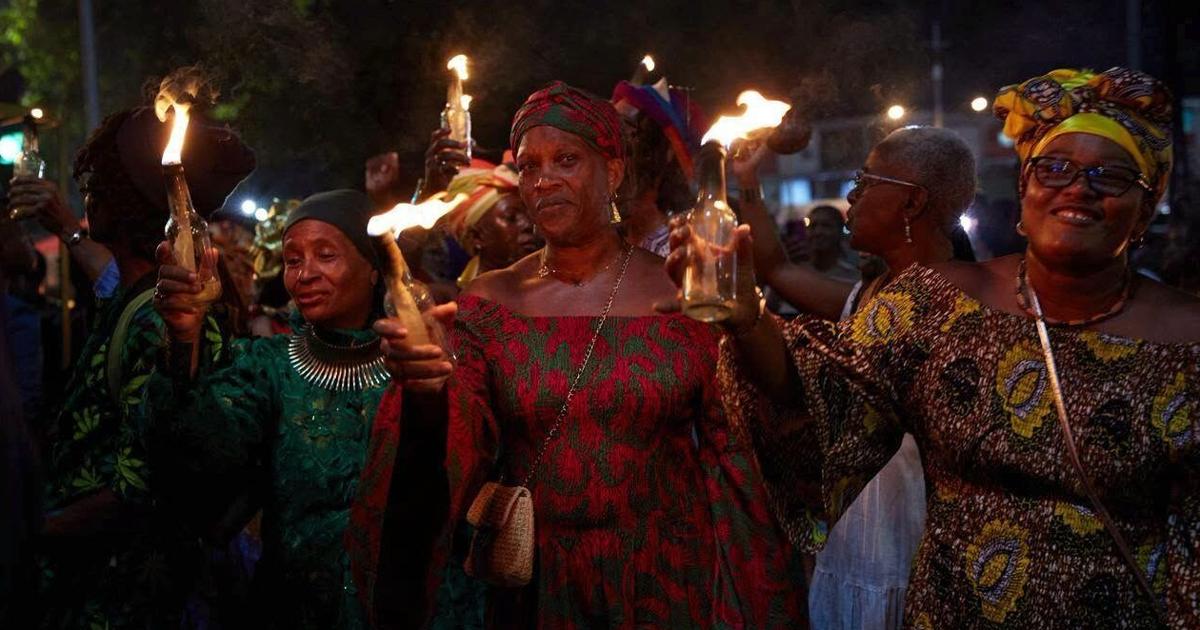
A public verbal feud between Trinidad and Tobago’s top political leaders over racial dynamics and national unity, ignited by incidents during last Saturday’s African Emancipation Day commemorations, has drawn widespread rebuke from the country’s cross-faith religious leadership, who have united to call for an immediate end to divisive rhetoric and a restoration of the nation’s long-standing culture of tolerance.
The conflict began unfolding on Emancipation Day, when Culture Minister Michelle Benjamin was booed by attendees during celebrations at Port of Spain’s Independence Square. Later that same day, crowds at the Lidj Yasu Omowale Village, hosted at Queen’s Park Savannah in the capital, jeered when Prime Minister Kamla Persad-Bissessar’s name was announced. The tension quickly escalated into a public confrontation between the Prime Minister and Opposition Leader Pennelope Beckles, with each leader accusing the other of stoking societal division across the country. Beckles publicly criticized Persad-Bissessar for skipping the official Emancipation Village event at the Savannah and raised alarms over deepening rifts in national society, calling for renewed commitment to unity. In response, Persad-Bissessar dismissed Beckles’ concerns as disingenuous and launched a sharp counterattack against the Opposition Leader.
In interviews following the clash, leaders from across Trinidad and Tobago’s diverse religious landscape uniformly expressed sorrow and regret over the public fight, emphasizing that the nation’s centuries-long tradition of intercultural and interfaith harmony must be protected and preserved above political gain.
Dr. Ellis Burris, president of the Inter Religious Organisation (IRO), slammed what he called “immature behaviour” from both the ruling People’s National Movement and the opposition United National Congress. “This is nothing more than petty politics. There is no excuse for public bickering of this sort on a national holiday that belongs to all of us,” Burris said in a phone interview. “Emancipation Day is a national observance for every Trinidadian, not just one specific group. Why would any side attack others for simply joining in the celebration? That level of confrontation is completely immature.”
Burris added that all citizens have the right to enjoy national holidays regardless of political affiliation, arguing that political rivalry should not spill over into shared national celebrations. “If the government organizes an official event, that is their prerogative. If the opposition wants to host its own gathering, they deserve the same right to do so. There is no reason this should descend into chaos,” he said. Closing his comments, Burris issued a formal appeal for renewed national unity and pride, noting that the nation will soon mark its 64th Independence Day. “We should celebrate this milestone with love and mutual care. Trinidad and Tobago has always been known for our religious and cultural harmony – that is a legacy we cannot afford to lose.”
Manwar Ali, president of the Takaaful Friendly Society, echoed Burris’ criticism, but placed particular blame on Prime Minister Persad-Bissessar for what he called disrespectful conduct. Ali argued that the Prime Minister’s choice to skip the Emancipation Village event, paired with her sarcastic response to criticism, was inappropriate for a national leader. “Emancipation Day deserves the same respect as every other major cultural and religious observance in this country, from Divali to Eid-ul-Fitr,” Ali said. “The Emancipation Support Committee of Trinidad and Tobago earned far more respect than it was given. A leader must be thoughtful and measured in how they respond to public events – this was far from that standard.”
Ali also condemned the open public fight between the two top political leaders, warning that public infighting sets a dangerous example for ordinary citizens. “These two leaders should not be brawling in public. Government and opposition do not have to agree on everything, but they owe it to the public to debate issues constructively in the national interest. When they fight openly, it gives permission for ordinary people to lean into negative, divisive behavior too,” he said. “I reject all talk of racial division. I am a Trinbagonian first, born and raised here alongside people of every background. We have to protect this country and build it together, not fight one another.”
Pandit Mukram Sirjoo, second vice-president of the IRO and chairman of the Trinidad Academy of Hinduism, noted that the division is entirely limited to the political elite, with daily life across multiracial grassroots communities remaining harmonious. “All this fuss is between politicians, not ordinary people. I have no issues with my Muslim or Christian brothers. Walk through any market, visit any local food stall – people of all races eat, work and shop together every day. The problem is at the top, not at the ground level. Grassroots Trinidad is still normal,” Sirjoo said.
Anglican Bishop Claude Berkley echoed calls for collaboration, saying “All of this is deeply regrettable. The nation must come together to work for the common good of all people.”
Canon Knolly Clarke, former dean of Port of Spain’s Holy Trinity Cathedral, called the clash a distressing moment for the nation. “This is a sad occasion. We are supposed to hold ourselves to a standard of dignity and mature conduct as a society. When people in high office behave this badly, it puts our whole country in a bad position,” Clarke said.
Archbishop Barbara Gray-Burke added her voice to the condemnation of racial rhetoric, saying “Emancipation Day is a national event for all of us. There is no place for talk of race that divides us. We should all be able to join this celebration together. I condemn all divisive racial talk and any attempt to ruin the sanctity and beauty of this national observance.”
As of yesterday, attempts to reach Roman Catholic Archbishop Fr Jason Gordon and Monsignor Martin Sirju for comment were unsuccessful.