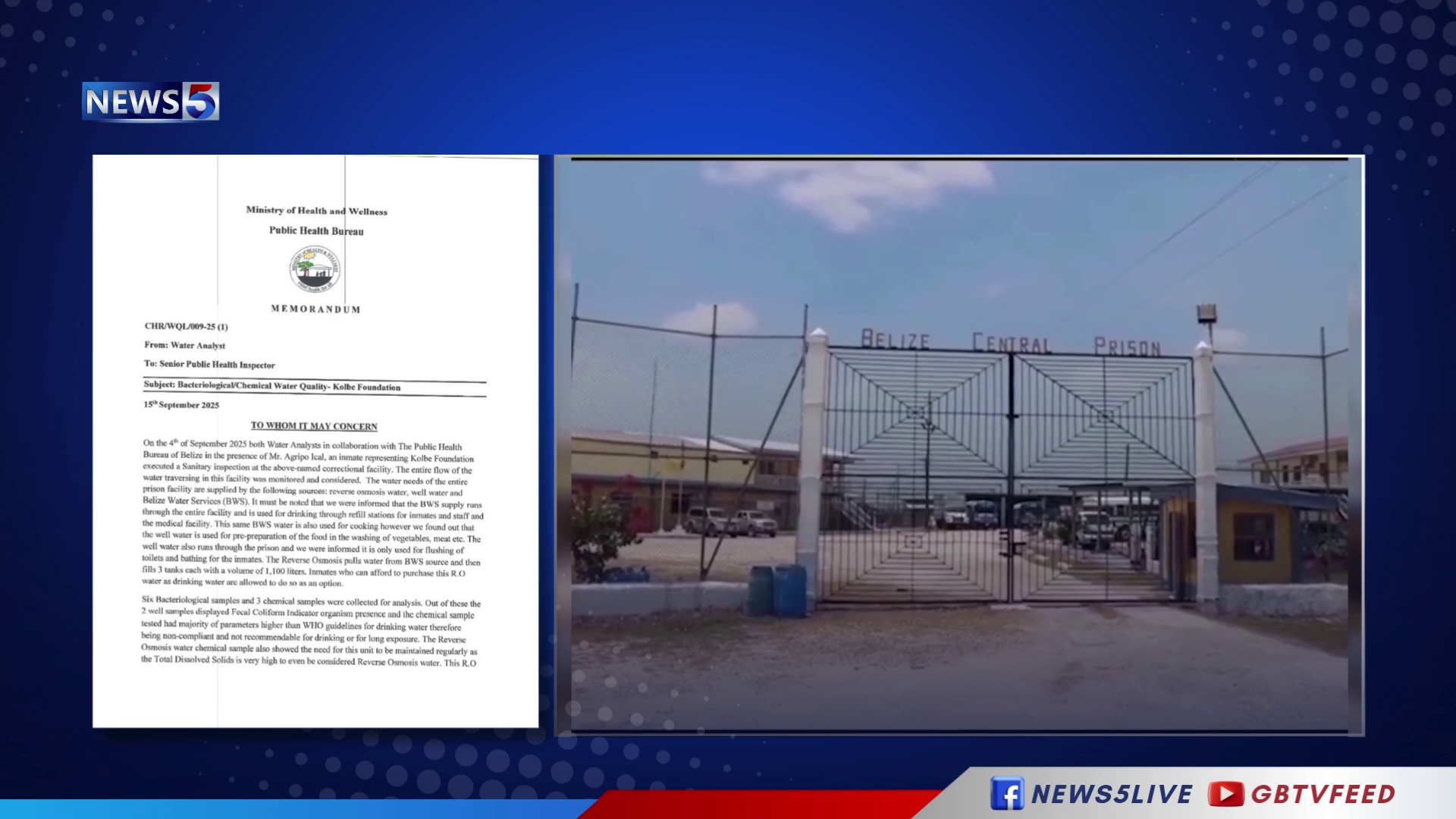
In a newly disclosed health inspection report from 2025 conducted by Belize’s Ministry of Health and Wellness, dangerous fecal coliform bacteria and chemical levels exceeding World Health Organization (WHO) safe drinking water standards have been detected in well water at Belize Central Prison, sparking urgent discussions over the health and safety of incarcerated people and facility staff.
The inspection findings, documented in a ministry memorandum made public in September 2025, confirm that the contamination was limited exclusively to the prison’s untreated well water. Independent testing of water supplied by Belize Water Services (BWS) — which serves the surrounding Hattieville community and nearby roadside residents — and the facility’s on-site purified water systems found no trace of the harmful microorganisms.
Francis Woods, Acting CEO of the Kolbe Foundation, which manages the prison, clarified the facility’s water usage protocols in an interview with reporters. According to Woods, the contaminated well has long been designated only for toilet flushing, with separate BWS potable water supplied for all domestic and consumption uses. Every incarcerated person at the facility receives five gallons of treated BWS water daily for drinking, bathing, and laundering, and all cooking and food preparation also relies exclusively on this regulated clean water supply.
Woods explained that prior tests of the well had not detected any fecal coliform contamination. Prior to the 2025 inspection, the well was occasionally used to wash produce and raw meat before cooking, but once contamination was confirmed, prison administrators took immediate action to cut off the well’s access to all food handling areas. “We rectified it right away and we reached out to the Ministry of Rural Transformation for technical assistance on how to handle that well,” Woods stated.
He also noted the well has naturally high iron content, which previously forced the facility to decommission its reverse osmosis (RO) water treatment system. High iron levels would quickly clog RO system filters, making the facility too costly and unsustainable to maintain. While no widespread contamination of the prison’s main water supply has been confirmed, the discovery has still drawn attention to gaps in routine water quality monitoring for correctional facilities, highlighting the need for consistent testing to protect the health of prisoners and staff who live and work on site.
This report is adapted from a transcript of an evening television news broadcast.