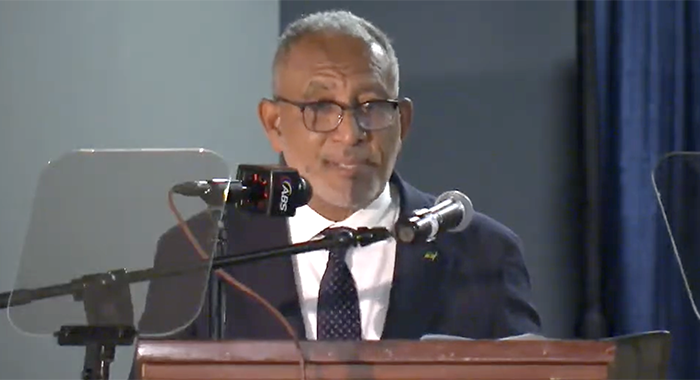
Against the backdrop of escalating global geopolitical instability, outgoing chair of the Organisation of Eastern Caribbean States (OECS) Authority and Prime Minister of St. Vincent and the Grenadines Godwin Friday has issued a urgent call to regional leaders: treat deepened integration as a non-negotiable survival tool in an increasingly hostile international landscape. Speaking at the opening ceremony of the 78th OECS Authority Meeting held in St. John’s, Antigua on Sunday, Friday framed his seven-month tenure leading the regional bloc around a core principle that advancing regional collective goals is fundamentally linked to delivering for domestic constituents.
“As a small island developing nation, the demands my people raise at home cannot be achieved by St. Vincent and the Grenadines acting alone. Only through coordinated collaboration with our neighboring states can these goals be realized,” Friday told attendees. “By serving the OECS effectively, I am directly advancing the interests of the people I represent at home.” During the meeting, Friday formally handed over the bloc’s rotating chairmanship to Prime Minister Gaston Browne of Antigua and Barbuda, passing along a robust policy agenda that includes ongoing negotiations over air transport restructuring, energy security frameworks, development finance expansion, and a coordinated regional response to security and migration demands from major global powers.
Friday assumed the OECS chairmanship on the exact same day he took office as St. Vincent and the Grenadines’ Prime Minister seven months prior, a coincidence he described as “two inheritances on a single day” in alignment with remarks from OECS Director General Didicus Jules. Contrary to expectations that dual leadership roles would create competing priorities, Friday explained that the two positions have proven mutually reinforcing: core domestic priorities including accessible energy, reliable air connectivity, and climate change resilience can only be effectively addressed through collective regional action.
Reflecting on the unique challenges small island states face amid today’s global shifts, Friday emphasized that his tenure coincided with a period of “profound geopolitical uncertainty” that is reshaping the region’s security dynamics, energy pricing, migration patterns, and diplomatic positioning. “What register as minor tremors for large, economically powerful nations hit small island developing states as catastrophic earthquakes,” he warned. “We bear the worst of these consequences, and we feel them for far longer than larger powers.”
One of the most sensitive policy issues addressed during Friday’s chairmanship was a formal request from the United States asking OECS member states to accept third-country nationals deported from US territory. Friday characterized the request as a “delicate and serious matter” that carries far-reaching implications for regional national security, already strained public budgets, and sovereign autonomy. Instead of pursuing individual negotiations that would put small member states at a disadvantage, OECS leaders intentionally opted for a unified collective approach, agreeing to launch joint negotiations and establish a shared technical working group to manage the issue. Friday framed this coordinated response as clear proof that national sovereignty and regional solidarity do not have to conflict – instead, they can strengthen one another.
To match the rapid pace of unfolding global events, the OECS Authority adjusted its traditional working rhythm during Friday’s tenure, moving beyond the two annual meetings required by the bloc’s founding treaty. Since the start of 2024, the authority has convened a regular session in Saint Lucia in January, a special emergency session in March, and held a continuous series of virtual coordination meetings. “We operate with the understanding that a small region cannot afford to move slowly when the rest of the world is accelerating,” Friday said. “We have committed to acting quickly, coordinating closely, and keeping our populations informed, assuring them that every decision we make centers their best interests.”
A central strategic priority during Friday’s term was leveraging the bloc’s collective sovereignty and negotiating power to unlock larger development gains than any single OECS member could secure independently. A key example of this work is ongoing engagement with a European Union proposal for a regional energy and digital connectivity initiative, which would create a unified Eastern Caribbean energy grid and lay submarine telecommunication cables to connect the region’s abundant geothermal, solar, and wind energy resources. Friday noted that the initiative could dramatically cut the region’s cripplingly high fuel import bills and, over the long term, open opportunities for the bloc to export excess clean energy to neighboring markets – while also stressing the need for careful fiscal management to avoid unsustainable debt. The bloc also made progress developing “integrated finance-ready portfolios” and innovative financing instruments that classify natural capital and climate resilience investments as viable economic assets, expanding access to concessionary development funding from global institutions.
On the long-running crisis of regional air connectivity that followed the collapse of regional carrier LIAT, Friday reported that the OECS Authority has moved past discussion to formal planning for a new jointly owned regional airline, though he acknowledged that critical final decisions remain to be finalized. Friday tied reliable, affordable air travel directly to the success of political and economic integration, reinforcing his argument for redoubled collective regional effort.
Friday’s tenure also included work to modernize and deepen the OECS’s long-standing partnership with Canada, with a focus on climate resilience financing, sustainable energy development, food security, and cross-border cooperation to counter transnational organized crime. He added that steady progress has been made on expanding regional labour mobility arrangements and strengthening regulation of the bloc’s popular citizenship by investment (CBI) programs, stressing that an independent regional regulatory body for CBI is critical to upholding program standards, echoing concerns shared across the Caribbean and in partner government capitals. “While we still face significant challenges, progress is undeniable – but there is still much more work to do,” he noted.
Friday openly acknowledged that the OECS Economic Union has substantial unfinished business, pointing out that while the region has guaranteed free movement of people for more than 15 years, regulatory frameworks for the free movement of goods and the full implementation of contingent citizens’ rights remain incomplete. High transportation costs and inconsistent service, he added, have created measurable damage to both political and economic integration efforts across the bloc.
Even with these acknowledged gaps, Friday reaffirmed the enduring relevance and value of the OECS regional integration project. “While the enthusiasm of the early years may have faded a little, we must never question the enduring relevance and appeal of this organization. External actors recognize its value, and many neighboring jurisdictions are seeking membership or deeper ties with the bloc,” he said. “It is not only necessary, but deeply desirable that we redouble our efforts to make this project succeed. We do this because of the tangible benefits it delivers to our people today, and the even greater benefits it will bring in the years ahead.”