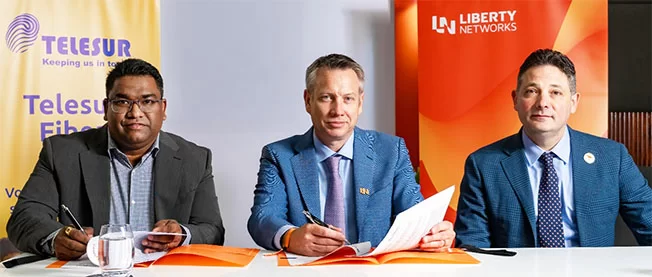
As Suriname prepares for a rapid expansion of its offshore oil and gas industry and broad-based economic digitalization, national telecommunications provider Telesur and regional digital infrastructure operator Liberty Networks have agreed to deepen their long-standing cooperation to strengthen the country’s international digital connectivity. The expanded partnership, formalized via a signed Memorandum of Understanding (MoU) during the 41st annual CANTO conference held in the Dominican Republic from August 9 to 12, is designed to deliver increased network capacity, greater reliability, and enhanced redundancy for Suriname’s cross-border digital links.
This collaboration builds on the two firms’ existing work on international submarine connectivity, most notably through the Suriname-Guyana Submarine Cable System (SGSCS), which has supported Suriname’s international telecommunications links since 2009. Industry analysts note that demand for robust digital infrastructure in Suriname is set to surge in the coming years, driven first and foremost by the needs of the fast-growing offshore energy sector. Modern offshore oil and gas operations rely heavily on uninterrupted data flows, real-time digital communication, and constant connections to global corporate networks, requirements that outdated or overstretched infrastructure cannot meet.
Yet the need for improved connectivity extends far beyond the energy industry. Banks, government agencies, healthcare providers, educational institutions, cloud service users, and private sector businesses across Suriname are increasingly dependent on stable international data connections to operate effectively. To address this growing demand, the partnership will add new international connectivity routes, integrating Telesur’s national network more deeply with Liberty Networks’ regional fiber-optic footprint. This integration will drastically reduce Suriname’s vulnerability to single-point connection outages, a critical improvement given the persistent risk of damage or faults to submarine cables.
By diversifying routes and adding network redundancy, the two firms will ensure that internet and other digital services remain operational via alternative pathways if one connection fails. The agreement also includes plans to boost joint response capabilities to address cable faults and service interruptions more quickly when they do occur. Beyond reliability, the expanded partnership will add substantial new international capacity to accommodate surging consumer and business demand for internet access, online communication, digital financial services, streaming entertainment, and e-government services.
Speaking at the conference, Ray Collins, Senior Vice President for Infrastructure and Corporate Strategy at Liberty Latin America and CEO of Liberty Networks, noted that Suriname is entering an extraordinary period of economic transformation, where reliable connectivity will play a foundational role in supporting sustainable growth. Collins added that Liberty is committed to leveraging its extensive regional network infrastructure to support Suriname’s development goals.
Telesur CEO Doric Ramlakhan echoed this sentiment, emphasizing that the MoU formalizes the two organizations’ shared ambition to scale their cooperation in lockstep with Suriname’s growing digital and economic needs. Ramlakhan specifically highlighted that the upgraded infrastructure is being designed to meet the strict reliability and capacity requirements that the expanding oil and gas sector will demand in the coming years.
Ultimately, the partnership aims to deliver greater stability, scalable capacity, and long-term consistent availability of international connectivity for Suriname. The expanded collaboration carries broad economic significance for the country: the upgraded digital infrastructure will not only keep pace with current internet usage growth but will also proactively prepare Suriname for the wave of new economic activity that offshore oil and gas development is expected to bring over the next decade.