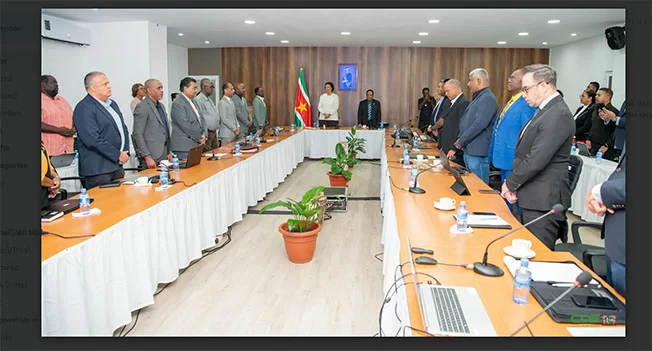
On June 20, Suriname’s government took a foundational step toward building a resilient, future-ready national energy system, convening a high-profile Strategic Energy Roundtable at the President’s Cabinet alongside public and private sector stakeholders. The meeting marks the first milestone in a process that will culminate in the release of a binding National Energy Roadmap spanning 2026 to 2035, a comprehensive policy document that will outline investment trajectories, regulatory frameworks and implementation roadmaps for energy projects across the decade.
Chaired under the overarching theme of “Energy Security, Investment, and Strategic Partnership for Suriname’s Future”, the roundtable serves as a precursor to a full national energy conference scheduled for later this year. Attendees included senior representatives from key national entities: Suriname Energy Company NV (EBS), Staatsolie, the Suriname Bankers Association (SBV), the Suriname Energy Chamber, the Suriname Business Association (VSB), the Suriname Investment and Trade Agency (SITA), the Energy Authority Suriname (EAS), alongside top government officials. Over the course of discussions, participants mapped out core challenges and untapped opportunities for advancing the sustainable growth of Suriname’s energy sector.
In her opening address, President Jennifer Simons emphasized that energy security is a non-negotiable prerequisite for Suriname’s long-term economic and social development. She noted that affordable, consistent energy pricing is critical to expanding housing development, supporting local entrepreneurship, and maintaining national social stability. “No one wants to see an increase in energy tariffs,” the President stated. She acknowledged that government subsidies have helped ease cost burdens for households in recent years, but stressed that structural, systemic solutions are required to build a truly sustainable, accessible energy supply for all Surinamese.
Vice President Gregory Rusland echoed this sentiment, underlining that reliable, affordable energy is a foundational utility for households, commercial operations, agriculture, education and public healthcare. He pointed out that Suriname holds enormous untapped potential in hydropower and solar energy, but that these abundant natural resources remain underutilized and require more strategic development. He added that future revenue streams from the country’s oil and gas reserves should be directed toward advancing sustainable development and lowering overall energy costs for the general population.
Minister of Natural Resources David Abiamofo noted that investment can only deliver meaningful impact if paired with sufficient implementation capacity. He identified securing financing for the expansion of electricity infrastructure as one of the sector’s most persistent challenges, with a specific focus on extending access to rural and remote communities that are currently not connected to the EBS national grid. In addressing this gap, Abiamofo emphasized that international partnerships and robust public-private collaboration are indispensable to delivering infrastructure expansion.
Chief of Staff Sergio Akiemboto added that the roundtable was intentionally focused on actionable solutions rather than abstract discussion, with clear near-term commitments already agreed. In the short term, EBS will prepare a public tender for expanded electricity generation capacity. Working groups will also conduct a review of existing national regulations to identify necessary legislative updates that will streamline and accelerate future investment approvals.
For the medium and long term, the government’s priorities include finalizing a list of high-priority energy projects, securing committed financing for infrastructure development, and making preparations for planned commercial gas production set to launch in 2030, which is expected to drive down costs for domestic electricity generation. Following the roundtable, a results-focused action document will be drafted to formally assign responsibilities, rank priorities, and outline clear next steps. A follow-up meeting with international investors, financial institutions and technology suppliers is also being organized to formalize partnerships for project execution.
The outcomes of the Strategic Energy Roundtable will form the foundational framework for the 2026–2035 National Energy Roadmap, a new Energy Action Memo, and the launch of a dedicated cross-sector Energy Task Force. Through these initiatives, the Surinamese government aims to lay the groundwork for an energy system that will be progressively more affordable, more reliable, and capable of meeting growing national energy demand for decades to come.