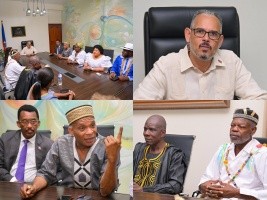
In a landmark step toward national unity amid Haiti’s ongoing security and political crisis, Prime Minister Alix Didier Fils-Aimé convened a high-stakes dialogue with leaders of the country’s Voodoo community on Wednesday, June 17, 2026. The meeting, held at the prime minister’s initiative, included Foreign Affairs and Religious Affairs Minister Raina Forbin alongside the Voodoo delegation, centering talks on three urgent national priorities: ending widespread insecurity, consolidating fractured national unity, and advancing lasting reconciliation.
This historic gathering marks a significant shift in the Haitian government’s approach to inclusive governance, as officials have explicitly recognized Voodoo community leaders as key national stakeholders critical to stabilizing the country. For decades, the Voodoo tradition—one of Haiti’s most widely practiced faiths, deeply intertwined with the nation’s cultural and social fabric—has been marginalized in formal political processes. This meeting signals the administration’s commitment to expanding cross-sector consultations to lay the groundwork for what it calls credible, inclusive, and secure national elections, a long-delayed goal that remains central to restoring democratic governance to the Caribbean nation.
During the closed-door discussions, Prime Minister Fils-Aimé outlined the executive branch’s roadmap to address Haiti’s acute security challenges, which have displaced hundreds of thousands and paralyzed state functions in recent years. The administration’s plan focuses on three core pillars: gradually expanding the operational capacity of national law enforcement agencies, improving coordination between overlapping security institutions, and mobilizing all available state resources to restore consistent security across every region of the country. Beyond immediate security action, attendees emphasized that long-term stability can only be achieved through open, inclusive dialogue across all segments of Haitian society, a process designed to strengthen social cohesion, expand access to justice, and repair deep divisions that have fueled conflict.
A core theme of the talks centered on centering victims of gang violence and political unrest in all national reconstruction and peacebuilding efforts. Participants across both delegations agreed that any lasting peace must be rooted in public truth-telling, accountability for perpetrators of violence, and mutual respect between all cultural, religious, and political groups in the country.
For their part, Voodoo community representatives reaffirmed their willingness to contribute to national recovery efforts, leveraging the faith’s deep roots in local communities to lead social mediation, resolve intercommunal tensions, and expand grassroots outreach to advance peacebuilding. Voodoo leaders have a long history of informal conflict resolution in rural and urban Haitian communities, a resource the government now hopes to formalize as part of its national stabilization strategy.
By the conclusion of the meeting, both sides reached a concrete agreement to establish a permanent monitoring and coordination mechanism. This body will ensure the dialogue continues beyond the initial gathering and will oversee the implementation of all joint recommendations agreed upon during the talks, creating a sustained channel for collaboration between the government and the Voodoo sector moving forward.