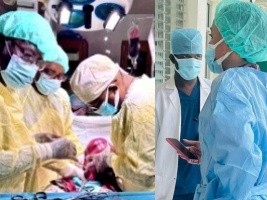
Three weeks after its official launch at Haiti’s Sainte-Thérèse Hospital in Miragoâne, a public health-led free surgical caravan initiative in the country’s Nippes department has hit a major milestone, with nearly 200 vulnerable patients already receiving no-cost life-changing surgical procedures across two participating facilities.
Organized under the direction of Haiti’s Ministry of Public Health and Population, the initiative was developed to address widespread unmet demand for specialized surgical care that remains out of reach for many low-income Haitian households. Following a directive from Health Minister Dr. Sinal Bertrand, all components of care — from pre-surgical consultations to post-operative monitoring and the procedures themselves — are provided entirely free of charge, eliminating the crippling cost barriers that have long blocked access to care for the department’s most underserved communities.
Initially operating out of Sainte-Thérèse Hospital and the Asile Community Referral Hospital (HCR), the program expanded this week with the addition of a third treatment site: Jules Fleury Hospital in Anse-à-Veau. The new site became available after the Nippes Health Directorate, led by Dr. Esther Ceus Dumont, completed urgent repairs to the hospital’s idle operating theater, bringing it back into service to expand the initiative’s care capacity and improve treatment conditions for patients.
The rollout of the mobile surgical caravan received early support from central government healthcare specialists, who assisted local clinical teams in launching the program. Currently, ongoing care delivery is sustained by a partnership between the Cuban Medical Brigade and Nippes’ local health workforce, who collaborate across all three sites to maintain consistent, high-quality services for patients.
Framed as a pilot project by Minister Bertrand, the initiative is already being recognized as a model for expanding access to specialized surgical care across Haiti. Early results have positioned Nippes as a trailblazer in rolling out people-centered public health strategies that prioritize the needs of low-income and marginalized populations, laying the groundwork for potential expansion of the free surgical caravan model to other departments in the future.