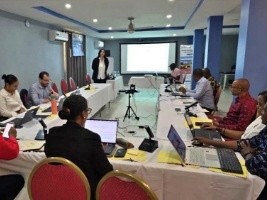
On June 17, 2026, senior Haitian government officials and World Bank leadership gathered at Haiti’s Ministry of Social Affairs and Labor (MAST) for a dedicated technical workshop focused on advancing the country’s flagship social protection initiatives. The meeting brought together William Wiseman, head of the World Bank’s Social Protection Division for Latin America and the Caribbean, a delegation from the global financial institution, and Haitian policymakers to review progress, address ongoing challenges, and map the next phase of two core programs: the Adaptive Social Protection Project for Increased Resilience (PSARA, locally known as Kleren Chimen), and the Productive Inclusion of Persons with Disabilities Project (PROPIPED).
Opening the discussions, MAST Minister Jean Nelson praised the World Bank’s unwavering partnership with Haiti, particularly amid the country’s cascade of overlapping crises that have strained public resources and community stability. He framed modern social protection not as a secondary public policy priority, but as a foundational tool that drives national stability, community resilience, and social cohesion for the Caribbean nation. Facing interconnected challenges of widespread insecurity, economic collapse, repeated climate disasters, and mass population displacement, strengthening the country’s social protection infrastructure has emerged as an urgent national mandate for the Haitian government.
At the center of this national strategy is the PSARA program, MAST’s flagship initiative first rolled out in March 2022. Designed to deliver direct cash transfers and targeted support to Haiti’s most economically vulnerable households, the program has already established a footprint in all municipalities of Haiti’s Grande Anse department and six municipalities in the country’s southern department. During Wednesday’s meeting, stakeholders centered discussions on three core priorities to expand and solidify Haiti’s national social protection system.
First, attendees prioritized the full national scaling of the PSARA program, with a focus on deepening territorial integration across all Haitian regions. This expansion is intended to extend the reach of state services to underserved communities, while allowing interventions to be adapted to the unique local needs of different regions across the country. Second, the meeting addressed long-term program sustainability, with plans to fully integrate PSARA into MAST’s permanent institutional structures and invest in expanding the operational capacity of the program’s executive Project Management Unit. Third, stakeholders prioritized expanding coverage to meet the urgent needs of Haiti’s nearly 1.5 million internally displaced persons, with plans to leverage additional funding to integrate this highly vulnerable population into existing social protection frameworks.
Minister Nelson closed his remarks by expressing optimism that the technical talks would yield clear, actionable policy guidance, formalized commitments from both parties, and tangible on-the-ground actions that will deliver lasting improvements to the daily lives of Haitian citizens. For its part, the World Bank, which has provided critical financing and technical expertise to MAST for both core programs, reaffirmed its long-term commitment to supporting Haiti as it develops context-specific solutions to address its recurring, interconnected crises.