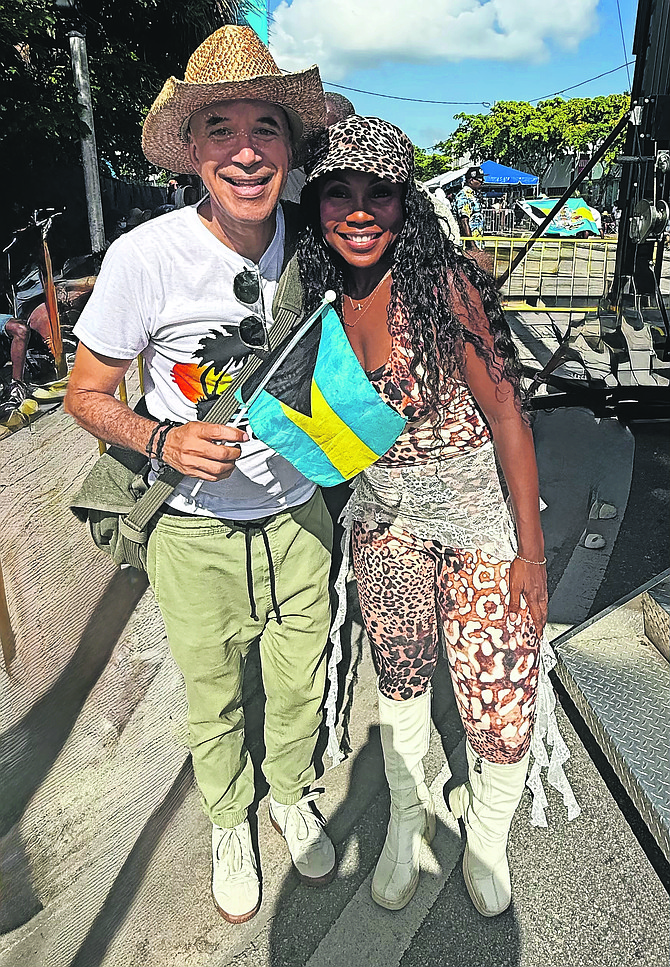
Last weekend, while attending the iconic Bahamas Goombay Festival in Miami’s Coconut Grove neighborhood, I had an unexpected encounter that capped off a day of reflection on culture, community, and legacy. To understand the weight of this annual gathering, one must first unpack the deep roots Bahamian immigrants have planted across South Florida, a history that is too often overlooked in popular narratives of the region’s growth.
Bahamian migration to South Florida dates all the way back to the 1870s, decades before Miami’s formal incorporation. From the southern reaches of Key West up to the northern edges of Fort Lauderdale, these immigrant communities helped shape the economic, social, and cultural landscape that turned South Florida into the vibrant, diverse region it is today. Their contributions are literally written into Miami’s origin story: a number of Bahamian settlers were signatories on the city’s 1896 incorporation documents. Coconut Grove grew into one of the largest and most tight-knit Bahamian communities in the state, a history that hits close to home for me—my own great-grandfather relocated here from Grand Bahama in 1916, bringing his entire family, including my grandmother, who would go on to raise generations of our family rooted in both Bahamian tradition and South Florida life. Today, our family’s ancestors are buried just a few blocks from the festival grounds at Charlotte Jane Cemetery, a resting place where generations of Bahamian families are memorialized on tombstones etched with familiar names that have been part of this community for more than a century.
The Bahamas Goombay Festival itself was launched in the 1970s, and over the decades it has weathered no shortage of challenges: multiple venue relocations, shifting leadership, financial hurdles, and even multiple years where the event was canceled entirely. Despite these obstacles, it has persisted to stand as one of the largest celebrations of Bahamian culture held anywhere in the United States. For the past several years, the festival has operated under new leadership, headed by chair vonCarol Kinchens-Williams, who has made it her mission to rebuild the event to the peak popularity it enjoyed in the 1980s and 1990s, when it drew as many as 500,000 attendees each year.
When I caught up with Kinchens-Williams amid the chaos of festival weekend, she spoke graciously of the organizing teams that came before her, acknowledging the heavy lifting required to pull off an event of this scale. “Hats off to the previous organisers. Now I understand what they had to do to make sure something like this runs smoothly, but in the end, it’s worth it,” she told me, laughing when I asked her to pause for a photo and adding, “I will when it’s Sunday.”
For years, I have held complicated feelings about the direction of the festival, torn between its core mission of celebrating authentic Bahamian culture and the pressure to broaden its appeal to draw larger, more diverse crowds. This tension plays out most visibly in the lineup: there is a constant push and pull between centering traditional Bahamian music and food, and booking more mainstream hip-hop and R&B acts that draw a wider audience. This struggle is not unique to South Florida, either—even in The Bahamas itself, traditional cultural expressions often only get widespread public support during national elections and major public holidays.
In Coconut Grove, this dynamic is amplified by gradual demographic shift over generations: the historic Bahamian community has increasingly integrated with the larger African American community that now dominates the neighborhood. While many descendants of the original Bahamian settlers still carry deep pride in their heritage, passed down through family stories, recipes, and folk music, for many this identity is only fully activated when they are surrounded by other Bahamians or at cultural events like Goombay. What is more striking is how many of these descendants have never even traveled to The Bahamas, despite the archipelago being only a 30-minute flight from South Florida. Only those with more recent ancestral roots tend to make regular trips back.
This year, I was thrilled to see a full slate of authentic Bahamian performers take the stage, including fan favorites Wendi, Shaad Collie and the VIPs, Qpid, and Stileet. That said, these acts were scheduled earlier in the day, before the higher-profile hip-hop and R&B headliners, and were initially overshadowed by the bigger draw of the later acts. Most of the crowd began the day clustered at the eastern end of the festival grounds, where all the food vendors were set up. But as soon as the first notes of traditional Bahamian music drifted across the grounds, attendees began migrating west toward the main stage in a steady stream. By the time the last Bahamian performer wrapped their set, the entire crowd had assembled right at the front of the stage, creating an energetic, engaged audience that perfectly set the tone for the mainstream acts that followed.
In my view, these traditional Bahamian artists deserved top billing as the festival’s headliners. There was no mistaking the crowd’s reaction when they launched into beloved classic Bahamian tracks that multiple generations grew up singing: the entire audience came alive, dancing, singing every word, and fully leaning into the shared cultural experience. On Sunday, beloved performer Sweet Emily took the stage, and even with oppressive heat beating down on the crowd, she called the show a success. “It was very hot, but it was a great show, and I can always depend on my South Florida fans to come out and support me,” she told me after her set.
Of all the festival’s traditional attractions, none draws a crowd like Junkanoo. Groups of costumed performers paraded through the festival grounds multiple times each day, and as soon as the first deep drumbeat rang out, crowds of attendees fell in behind them, dancing and following along through the venue like children following the Pied Piper.
Credit where it is due: this year’s organizing team made a clear, committed effort to center Bahamian culture throughout the event. I saw hundreds of attendees proudly waving Bahamian flags, wearing the nation’s signature aqua, black, and gold colors, and embracing their roots all weekend long. Even so, I left the festival with a lingering question: as South Florida’s demographic landscape continues to shift, is the region’s historic Bahamian identity slowly fading? I earnestly hope that it is not. Bahamian immigrants were foundational to building Miami and South Florida into what it is today, and that legacy should never be overshadowed by the more visible, tightly knit cultural communities that have grown in the region in more recent decades, most notably the Cuban American community that has retained such a strong, cohesive shared identity.
As for that surprise encounter I mentioned at the start of this story? I ran into none other than the editor of The Tribune, the very newspaper this column appears in—an unexpected, fun end to a day of deep reflection on culture and legacy.
For more content like this, be sure to tune into The Charlie Bahama Show on Cable Bahamas, follow Charlie Bahama across all social media platforms, and subscribe to the official Charlie Bahama YouTube channel.