Haiti’s long-awaited return to the FIFA World Cup after more than half a century has been marred by two consecutive setbacks ahead of the 2026 tournament, throwing the nation’s historic campaign into unplanned turmoil.
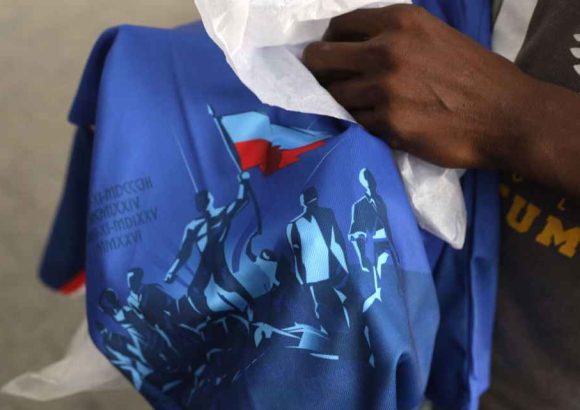
The Caribbean side, which qualified for its first World Cup appearance since 1974 after a stunning qualifying run that ousted regional heavyweights Honduras and Costa Rica, was set to unveil a new, symbol-rich blue home jersey manufactured by Colombian sportswear brand Saeta. The design was crafted specifically to honor a defining moment in Haitian history: the 1803 Battle of Vertières, the decisive victory that cleared the path for Haiti to gain full independence from French colonial rule. At the heart of the illustration was an image of a figure raising the Haitian flag atop a hill, an image deeply ingrained in the nation’s collective memory as a marker of its decades-long fight for freedom and unique national identity.
However, global governing body FIFA has blocked the team from wearing the kit in any official 2026 World Cup matches, demanding sweeping design changes. FIFA’s stance rests on its long-held competition regulations, which prohibit any uniform or equipment from bearing political, religious, discriminatory, or offensive messaging. The governing body argues the Battle of Vertières illustration could reasonably be interpreted as a political or militaristic statement. Neither FIFA nor 2026 World Cup organizers have released further public details explaining the full reasoning behind the ruling.
The decision has been met with immediate pushback from both Saeta and Haitian football governing officials, who reject the characterization of the design as a politically charged statement. They emphasize that the kit was never intended to serve as a political statement, but rather as a respectful historical tribute to the nation’s journey. The manufacturer frames the jersey as a celebration of Haitian national resilience, collective pride, and hard-won independence, adding that the kit’s color scheme also carries layered meaning: the iconic blue base represents the surrounding Caribbean Sea that shapes the nation’s geography, while red accents stand for the enduring strength and passion of the Haitian people.
Compounding the pre-tournament challenges for the side, the Haitian Football Federation has confirmed that starting midfielder Leverton Pierre will miss the entire 2026 tournament. Following routine pre-camp medical screenings, specialists diagnosed Pierre with a significant injury to his right adductor muscle that rules him out of competitive action for the coming months. To fill the vacant roster spot, officials have called up Garven Metusala, a defender who currently plies his trade with the Colorado Springs Switchbacks, a United States-based professional side.
Haiti is set to kick off its Group C campaign against Scotland, before facing continental powerhouse Brazil and North African contender Morocco in the group stage. Despite the dual blows to their pre-tournament preparations, the Haitian squad remains focused on building on the momentum of their historic qualification. For the Haitian people, who have faced widespread social and economic uncertainty in recent years, football remains one of the most powerful unifying forces and sources of national pride, and the team is eager to put in a performance that honors that connection.